Categories
Theatre review

Jekyll and Hyde, National Youth Theatre, Ambassadors Theatre, London

©NOBBY CLARK
+44(0)7941-515770
+44(0)20-7274-2105
nobby@nobbyclark.co.uk

The National Youth Theatre’s production of Jekyll and Hyde is a deconstruction of the original novella by Robert Louis Stevenson, rebuilt with a modern feminist twist by writer Evan Placey. Combining Victorian settings and morals with modern day language and values adds a new dimension to the duality theme of the story.

The decision to have a female Jekyll is not only brave but astute, and this production perfectly captures the zeitgeist with the discussion about sexism in film and theatre so much in the news. The writing is forthright, the jolt of the coarse language spoken by the Victorian ladies near the start of the play becomes clear in the second act, there is no doubt that Evan Placey is a talented author, of whom we will hear more in the future.

Aside from the writing there is much to recommend in this production. The acting throughout is accomplished. Jennifer Walsh in particular is excellent as Florence, a young adult coming to terms with the fact that although no one else is going to stand up for her, she has the power to stand up for herself.  Elizabeth McCafferty confidently makes the transitions between Jekyll and Hyde both striking and convincing. Mohammed Mansaray has a funny scene as a priest, which he delivers very well.

©NOBBY CLARK
+44(0)7941-515770
+44(0)20-7274-2105
nobby@nobbyclark.co.uk

The direction is brisk and contemporary, so that even in the midst of 19th century London, we feel linked to the current day. The director, Roy Alexander Weise, is not afraid to be confrontational, daring to breach our comfort zone in order that we feel the characters’ anger. The costume design is remarkable and clever, the ensemble changes from church house to flop house in the blink of an eye.


©NOBBY CLARK+44(0)7941-515770
+44(0)20-7274-2105
nobby@nobbyclark.co.uk
Pictures courtesy of Nobby Clark


Jekyll and Hyde has a few rough edges, but challenging, thought provoking productions like this are exactly the remit of The National Youth Theatre and I have to say that I thoroughly enjoyed this show.

Categories
Theatre review

Follies, National Theatre, Southbank, London.

ntgds_lr_follies_editorial_lores_rgb-xlarge_trans_nvbqzqnjv4bqrztbxiabcvehja2lncrbaqctb0fis-lilonsyie-xyy

Follies is probably Sondheim’s most traditional musical, in that it has set pieces, dance routines, show girls and, separate songs that don’t bleed into each other. However, it is still complex; the story has great depth and some of the songs are operatic in nature.

It is expensive and complicated to produce, it has a large company, with demanding roles throughout the cast. It needs an orchestra. Full productions of Follies are rare, the last proper one in London was thirty years ago, so when there is a high quality, committed revival such as this on offer, the opportunity needs to be grabbed.

It’s Sondheim, so the material is fantastic. It has some of his most famous songs, the storyline is elegant, and it is almost upbeat for Sondheim, (that means everyone in the cast isn’t going to live out the rest of their lives in abject misery!). It’s the National Theatre, so the production values are top notch. Dominic Cooke and Bill Deamer as director and choreographer have both done a wonderful job. I particularly loved the way each dancer at the reunion had their younger version dancing with them. I also loved the way all the mature dancers paraded down the stairs in a dignified manner wearing evening gowns, while their younger incarnations scrambled in over the rubble at the back of the stage, in their high heels, basques and feathers.

Imelda Staunton, Janie Dee, Philip Quast and Peter Forbes are the four leads, so the acting and singing are outstanding. Imelda Staunton does an emotionally draining rendition of “Losing My Mind” and Philip Quast’s voice is as amazing as it always is. It has Tracie Bennett and Geraldine Fitzgerald in supporting roles so it has incredible strength in depth. Tracie Bennett is in full on scene stealing mode with “I’m Still Here” sung with a mixture of pain and defiance.

Follies at the National Theatre is fantastic, and given all the elements that went into making it, there was never any doubt that it would be.

Categories
Theatre review

The Ferryman, Gielgud Theatre, Shaftsbury Avenue, London W1

theferryman_03

The Ferryman is a kitchen sink drama with an epic storyline. Apart from the prologue, it is totally set in the large kitchen of a family farmhouse outside Derry. The action is a day and a half in the lives of the extended family that resides there. But, the themes are huge, its about family and war, about love and loyalty, about freedom fighting and terrorism, and it tells these stories through short interwoven family interactions that come and go throughout the play that gradually meld together to make a complex tapestry.

Jez Butterworth has been spoken of as one of the best writers around today, and with  The Ferryman he delivers. The language and the narrative are superlative, it is the writing of someone both confident and ambitious. He is brave to wind traditional songs and ancient stories through the dialogue and he is talented pull it off so well.

The direction is awesome, there are 17 characters in this play, without counting the live goose, rabbit or the baby. Just moving them all around the stage must have been a major task but, Sam Mendes makes the whole setting feel real,  natural and, even simple.

The cast is also fabulous, lots of lovely performances from so many different actors. Paddy Considine and Laura Donnelly are great as Quinn and Caitlin, but right through the cast there were great turns. I loved Rob Malone as the troubled Oisin. Brid Brennan had a scene stealing part as Aunt Maggie Faraway and she played it perfectly. Dearbhla Molloy and Des McAleer are wonderful as Aunt Patricia and Uncle Pat.

As you can tell, I loved this show. I have to finish because I am about to run out of superlatives. This is a play that will become a classic piece of literature that will be on school curricula.


Categories
Theatre review

Late Company, Trafalgar Studios 2, London SW1

xlatecompany-pagespeed-ic-d7h0sbiznu

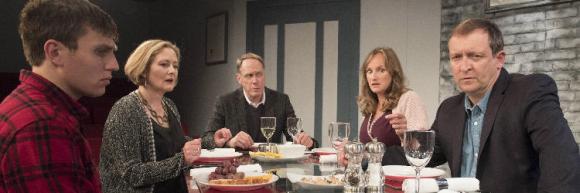
Late Company is an intense, intimate play, perfectly suited to the small Trafalgar Studio 2, whose three rows of seats all feel right in the heart of the action.

The parents of a teenager who committed suicide, invite one of his teenage tormentors, and his parents, to dinner. Brave, is one word you could use, to describe the sending of that invitation, and equally brave to accept.  Presumably one set of parents is hoping for some kind of closure over the death of their son and the other parents are hoping for some kind of redemption for theirs.

The result is an awkward dinner party of epic proportions; raw emotions unsuccessfully reined in over pasta and salad, broken occasionally by moments of dark humour. The play is beautifully written and wonderfully acted. The writing is very even handed, you can understand the pain and resentment of each character as they speak, and yet you can also understand why the others cannot forgive.

The acting is key to this play, all five are brilliant, but David Leopold as Curtis, the accused bully, is exceptional, his part is a great one, and he delivers it perfectly. I love writing that encourages us to examine our prejudices, and this is a play that complicates the allocation of blame.

Jordan Tannahill, who wrote this at the age of 23, shows all the hallmarks of a very talented new playwright and I will be looking out for more of his work when it comes to London.

Categories
Theatre review

Apologia, Trafalgar Studios, London

dd913zrxgaecwyp

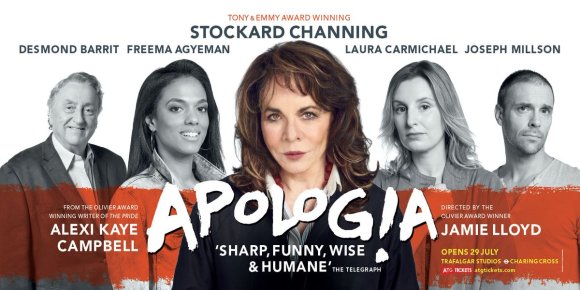
I went to the first night of the previews. I really enjoyed it. The action takes place over an evening birthday party and the morning after. It was a little slow to get started but after that, the first act is good; the script is funny, arch and sharp. It appears to be a play about nostalgia for the idealism of the 1960s and children with abandonment issues. However, the second act is transformative, I love how it turns your perspective on its head, we get to know the characters better and see their motivation differently. The play is really about women’s place in society, whether this has changed over the past 50 years and about the price people are willing to pay for attempting to bring about change.

The direction is simple, Jamie Lloyd lets the words speak for themselves. The set is clever, the stage is framed like a picture or perhaps the old photograph given as a birthday gift.  The whole cast is good, but this play is really about the women, Laura Carmichael and Freema Agyeman are both outstanding and Stockard Channing is amazing.

The writing is great and I will be looking out for other plays by Alexi Kaye Campbell. I guess there will be a few tweaks before the general opening, but it got a full standing ovation on the night I went. I hope the critics like it as much as I did and that Apologia is a huge success.

Categories
Theatre review

Hamlet, Harold Pinter Theatre, London,

hamlet-2017-main-400x400

Hamlet is a play that has been done so many times in London over the last few years, it seems to be the role that every major star wants to do, to prove their worth. Well, this version, directed by Robert Icke and starring Andrew Scott is, without doubt, the best of them.  The direction is wonderful, it makes the play feel current and relevant to today. I love the use of technology; the ramparts on video cameras, the war coverage on a 24hour news station,  the paparazzi at the wedding.

Andrew Scott is a fantastic Hamlet, hurt, sarcastic and sardonic, he speaks every line as though he is having difficulty putting the depth of his feelings into words. The words are 17th century but his delivery of them is 21st century psychoanalytical. The modern setting brings out humour, in his lines, that was previously hidden and it makes his cruelty towards Ophelia and his mother, all the more harsh.

Derbhle Crotty plays Gertrude, as a worried caring mother, a bit frivolous and taken in by the attentions of her late husbands brother. I liked the chime in accent between her and Hamlet, it emphasised their bond and highlighted his reason for feeling betrayed by her.  Angus Wright is wonderful as Claudius. In this production he is a modern Machiavelli, concerned with approval ratings and how the public would feel if he prosecuted Hamlet for the death of Polonius. He is the ultimate politician king, bland and reasonable while plotting death. It makes one realise how little politics has changed through the centuries.

Peter Wight is great as Polonius, usually played for laughs, but here he is a family man, desperately trying to enhance the lives of his children by means of his diplomacy. The affection between Laertes, Polonius and Ophelia is underlined in this production, and the sense of loss is deeper because of it. David Icke is not afraid to take risks, I am not sure about the Bob Dylan songs, bringing 1960s music into such an up to the minute setting jarred a little, but Rosencrantz and Guildenstern work very well as a romantically involved couple and why wouldn’t one of them be female. I am looking forward to the Tom Stoppard update.

The finale is deliberate, each character allowed their own time. Horatio is solicited to tell the tale, but it has all been recorded on video, so it will be available for the news channels to package and present, from all points of view, for years to come….

This is a fantastic production, it has a month left to play, London theatre at its very best.

Categories
Theatre review

Our Ladies of Perpetual Succour, Duke of York’s Theatre

olops16_13-announcement-assets-2160x2160_aw_0

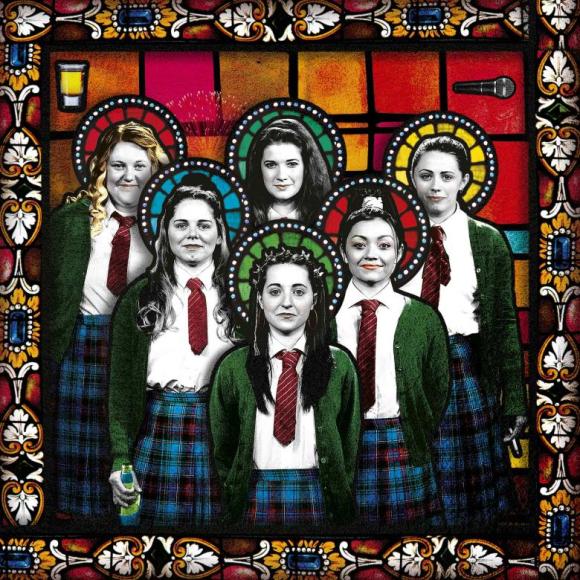
Six catholic schoolgirls in uniform arrive on stage to sing a hymn, Mendelssohn’s “Lift Thine Eyes”. They have angelic voices, it is beautiful. After the song they begin to talk, the language is sinful and the subjects are carnal. The juxtaposition is funny and moving.

This play is the story of their day trip to Edinburgh to sing in a choir competition. Over the course of this twenty four hours they meet various characters from the places they visit. These characters are played by the girls themselves and this combined with the strong accents and dialect made following the action hard work in places. However, the script is witty and coarse and the singing is fantastic, especially the classical pieces and hymns. Many of the rock songs are Electric Light Orchestra covers.

Our Ladies of Perpetual Succour is a well observed play. It is insightful, in that it makes us aware of the difference between the world that their convent schooling is preparing them for and the actual world that they will inhabit when they leave. This play makes you question how qualified ecclesiastic schools are at preparing children for a life in a secular society.

An entertaining and thought provoking show, with a very talented cast. I am sure we shall hear of many of these actors again.

Categories
Film Review

Victim (dir. Basil Dearden) 1961

victim_1961_03

Victim is a classic movie in so many different ways. It is a great representative of the black and white, crime thriller, genre of the early 1960s. The storyline is good, it is well told and the suspense will keep you interested right until the finale.  It is a fantastic British movie, made in the Pinewood studios with high production values. It has all the hallmarks of British film making at the time. The dialogue is clipped and the characters are bristling with repressed emotion.

It has a wonderful setting with splendid views of London just before the start of the swinging ’60s. St Martin’s Lane and Cecil Court are still recognisable, with Oliver! playing at what is now the Noel Coward Theatre. There are also nice shots of Millbank, Soho and the Thames. The pub scenes were filmed in a real pub, The Salisbury, on the corner of St Martins Lane, which was a gay pub until the 1980s. The pub is still there today and still has the Victorian fixtures and fittings seen in the film.


Victim has a courageous and dashing performance by Dirk Bogarde who risked his matinee idol status by taking on such a controversial role. He was a male romantic lead, so playing a man with homosexual tendencies, constrained though they may have been, would have put this career in jeopardy. He is excellent in the role and apparently he added the line “I wanted him!” which almost had the film banned. Sylvia Syms puts in a good performance as his unfulfilled wife, wavering between hurt and compassion. The whole cast is excellent and there are recognisable faces throughout the film.

from-victim-to-hero-revisiting-basil-dearden-s-victim-1961-jpeg-142470

This was a shocking film when it came out in 1961 and it almost did not get past either the British or American censors at the time. It was the first film to use the word homosexual and it was the first mainstream movie to allude to it in a non negative manner.  It was this, that made it a danger to public morals and gave it the X rating that it received when it was released. Homosexuality is not the direct subject matter, but a blackmail ring that was targeting the frequenters of a gay pub. This was a common occurrence at the time as homosexual relations were an offence that could land one in jail and would certainly ruin a career.

While this film, itself, did not advocate gay rights, its sympathetic portrayal of some gay characters allowed the conversation to begin and this will have helped to bring about the change in the law six years later. Victim often appears in lists of all time greatest films, and it was certainly a brave and groundbreaking piece of film making.  Whether you are interested in the history of cinema, or the history of gay rights then you should see this movie. It is being shown currently at the BFI on the south bank as part of the gross indecency season, celebrating the 50th anniversary of the partial decriminalisation of homosexuality in Britain, but it very often included in retrospective seasons of gay film, British film, or classic crime thrillers.

Of course, most importantly of all, it is a very enjoyable film to watch!

Categories
Theatre review Uncategorized

Girl from the North Country, Old Vic Theatre, London

girl-from-the-north-country-booking-from-19-july-until-7-oct-2017-tickets_10-07-17_17_595fa6985a020

Girl from the North Country contains three or four intertwining stories. These are slight, almost sketches really, but are beautifully told so that we care about the people we see on stage. It contains about twenty songs from Dylan’s back catalogue. These are used, in  an abstract way, to accentuate the drama rather than to move the narrative forward. It would be misleading to call this a musical, it is more a play with musical accompaniment.

The prose and the songs complement each other very well. Given the quality of the cast, the strength of the acting is no surprise. The singing, orchestration and choreography are the revelation. There are some amazing voices in the ensemble. Shirley Henderson and Jack Shalloo, in particular, shock when they sing, but every song is delivered well. The impact of a downtrodden, beaten character suddenly opening their vocal cords is not to be underestimated. Even the songs that I already knew, appeared to be given new life in the context of the play.

The reception of the audience was good, it is not too often that the whole audience stands at the end. I enjoyed this show, Conor McPherson and Bob Dylan are a combination that go together very well.

Categories
Attractions Days Out

Apsley House, Hyde Park Corner, London

Apsley House.JPG

Apsley House is the smart, columned building on the north side of Hyde Park Corner. It has been the home of the Wellington family since the 18th Century, and it is open to the public Wednesday to Sunday during the summer months. It is a stunning Grade 1 listed building, and many of the interiors are kept in the style of decoration that they would have had at the time they were built. It is unlikely that there is a better maintained aristocratic home in Central London.

The decoration is interesting, there is some of Roberts Adam’s 18th century classical interior design remaining. It was renovated in the early 19th Century when Wellington was living in Downing Street as Prime Minister. The Waterloo Gallery was added at this time to commemorate his victory over Napoleon, and to this day, there is a banquet held annually on 18th June to celebrate this.

Wellington Shield

There is also an amazing art collection, made up of gifts from grateful war allies, or items acquired as the spoils of war during the defeat of Napoleon. There are paintings by Titian, Van Dyke, Rubens, Goya and Velazquez and many others. You can even see the original painting that contained the image of Wellington, that was used on our old five pound note.

Wellington Window.JPG

The are many other items of historical interest. It holds the oldest grand piano in England. There are two beautiful porcelain dinner services on display; The Waterloo Meissen Banquet service, painted with scenes of his greatest victories, and the Josephine Egyptian dessert service given by Napoleon to his wife as a divorce gift.  Another highlight is the wonderful 3.5metre nude statue of “Napoleon as Mars the God of Peace” by Canova.

Meissen Plate.JPG

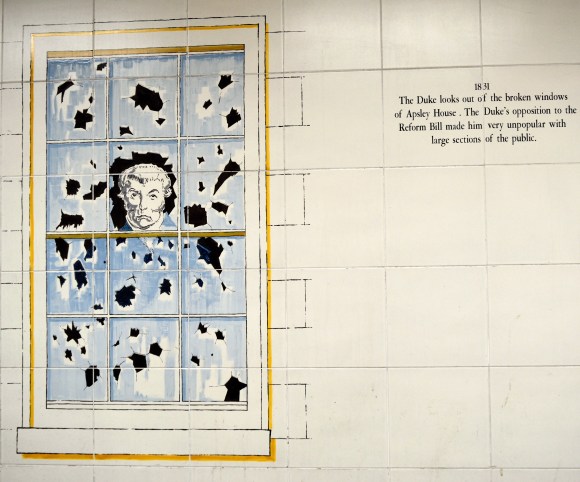
The property is run by English Heritage, so it is free to enter if you are a member, but chargeable otherwise. The entry fee includes a touchscreen audio tour, this is very informative and there are seats in some of the rooms, where you can sit and listen to descriptions of the paintings and decoration. The no photographs rule is disappointing. The pictures here are from the tiled passageways under Hyde Park Corner.  The building is nice and cool on a warm summer day. It is also surprisingly quiet given its position, right in the centre of London.

If you are looking for a break from the more crowded tourist attractions in central London, Apsley House is well worth a visit.