Categories
Theatre review

Pinter 2, Pinter at the Pinter Season, Pinter Theatre, London WC1


lover-25-06-18-lead_1

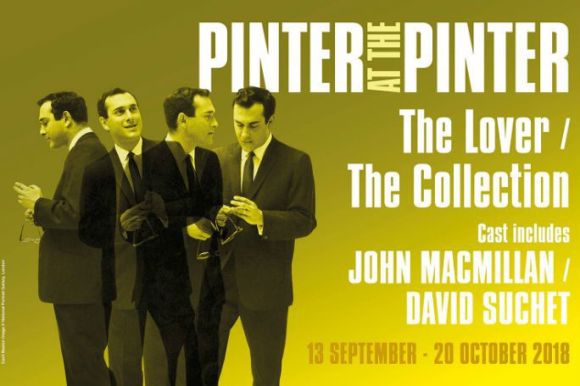
In December 2018 it will be 10 years since the death of Harold Pinter. In celebration of his legacy, the Jamie Lloyd Company is producing a season of all 19 of his one act plays at the Pinter Theatre. There will be 7 different programmes each containing either 2, 3 or 4 of his pieces. The cast list for the season has to be seen to be believed, stellar is no over-estimate of their quality.

Pinter 2 contains two plays, The Lovers and The Collection, both comedies and both written in the early 1960s. The Lovers has John MacMillan, Hayley Squires and Russell Tovey. The Collection has these three and David Suchet. The Lovers is a one room play set over a couple of days in the living room of a married couple. The dialogue is, in true Pinter fashion, bright and stilted. The set and conversation are pastiche early TV sitcom. This works really well, it makes the subject matter funnier, darker and pinpoints it in time perfectly. John MacMillan and Hayley Squires are the husband and wife, Richard and Sarah. Their comic timing is impeccable. The piece lasts about 50 minutes, it starts off light an funny. The story is inventive and the writing witty. In short, this is classic Pinter done well.

The Collection is a four hander, this time about 2 couples, set in 2 living rooms. This one is more sinister, right from the start. It is still very funny though. David Suchet and Russell Tovey, play Harry and Bill, the other couple are Stella and James, played by Hayley Squires and John MacMillan. Although there is nothing explicit anywhere in this play, it must have been quite shocking when it was first performed in 1961, and I can imagine that the censor would have taken an interest in how it was produced. It is beautifully written, in that, there is nothing overt in the manner of their relationships, however we are in no doubt as to what is going on. For it to work this well, the actors have to be well attuned to the writing. All four of them are wonderful. David Suchet gives an acting masterclass in this play, he knows perfectly when to be larger than life and when to rein it in. Russell Tovey too, gave a nicely nuanced performance delivering funny double-entendres with an ominous undertone.

The set is simple and clever, spot lit areas move us from one scene to another. Jamie Lloyd directs both plays sympathetically, he allows the writing and acting to shine. This play is also just about an hour long. I am beginning to think this might be Pinter’s perfect length. This pair of plays are pure joy to watch and now I am left with the quandary of how to get hold of tickets for the other 6 in the season.
Categories
Theatre review

Strictly Ballroom, Piccadilly Theatre, London W1.

Strictly

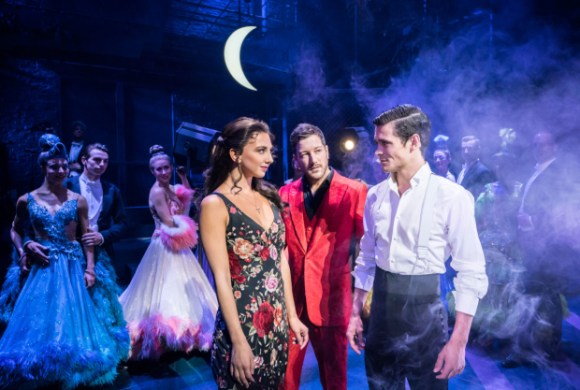
Strictly Ballroom is a crowd pleasing juke box musical. It certainly has a lot of good things going for it. The film, on which is based, is a classic Australian indie comedy of the early ’90s and it is wonderfully odd and funny. The songs are popular upbeat singalong tunes that the audience will know and love. The cast is great and the director and choreographer have some great musicals on their CV.

The show has been rewritten for the stage and a new character, a narrator, has been added. The idea is brilliant, he sings the songs, adds perspective to the larger than life characters and propels the action along with some knowing repartee. Matt Cardle plays this part, Wally Strand, and he does a good job. He has a great voice and he is nicely self deprecating. However there are 35 different songs in this 2 hour show, many of them delivered in two, three or more pieces. He rarely get to sing more than one bar without stopping. It would have been lovely to listen to a complete song in one go, instead of hearing them broken up into fragments.

The story has not been changed from the film and is simple but solid. The difference is that, in the film it was mostly played straight and the characters were unintentionally amusing. Here we have cartoon-like caricatures played for laughs and the comedy feels strained at times. There are funny lines and the caricatures are comical. The acting is  good, Matthew Stevens and Anna Francolini’s over the top performances as Doug and Shirley Hastings were both enjoyable.

Jonny Labey and Zizi Strallen are both good dancers and excellent as Scott and Fran. The ensemble look good, but the stage at the Piccadilly is too small fit the entire company  and the group set pieces feel cramped and uncomfortable.

The set is sparse and effective, it needs to be because of the lack of space. The costumes are wonderfully sparkly and camp. “Strictly Ballroom, the Musical” has been damned with faint praise, the show is fun and the audience gave it a warm reception. It is a good show, but the sum does not quite live up to all its parts. I liked it but the expectations are high and, in London’s West End, the competition is fierce.


Categories
Theatre review

Allelujah!, Bridge Theatre, London SE1

alellujah

Alan Bennett has consistently been one of England’s best playwrights over the course of the past fifty years. His last couple of plays have been well written and funny, but were a little too cosy to be among my personal favourites of his work. Having said that, everything he writes is at least very good and nicely droll.

Allelujah! is set in the geriatric ward of a hospital that is at risk of closure, and for most of the first act we are lulled into a gentle musical comedy about the hardships and indignities of growing old. However, towards the end of the act, things take an unexpected and darker direction and we realise that, during the first third of the play, the scene was being set for a biting political satire. Alan Bennett is cross, and this irritation has led to some of his best writing in years.

This is a play about how poorly we treat the aged in our society and it examines the reasons why this is the case, while entertaining us with smart one liners and whimsical song and dance routines. Nicholas Hynter directs the play, he is a long time collaborator with Bennett and he complements him well. The cast is big and there are many good performances. I particularly liked Sacha Dhawan as Valentine, diffident at first, but bristling with restrained anger by the end. Samuel Barnett is good too, he has an unlikable character to play, yet he manages to have us understand his motivation.

The play has so many scene changes that it might have been written for television. The ingenious set design prevents us feeling that the stage is in a constant state of flux. Arlene Phillips is the choreographer and she has a fine line to tread between keeping the routines tight and having us remember that these people are too old and unwell to be released from hospital – she does a fine job.

The real star of the show is the writing. I love Alan Bennett’s balance, he always presents both sides of an argument. Even when he is presenting a personal point of view, I admire his fairness in giving the other side a voice. He does this particularly well here, he writes some characters with quite unsavoury personality traits in this play, yet they are unapologetic and we understand that they feel justified in their actions, even if we cannot condone them ourselves.

I hope that I haven’t made the play seem too dark and political, because it is a truly funny and entertaining show, made all the better by the fact that it makes you think about the way the old and infirm are treated in our society. I think this is possibly my favourite Alan Bennett play yet.


Categories
Theatre review

Imperium, Gielgud Theatre, Shaftsbury Avenue, London W1.

ImpreriumIII_SwpMH7Z

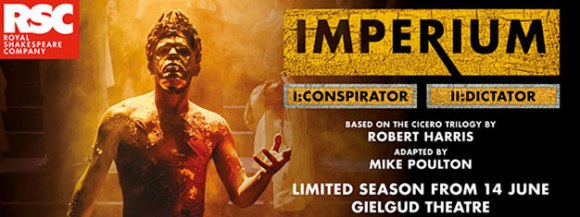
Imperium is an adaptation of Robert Harris’ three books on the life of Cicero, into six plays, each just over one hour long. These have been amalgamated into two plays; Conspirator and Dictator, which are running concurrently with the same cast at the Gielgud Theatre. It is possible, if you choose the correct day, to watch the first play as a matinee and the second one the same evening.

This is a Royal Shakespeare Company production which has transferred from Stratford to the West End. Robert Harris is an acclaimed author of historical novels, renowned for making history accessible. Mike Poulton who adapted these novels has recently brought Hilary Mantel’s,Tudor novels to the stage with great success. These three combine well to make a thoroughly entertaining and interesting biography of one of Rome’s less covered  characters.

Imp

Cicero has been written as the hero here although not without flaws. He is honourable and steadfast to his belief in the Republic of Rome. He has great oratorical skills and is politically adept. He is also vain, aware of his talents, but blind to his faults. Richard McCabe plays the part admirably, with charisma – he is self important and gossipy, but witty and likeable still. The other main part in this play is Tiro, Cicero’s slave, who is writing his biography. Joseph Kloska is fantastic in this role, he is effectively the narrator of the story. He is integral to making Cicero likeable and his affection for his master, while seeing his faults, shines through his performance. Both of them are on stage for almost the entire seven hours of the show. The synergy between these two main characters is lovely and is the column around which the whole production is built.

Nearly everyone else is an antihero and a threat to the Roman Republic. Peter de Jersey is a smooth, smiling Julius Caesar – politically adept, desirous of power for personal gain. Joe Dixon is very good as Cataline, all brawn and little brain, who believes that he deserves to rule Rome and is prepared to bring it down in revenge, if it fails to deliver his wishes. In the second series of plays Oliver Johnstone is good as Octavian Caesar. He is cold, calculating and calm, able to bide his time as he is convinced of his own divinity.

First-Look-Imperium-e1530081620609

For me, the one misstep was portraying Pompey as a Donald Trump type figure. In historical terms it is likely that they were far from alike politically, and director Gregory Doran did a nice job of drawing our own comparisons with the present day throughout the rest of the show, without us needing any coercion, so maybe we should have been trusted to do the same here. However that is a small quibble, for a production that has managed to walk the line between accuracy and accessibility.

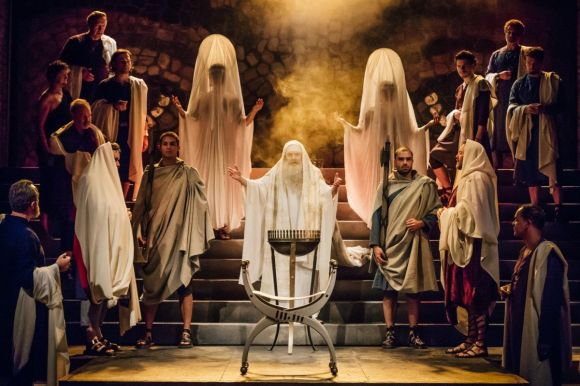
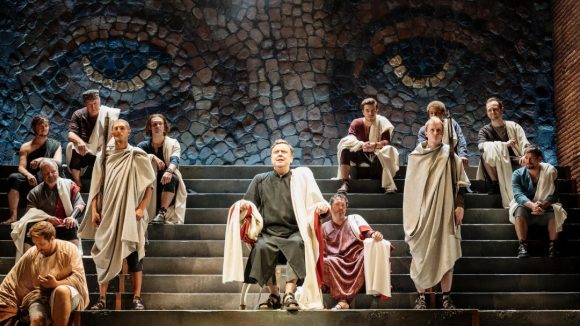
The set too is good, simple and effective. Senate steps that the cast sit upon while listening. Tesserae of watching eyes at the back of the stage. The walls of the senate are built with Roman bricks. There is a huge revolving, reflective, silver globe suspended over the set, that changes hue with events on stage – perhaps a pun on Urbis et Orbis from the city to the world. Anthony Ward has done well making the audience the forum, to whom the senate are speaking and drawing us in to the action.

Imperium is a lovely reproduction of a small part of ancient history. it is witty, funny and accessible, an enjoyable show whether or not you have an interest in the Roman Republic. Robert Harris famously said of his Cicero trilogy that is “The West Wing with Togas”, well this contemporary adaptation turns it into “House of Cards in Ancient Rome”. Surely a Netflix production cannot be far away – and if it is I will surely be watching!


Categories
Theatre review

Kiss Me Kate, Opera North, London Coliseum, London WC2

kiss me kate

Cole Porter’s 1948 musical, Kiss Me Kate is a complex show, some of its numbers are  classic Broadway showtunes, while others have a light opera edge. It has complicated, full company dance routines as well as individual virtuoso displays. It also has a couple of good comedy roles that require great timing and delivery. On top of this, the Coliseum itself, has a big stage that needs a large company to fill. All in all, this is a show, in a venue, which will test every part of the company putting it on, to the fullest degree. I have to say that Opera North have passed this test with honours.

The two operatic leads, Quirijn de Lang and Stephanie Corley, as Fred/Petruchio and Lilli/Kate both have splendid voices, suited to their roles.  Zoe Rainey and Alan Burkitt, as Lois and Billy, carry the more standard musical numbers perfectly. Each of the four of them has at least one great song to show of their respective talent. Lois has possibly the most famous songs in “Always true to you in my fashion” and “Tom, Dick or Harry” but Kate’s “I hate men” and Petruchio’s “Where is the life that I led” are really great songs that show of their vocal abilities. The show’s biggest song, of course, “Too Darn Hot” is sung by the chorus, and the dancers, particularly Aiesha Pease and Stephane Anelli, deliver a truly show stopping performance to this number.

Kiss me kate 2

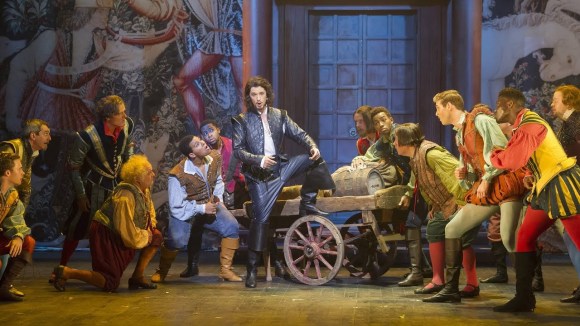
Joseph Shovelton and John Savournin play the comedy roles of first and second Gunman. They work very well together, their interaction is excellent and they make the most of their comedy duet “Brush up your Shakespeare” – a song more full of puns than I had previously realised. The company as a whole is excellent and you realise that this is going to be a show full of movement and vigour, right from the first song of “Another Op’nin’, Another Show”.

Kiss Me Kate is a big show, and this is a big full-on production of it. The costumes are bright and lavish.  The choreographer has a tough job, with so many people on stage at once, however the dance routines are vivacious and have lovely shape. The set design needs ingenuity too, and is very clever at swapping from front of stage to back of house in seconds.

The director, Jo Davies, has taken the bold decision not to update the show in any obvious way. At times, it felt like you were actually watching a show made in the 1940s, giving the show an interesting post-war period feel. The tap routine, in particular, had a dated, black and white movie quality, which suited the production very nicely. This is a lush and exuberant production of a distinguished show and it fully deserved the love it received from the packed audience at curtain down.


Categories
Theatre review

Sea Wall, Old Vic, London, SE1

sea wall

Sea Wall was written by Simon Stephens specifically for Andrew Scott. He first performed it ten years ago at the Bush theatre in Hammersmith. Since that time, both of them have become regarded as leaders in their sphere. Simon Stephens was already very well regarded, being involved with young writers at The Royal Court, but his hugely successful adaptation of “The Curious Incident of the Dog in the Night-Time” has taken his career to a new level. Andrew Scott has been involved in the big hit TV series, Sherlock, where he plays Moriarty, and his stage performance of Hamlet was one of last years stand out performances. https://reviewdonkey.wordpress.com/?s=hamlet

This particular play has developed something of a cult following, it has been performed in the UK and Ireland and there is filmed version of it available online. I have to say that it is a truly remarkable piece, beautifully written. It plays to all of Andrew Scott’s  considerable strengths. He interacts directly with the audience, his naturalistic style of acting fits perfectly with the writing and one cannot help but be moved by his telling of the story. It was surely imagined for performance in a much smaller space than the Old Vic but Andrew Scott has even this larger audience in the palm of his hand.

The piece is short, only half an hour long, and the tightwad in me, initially felt a little short changed that The Old Vic is charging pretty nearly full price for a thirty minute one man show with no set. However, with perspective, Sea Wall is a very high quality, dense piece and I’m not sure that Andrew Scott, or the audience for that matter, could have kept up that level of intensity for any longer.

This show really enhances the reputations of both the actor and the writer. From Andrew Scott we really do get a masterclass in captivating an audience. He managed to make a thousand seat auditorium feel like a private conversation. I think that after he has finished the run here, there is life in the show yet and, I suspect that it is likely to be performed at other venues in the future. If not, I believe that you can watch the show on film at  http://www.seawallandrewscott.com/ I haven’t watched it yet, but if it is half as good as it is live then you are in for a treat!

Categories
Theatre review

The Prime of Miss Jean Brodie, Donmar Warehouse, London WC2

jean B

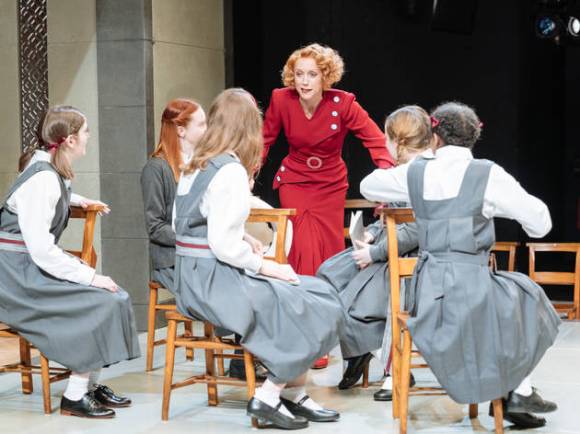
This is a new adaptation of Muriel Spark’s novel. David Harrower has changed the telling of the story, in some ways it is closer to the book than any of the previous adaptations have been. It is told in flashback rather than the flashforward of the book, but the main roles from the book are all here and their character foibles are more to the fore than in the 1969 film starring Maggie Smith.

The Jean Brodie of this play is more obviously manipulative, but still charismatic. She is a talented teacher, hugely influential, on the children she teaches. However, with great power comes great responsibility and the story is really about whether her personality allows her to use her talent to its best effect. There is no doubt that Jean Brodie is a fantastic role, although Maggie Smith – with her best actress Oscar for the part, makes it a brave soul who would be prepared to take it on. Lia Williams is amazing in the role, she really makes it her own. She shows us why the girls are so in her thrall, and she gives us an insight into why this is not necessarily always in their best interests.

The cast is small and all are good. Angus Wright is excellent, as usual, as Gordon Lowther, the music teacher whose love for Jean Brodie is not returned. His part, in particular, is more compassionately written here than in other versions, this works well as a contrast to the more dissolute role of Teddy Lloyd.   I really enjoyed seeing the role of Joyce Emily brought forward in this adaptation. Nicola Coughlan is really good in the part, I think we will be hearing that name much more in the future.

The set is simple with clean lines and cool colours, reminiscent of Rennie Mackintosh. There is also a kind of Japanese Shinto influence with different bells arranged around the set, ringing intermittently before the start and during the interval, ensuring that we are all in a state of relaxation before the action begins.

The Prime of Miss Jean Brodie is a great book and this is a lovely new adaptation of it. The dialogue is crisp and clear, the characters are sympathetically written, and the acting is top class. It is playing until the end of July, I know the Donmar has a tendency to sell out very quickly, but if you can get your hands on a ticket, then I would recommend that you do.

Categories
Theatre review

The Best Man by Gore Vidal, Playhouse Theatre, London WC2, 2018

the-best-man-01

First produced on Broadway in 1960, The Best Man points at the flaws in the democratic system that we had then and that we still have today, namely that those who crave political power are the last people who should be given it. It is really interesting to note how it manages to be a period costume drama and a commentary on the machinations of political life today. The period part comes in the fact that political drama in the early 1960s was a much more static affair than we are used to now. Since “The West Wing” and “House of Cards”, rarely do we see anyone actually sitting and talking political ideas.

Gore Vidal is a fantastic writer, and even almost 60 years on, “The Best Man” is full of provocative ideas and stinging backhanded compliments.  It is insightful and witty and has a stellar cast. Martin Shaw shows great balance being righteous without being too pompous, he carries himself as though he believes he is better than the people who he hopes to vote for him, but has to work hard to avoid showing it.  Jeff Fahey is the Machiavellian, but he makes you understand that he realises this, and it is ok because he is doing it for the right reasons. Jack Shepherd almost steals the show as the outgoing President – this is a fantastic part, he gets to deliver some nice home truths to both sides and he plays it perfectly.

This being the early 1960s one would expect the women to be ancillary to the action, but Vidal was ahead of his time here, and the three leading ladies all have relatively meaty roles, and are aware of their importance in the political machine. Glynis Barber and Honeysuckle Weeks have very different roles as the respective senators wives but both are very convincing in what they do. Maureen Lipman is hilarious in a beautifully written cameo as Mrs Gamadge, who promises to bring “the women’s vote” to the candidate of her choice. She plays it so well and so much as we know her that it feels as though it could have been written for her.

Simon Evans has done a good job as director by ensuring that, although the play was written with one senator being the more honourable and the other being more murky, we see the faults in both. Apparently there was film of this play made in 1964, I will certainly be on the lookout for it because it will be interesting to see the difference 54 years has made in our perception of its ideas.

Unfortunately, I have come to this show late and it is about to close in London, but if it goes on tour after, I urge you to try and catch it, especially if you have any interest in politics – either American or British, and either current of historical. Recommended.

Categories
Theatre review

Harry Potter and the Cursed Child, Palace Theatre, Shaftesbury Avenue, London W1

Harry Potter

I guess that I had better begin by explaining where I am on the Hogwarts spectrum. I enjoy the Harry Potter franchise. I read the first three books and really liked them. I have watched all the films, including the fantastic beasts one, although I couldn’t say exactly what happened in which film, especially the ones towards the end of the series. So, I know all the main characters pretty well, but I’m not a person you would invite to be on your team in the Harry Potter trivia quiz.

This play is written by Jack Thorne, although it is based on a story by him, JK Rowling and John Tiffany. However, it does really feel like it is written by JK Rowling because it is, first and foremost, a really good story and she does know how to construct a good story. I’m not too sure why it is separated into two plays, because it is a single adventure and I suspect that if you were to just see part two, you wouldn’t have a clue what was going on at the beginning.  So, if you are planning to book, do see both parts and do see them in the correct order. Never have I been to the theatre and been warned so often about revealing the plot; luckily, I prefer leaving the storytelling to the playwright so rarely reveal plot twists in a review.

The story is great, not particularly complicated or cutting edge, but it is told in convincing detail over the course of five and a half hours. We know most of the main characters already, having lived through their adolescence, and I have to say it is interesting to see them all fully grown up with children of their own. The actors playing these parts have a tough job, taking over characters with whom we are already very familiar, but needing to bring their own ethos to the role. They all cope admirably with this challenge, Rakie Ayola and Jamie Glover are good as Hermione and Harry. I loved the reimagining of Ron Weasley; Thomas Aldridge’s character probably did have a little more of a free rein for development given his incidental part in the story, but it is very funny and he delivers it well. The new people are really the stars in this show, Theo Ancient is very good as Albus Severus Potter and Samuel Blenkin is fantastic as Scorpius Malfoy. April Hughes has a wonderful, scene stealing cameo as Moaning Myrtle.

The magic and special effects are spectacular, it is one thing seeing them on film as we are used to, but seeing them around you in the theatre really adds to the excitement. The effects are constant throughout the show and they are all top notch. The sets are clever and engaging, there is always something new to attract your attention, not an easy achievement over the course of such a long play. The choreography felt clunky at first, with too many flourishes, but you come to realise that this is necessary to help the magic along, and by the end I was full of admiration for the choreographer – with a company of 43 people, military precision must have been crucial.

These were the most expensive tickets I have ever bought, so it needed to be good, but I have to say that even so, I still feel that they were good value for money.


Categories
Theatre review

Chess, The Coliseum, London WC2

Chess

Chess at the Coliseum is part opera, part rock concert, but full on spectacle. It has a large orchestra, positioned in full view, above the stage. It has fire eaters, stilt walkers, aerial silk dancing, a company of fifty people. There are video screens, pop concert style, at each side of the stage; showing the current singer in close up. There are video clips showing American capitalist advertising and Russian communist iconography. They have lavished both money and attention on this show and it has not gone to waste. Sometimes, it is good to see a big production and the extravaganza that can be delivered when no expense is spared.  The music and performances need to be strong to cope with these distractions, and luckily here that is the case. When Chess was written, it was set in the near present, however the world has changed so much sine the 1980s that now it has become historical period drama, and this has given it has a timeless quality that it did not have at that time.

Music by Benny and Bjorn from Abba and lyrics by Tim Rice, the songs are memorable and emotional. It is clever that the American characters have the more rock style songs. Tim Howar has the perfect voice for these songs, unsurprising I suppose, as his day job is lead singer with Mike and the Mechanics – a classic ’80s rock outfit. Alexandra Burke is Svetlana, the Russian wife, not many songs but she sings them very well. Cassidy Jansen plays Florence, which is the bigger part and she also has an amazing voice. Their duet “I Know Him So Well” is beautiful. Michael Ball is Anatoly, the lead character and is just as good as you would expect him to be. All four main singers are artists at the peak of their careers and they bring out the full potential of the songs. Phillip Browne and Cedric Neal, as Molokov and The Arbiter respectively, also have lovely rich voices.

The choreography is clever and witty. I particularly liked the British dance, with the suited, bowler hatted, umbrella wielding civil servants doing their homage to the swans in swan lake, while the typing pool work away in the background. There is so much going on, all the time, in this production that, no doubt, there are elements that I missed, however, rarely has two and three quarter hours flown by so quickly. The Coliseum is a venue that is more used for traditional opera than modern musicals and Chess fitted in very well. Seeing it here, and hearing it with the benefit of the ENO chorus, one realises that this is a show that could be performed in a venue such as this for centuries to come.