Categories
Attractions

Love London Part 2. Trafalgar Square, George IV, Victorian generals and the Fourth plinth.

DSC_5727

The painting above is of the NE corner of Trafalgar Square and St. Martin-in-the-Fields in 1888.  It hangs in Tate Britain and it is by William Logsdail. In case you missed it, the first part of my paean to Trafalgar Square is here: Love London, Part 1. Trafalgar Square, Nelsons Column and Charles I, London WC2.
2014-11-29 13.12.54

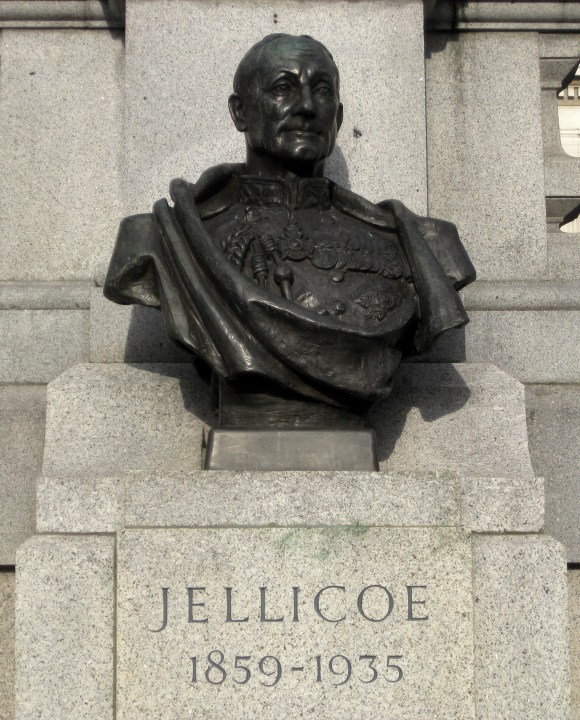
On the lower northern wall of the square are busts of three First Admirals of the fleet; Cunningham,  Jellicoe and Beatty. Admiral Andrew Cunningham was distinguished veteran of WWII and his bust was added after the other two in 1967. Jellicoe and Beatty are Admirals of WWI and their busts were placed in 1948, facing Nelson, “Hero of the fleet”. I hope it is true that they both admired Nelson as much as they are supposed to, because upon their deaths, in late 1935 and early 1936, they were both entombed in St Paul’s Cathedral, also facing his tomb.

standards-of-length-trafalgar-square

Also on the lower northern wall of square is an often overlooked historical treasure “The Trafalgar Square Standards”. They are low down along the steps and in the wall behind the seats. These were the official British Imperial measurements of length until we adopted the metric units of measurement in 1995. These were set into stone, by the Standards Department of The Board of Trade, in 1876 and if you suspected that any measuring implements were incorrect you could bring them here to settle the argument. There are three sets of these official standards, the others are in the Royal Observatory in Greenwich and in the Great Hall of the Guildhall in the city. The official measures included are; the inch, foot, yard, link, chain, perch and pole.

imperial-yard-trafalgar-square

There are four plinths built to contain statues in the square. The two on the south side of the square contain statues of Victorian Major Generals, Napier and Havelock. They both served with distinction in the campaigns in India. The third plinth is occupied by an equestrian statue of George IV. It was commissioned by the King himself and depicts him riding bareback, without stirrups and in ancient Roman dress. He intended it to be placed on the top of the Marble Arch, but it was put here in 1843.
IMG_2012

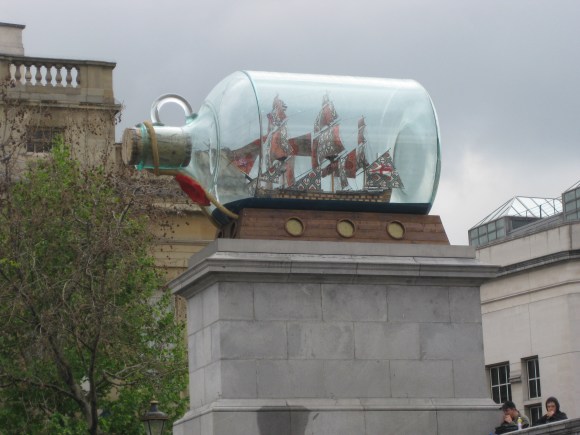
The fourth plinth was intended to hold a statue of William IV. It was empty for over 150 years until 1999 when it was decided to put a succession of works of art on the plinth, each occupying it for a limited amount of time. These art pieces have generated a great deal of debate over that past twenty years and, in that respect, the concept has certainly been a success. All of them have been controversial, most of them have been innovative and some of them have been attractive. Among the more memorable are; Anthony Gormley’s “One & Other” where over the course of 100 days, 2400 different people each spent one hour on top of the plinth, Marc Quinn’s “Alison Lapper Pregnant” and Yinka Shonibare’s “Nelson’s ship in a Bottle”. The current incarnation, Michael Rakowitz’s “The invisible enemy should not exist” is a recreation of a sculpture of a Lamassu (a winged bull and protective deity) that stood at the entrance to Nineveh from 700 B.C. It was destroyed in 2015 and this piece is made completely from empty Iraqi date syrup cans. I find it beautiful.

Lamassu

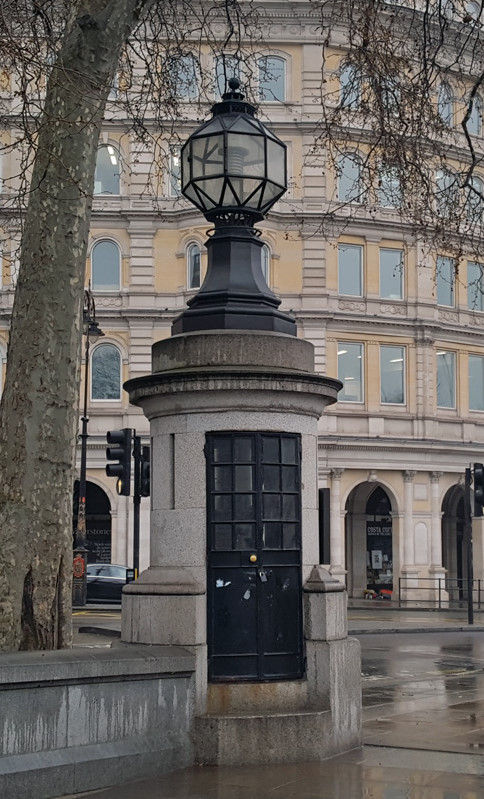
On the South Eastern corner of the Square is a round edifice with a light on top. This is claimed, by some, to be the smallest police station in the world. Put in temporarily in WWI but made permanent during the general strike of 1926, it is a raised room from which a policeman could stand and watch the square in order to phone Scotland Yard, if a demonstration in the square showed signs of becoming dangerous. When the light was changed from gas to electric, the light used to flash when the phone rang, in case the assigned policeman was patrolling the square.
trafalgar-square-police-box

I have a couple of pieces other random trivia about Trafalgar Square. The north side of the square is substantially higher than the south. This slope is not natural, the south end was lowered in order to made the National Gallery building more imposing. The earth was used to level St James’ Park.  Adolf Hitler planned to remove Nelson’s column and statue from Trafalgar Square when Germany conquered Britain. His intention was to place them in Berlin as a victory trophy.
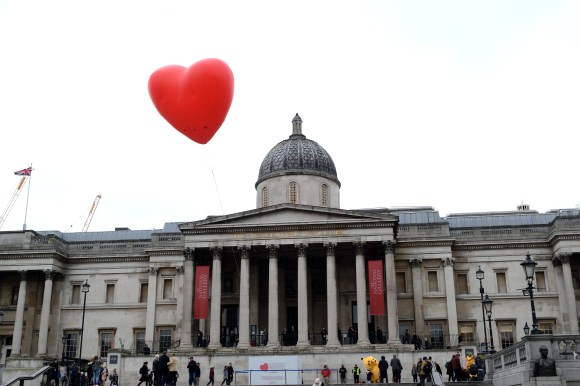
 

DSC_5034
National Gallery from Trafalgar Square


While you visit Trafalgar Square, you should visit St Martin-in-the-fields on the NE corner and the National Gallery. I plan to do separate pieces about these. I will put links here when I have completed them.  Also, on the South side, between Whitehall and The Mall,  there is an unobtrusive hotel called The Trafalgar. This is a smart hotel and if you go to the back you can catch a lift up to a rooftop bar. The cocktails are central London prices, but they are good and the roof terrace has lovely views over the square.


Categories
Attractions

Love London, Part 1. Trafalgar Square, Nelsons Column and Charles I, London WC2


DSC_2999Trafalgar Square is a tourist attraction that is packed with both dramatic architecture and history.  It has a claim to be the centre of London, in both a physical and psychological sense. Other places have claims also; Bank, Buckingham Palace, Piccadilly Circus even Hyde Park Corner, but there are a couple of good arguments in favour of Trafalgar Square.
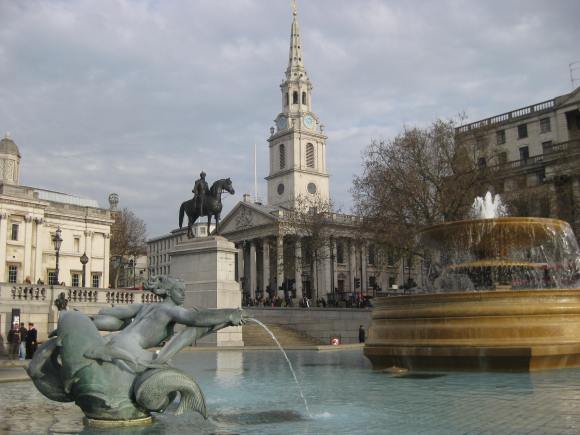
2014-11-29 13.12.11


It has been  the scene of major British public gatherings and demonstrations from soon after its opening right until the present day. It was the backdrop to the Poll Tax demonstrations in the 1990s, CND rallies in the 1960s and ’70s, Chartist gatherings of the nascent Labour movement in the late 1800s and more recently campaigns against Climate Change and the wars in Afghanistan and Iraq.

overview

Over the Christmas period it holds London’s most famous Christmas tree, a gift from Norway every year since 1947, as a thank you for Britain’s support during WWII. It was also the traditional gathering place for London’s New Year celebrations until the crowds became too big and deemed too dangerous to have at a single venue.

Trafalgar Square was designed in 1826 by architect John Nash, it did not really begin to take shape until the late 1830s when the National Gallery was built in 1838. It is named after the battle of Trafalgar, a famous 1805 victory over Napoleon.

Nelson


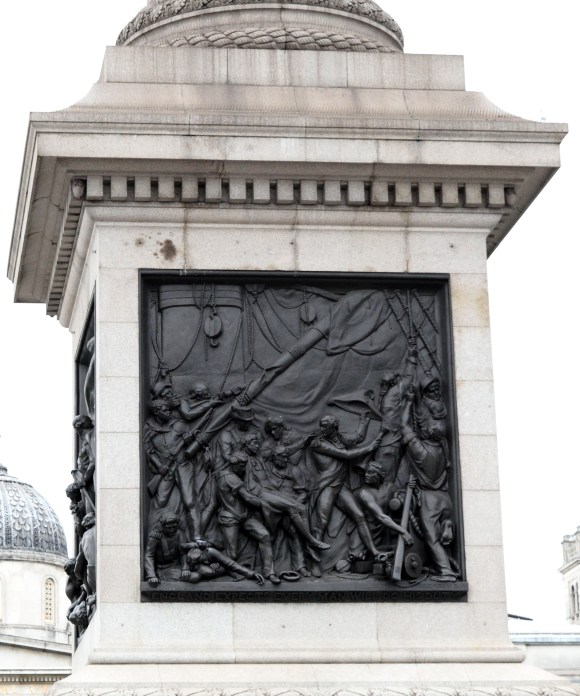
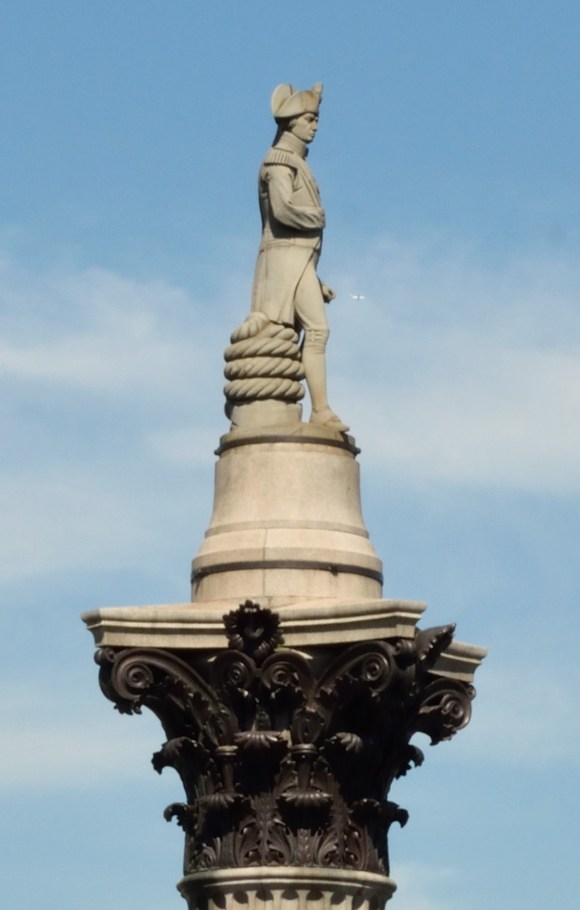
The centrepiece of the square is Nelson’s Column; a monument to the leader in that battle. This was erected in 1843 just before the square became a public area. It is a 43metre high, granite column with a 7metre statue of Horatio Nelson on top. The column itself is a Corinthian column, having an ornamental top. This ornament is made from British cannons.  There are also bas-reliefs on each side of the column at the bottom, depicting earlier famous British war victories and these are made from the melted down remains of weapons captured from the French and Spanish armies. Famously, the stonemasons who built the column are reputed to have had dinner served on its top, before the statue was placed.

DSC_3001

The Lions at each corner of the column were designed by Edwin Landseer and were installed in 1867. They are made of bronze and each one weighs over 6000kg. The fountains at either side of the column, were added later. The current fountains were designed by Edwin Lutyens and added just before the start of WWII. Trafalgar Square as a whole is Grade I listed, which is the highest level of architectural protection in the U.K. awarded only to buildings of exceptional interest.

2014-11-29 13.17.22

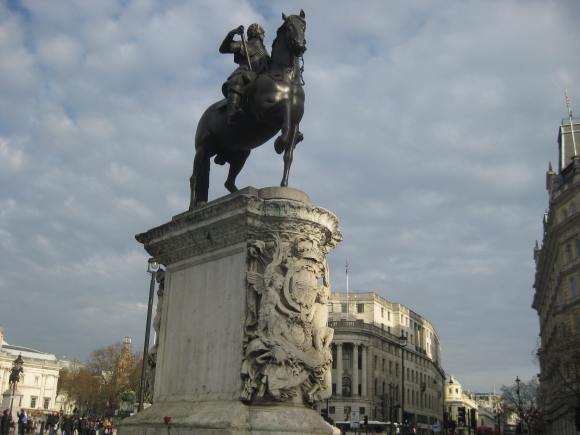
The oldest statue is to the South of the square. It depicts Charles I on a horse. This was made in 1633 and sent to be melted down after the abolition of the monarchy in 1653. The brazier to whom it was given, made his fortune selling trinkets made from the melted down statue, but he had kept it intact to return to the crown on their reinstatement. This is also what Trafalgar Square its claim to be the physical centre of London, as it is to the base of this statue that official distances to London are historically measured.

You may have heard that all the distances to London are measured from Charing Cross. This is true. The Charing Cross was one of 12 crosses placed by Edward I in memory of his wife Eleanor. It was originally in the spot currently occupied by the equestrian statue of Charles I. It was destroyed by order of Parliament after the civil war. A replacement cross was built and placed in front of Charing Cross station during the reign of Victoria. There is an original Eleanor cross still standing, from 1294, in Waltham Cross.

Part 2 of the Trafalgar Square post is here: Love London Part 2. Trafalgar Square, George IV, Victorian generals and the Fourth plinth.


Categories
Theatre review

Young Frankenstein, Garrick Theatre, London, 2018

Young Frank

Young Frankenstein is written by Mel Brooks and based on his 1974 film starring Gene Wilder, so don’t go in expecting any deep insights into the nature of the world. What you get is a smutty, slapstick, laugh-a-minute show, full of quick, clever, off-colour punchlines. It is packed with song and dance routines, which come along so swiftly that you haven’t time to notice the poor ones before you are being entertained by the next one which might be more to your taste.

There are some good performances, Hadley Fraser shows that he can do farce in a rare comedic role. His voice is excellent as you would expect from an actor who has previously been in “Les Miserables” and “Phantom of the Opera”. Lesley Joseph is as good as Frau Blucher, hamming it up just enough, without going too pantomime. Cory English has taken over from Ross Noble as Igor and he is very good indeed, his experience of playing the role on Broadway working to his advantage.

The jokes are sometimes obvious and often telegraphed but the direction is clever in making us enjoy the expectation of the punchline as much as the delivery itself. This is particularly evident in the scene involving the monster and the blind hermit. There are also nice homages to bygone musicals in the songs, “there ain’t nothing like a brain” and “the Liths in Lithuania, do it” are two lines that spring to mind. The show stopping number however, is the one song that is not an original. Irving Berlin’s “Puttin’ on the Ritz” is fantastically choreographed, inventive, surprising and funny; it will have you smiling at odd times for hours after you leave the theatre, remembering the routine.

Young Frankenstein is not profound, it is not ground-breaking, it is not even particularly original, but it is funny, it is fast and it is a very good evenings entertainment. I enjoyed it and judging by the reaction at the close, the rest of the audience enjoyed it too. Recommended.

Categories
Theatre review

Everybody’s Talking about Jamie, Apollo Theatre, London

01-everybodys-talking-about-jamie-john-mccrea-and-company-c-alistair-muir

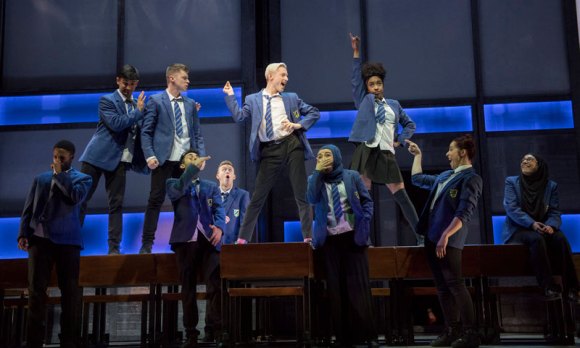
All the publicity that goes with “Everybody’s talking about Jamie” mentions what an  uplifting feel good story line it has, and that it taps into the current zeitgeist, and to be fair they are right but, really it has so much more than just that.

The songs are brilliant, “It means beautiful” will surely win an award for best new song in a musical. “He’s my boy”, “Work of Art” and “If I met myself again” are also wonderful, I think Dan Gillespie Sells is going to be a huge success as a songwriter for musicals. The lyrics are lovely too and are written by Tom Macrae, so perhaps this is a new partnership to look out for.

The whole cast is great. Obviously John McCrea is excellent as Jamie, a strong voice and a big stage presence. There are also outstanding performances from Josie Walker as his Mum, who has two big songs and a spectacular voice with which to deliver them, and from Lucie Shorthouse, who has an endearing part as his BFF, Pritti. I enjoyed Phil Nichol’s portrayal of Hugo Battersby too.

I also really liked the choreography, it is vibrant and up to date, break dancing with a hint of Justin Beiber video. The set design is good as well, a great mixture of simple, clever and efficient. She show finishes very well, the audience loved it and left the theatre wanting more.

I thoroughly enjoyed this show and I hope it is a huge success!

Categories
Theatre review

Trois Grandes Fugues, Lyon Opera Ballet, Sadler’s Wells, Islington, London

du17-trois-grandes-fugues-childs-2-photo-stofleth

Trois Grandes Fugues is a simple but clever idea. Three different choreographers take the same piece of music, in this case Beethoven’s “Die Grosse Fuge”, and bring their interpretation of it, to the stage. I came to the show not knowing the music and uninformed with regard to the language of dance.

The three dances are all completely different. The first is the most traditionally classical in its form. Lucinda Childs has six couples investigate the geometric patterns in the music. The dancers are dressed in simple grey figure hugging body suits, the dance is graceful, formal, mathematical and balletic.

4617

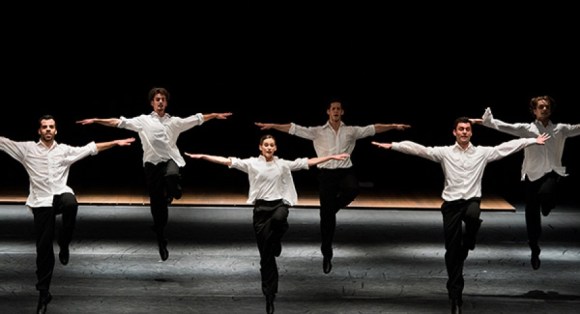
The next, Anne Teresa De Keersmaeker, has her 8 dancers, 6 men and 2 women, in dark suits with open necked white shirts. Formally dressed at first the jackets are removed and some of the shirts are opened as the dance moves on. Each dancer appears to be linked to different sections of the orchestra and they move across the stage, together or apart, each seemingly linked to their own particular instrument.

The final piece by Maguy Marin, has her dancers less formally dressed, in shades of red, and her interpretation is wilder, more emotional, and the four dancers emphasise the dramatic and canonical motifs. They follow each other round the stage in more staccato movements, showing the fierce energy and strife in Beethoven’s work.

du17-trois-grandes-fugues-marin-3-photo-bernard-stofleth-x

I like Beethoven, usually his pastoral pieces are more to my taste, having heard this 20 minute work three times, each time I enjoyed it more, and I will look out for it, to listen to at home. I had a fantastic evening and I felt like I had been given an introductory lesson into both classical music and dance.

Categories
Theatre review

Jekyll and Hyde, National Youth Theatre, Ambassadors Theatre, London

©NOBBY CLARK
+44(0)7941-515770
+44(0)20-7274-2105
nobby@nobbyclark.co.uk

The National Youth Theatre’s production of Jekyll and Hyde is a deconstruction of the original novella by Robert Louis Stevenson, rebuilt with a modern feminist twist by writer Evan Placey. Combining Victorian settings and morals with modern day language and values adds a new dimension to the duality theme of the story.

The decision to have a female Jekyll is not only brave but astute, and this production perfectly captures the zeitgeist with the discussion about sexism in film and theatre so much in the news. The writing is forthright, the jolt of the coarse language spoken by the Victorian ladies near the start of the play becomes clear in the second act, there is no doubt that Evan Placey is a talented author, of whom we will hear more in the future.

Aside from the writing there is much to recommend in this production. The acting throughout is accomplished. Jennifer Walsh in particular is excellent as Florence, a young adult coming to terms with the fact that although no one else is going to stand up for her, she has the power to stand up for herself.  Elizabeth McCafferty confidently makes the transitions between Jekyll and Hyde both striking and convincing. Mohammed Mansaray has a funny scene as a priest, which he delivers very well.

©NOBBY CLARK
+44(0)7941-515770
+44(0)20-7274-2105
nobby@nobbyclark.co.uk

The direction is brisk and contemporary, so that even in the midst of 19th century London, we feel linked to the current day. The director, Roy Alexander Weise, is not afraid to be confrontational, daring to breach our comfort zone in order that we feel the characters’ anger. The costume design is remarkable and clever, the ensemble changes from church house to flop house in the blink of an eye.


©NOBBY CLARK+44(0)7941-515770
+44(0)20-7274-2105
nobby@nobbyclark.co.uk
Pictures courtesy of Nobby Clark


Jekyll and Hyde has a few rough edges, but challenging, thought provoking productions like this are exactly the remit of The National Youth Theatre and I have to say that I thoroughly enjoyed this show.

Categories
Restaurant review

Browns, Cardinal Walk, London Victoria

browns-victoria-private-dining-image-1

Victoria Station and its surroundings have changed dramatically in the last couple of years. It is now full of pedestrian areas and buildings made of glass and steel. Cardinal walk is probably one of the oldest of these but still fits nicely into this environment. The décor and the ambience of Browns matches this well too, it is set over two floors, all glass. The restaurant is on the first floor so if you get a table by the window you can watch the world go by as you eat.

Their Pinot Grigio is good, although at over £8 for a large glass, it needs to be. They have a reasonable selection of beers and the cocktail list looks impressive although we did not try any. The service was good, our waiter was friendly and helpful, but he wasn’t really that busy, so maybe he should have picked up on our indifferent response when he enquired how the food was.

The thing that let them down was the food. The fish pie was ok, but I expect better than that when I pay over £15 for it. The only way to tell the difference between the different fish was texture, the overall effect was bland and the potato topping was runny. The steak sandwich was also all right, no butter on the bread – just mayo, but the chips were only slightly hotter than luke warm and they didn’t have any English mustard. The side order of onion rings contained four rings!

I wanted to like this place because I have enjoyed other restaurants in this chain in the past. With such a large choice of places to eat around Victoria now, average food will not get repeat business.

Categories
Theatre review

Follies, National Theatre, Southbank, London.

ntgds_lr_follies_editorial_lores_rgb-xlarge_trans_nvbqzqnjv4bqrztbxiabcvehja2lncrbaqctb0fis-lilonsyie-xyy

Follies is probably Sondheim’s most traditional musical, in that it has set pieces, dance routines, show girls and, separate songs that don’t bleed into each other. However, it is still complex; the story has great depth and some of the songs are operatic in nature.

It is expensive and complicated to produce, it has a large company, with demanding roles throughout the cast. It needs an orchestra. Full productions of Follies are rare, the last proper one in London was thirty years ago, so when there is a high quality, committed revival such as this on offer, the opportunity needs to be grabbed.

It’s Sondheim, so the material is fantastic. It has some of his most famous songs, the storyline is elegant, and it is almost upbeat for Sondheim, (that means everyone in the cast isn’t going to live out the rest of their lives in abject misery!). It’s the National Theatre, so the production values are top notch. Dominic Cooke and Bill Deamer as director and choreographer have both done a wonderful job. I particularly loved the way each dancer at the reunion had their younger version dancing with them. I also loved the way all the mature dancers paraded down the stairs in a dignified manner wearing evening gowns, while their younger incarnations scrambled in over the rubble at the back of the stage, in their high heels, basques and feathers.

Imelda Staunton, Janie Dee, Philip Quast and Peter Forbes are the four leads, so the acting and singing are outstanding. Imelda Staunton does an emotionally draining rendition of “Losing My Mind” and Philip Quast’s voice is as amazing as it always is. It has Tracie Bennett and Geraldine Fitzgerald in supporting roles so it has incredible strength in depth. Tracie Bennett is in full on scene stealing mode with “I’m Still Here” sung with a mixture of pain and defiance.

Follies at the National Theatre is fantastic, and given all the elements that went into making it, there was never any doubt that it would be.

Categories
Theatre review

The Ferryman, Gielgud Theatre, Shaftsbury Avenue, London W1

theferryman_03

The Ferryman is a kitchen sink drama with an epic storyline. Apart from the prologue, it is totally set in the large kitchen of a family farmhouse outside Derry. The action is a day and a half in the lives of the extended family that resides there. But, the themes are huge, its about family and war, about love and loyalty, about freedom fighting and terrorism, and it tells these stories through short interwoven family interactions that come and go throughout the play that gradually meld together to make a complex tapestry.

Jez Butterworth has been spoken of as one of the best writers around today, and with  The Ferryman he delivers. The language and the narrative are superlative, it is the writing of someone both confident and ambitious. He is brave to wind traditional songs and ancient stories through the dialogue and he is talented pull it off so well.

The direction is awesome, there are 17 characters in this play, without counting the live goose, rabbit or the baby. Just moving them all around the stage must have been a major task but, Sam Mendes makes the whole setting feel real,  natural and, even simple.

The cast is also fabulous, lots of lovely performances from so many different actors. Paddy Considine and Laura Donnelly are great as Quinn and Caitlin, but right through the cast there were great turns. I loved Rob Malone as the troubled Oisin. Brid Brennan had a scene stealing part as Aunt Maggie Faraway and she played it perfectly. Dearbhla Molloy and Des McAleer are wonderful as Aunt Patricia and Uncle Pat.

As you can tell, I loved this show. I have to finish because I am about to run out of superlatives. This is a play that will become a classic piece of literature that will be on school curricula.


Categories
Attractions Exhibition

The Wallace Collection, Manchester Square, London WC1.


Franz Hals, the Laughing Cavalier
The Laughing Cavalier


The Wallace Collection is a must see museum/gallery if you come to London. The items on show were bequeathed to the nation in the late 19th Century and have been on display here since 1900.

The Shepherd, Van Dyck.JPG
Van Dyck, The Shepherd Paris

The number and quality of the Old Masters from the 15th to the 19th century is amazing. It has some of the finest examples of 18th century French furniture in existence. There is also a rich assemblage of porcelain, sculpture and royal amour in the collection. One of the more unusual pieces is a particularly ornate cannon.


Cannon

Many of the pieces were bought during the sales of art following the French revolution, which is why the collection is so strong in 18th Century French art. Such good examples of the Louis XV cabinets and marquetry cannot be seen anywhere else in the world.

Vases

A condition of the bequest was that none of the pieces ever left the collection, even to go out on loan. So if you ever wish to see, say, “The Laughing Cavalier” or Canaletto’s “View of the Grand Canal” you have to come here.


Canaletto, the Grand Canal
Canaletto, The Grand Canal


It is astounding to discover that it is free to visit this collection, although they do ask for a donation. It is also surprisingly quiet, compared to the other, bigger museums and galleries in London. This is presumably because it is not in the main exhibition area of town, although you could argue that, situated between Oxford Street, Baker Street and close to Selfridges, it is even more central than those in South Kensington.


Rembrandt, Susanna van Collen and Anna
Rembrandt, Susanna Van Collen and her daughter Anna


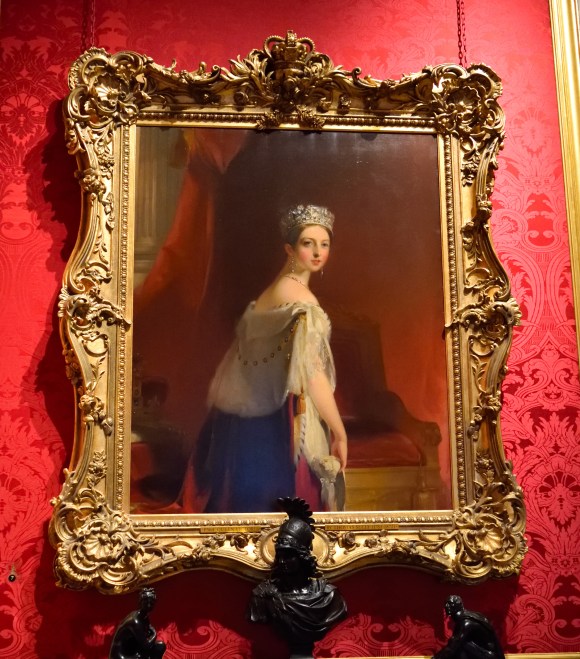
Notable among the Old Masters in the collection are 5 Rembrandt, 4 J. W. Turner, 8 Canaletto, 2 Titian, 12 Reynold, 5 Cuyp, 2 Gainsborough….. the list goes on, it is an amazingly rich and full list. There is even a wonderful portrait of Queen Victoria from 1837, when she was newly ascended to the throne.

Queen Victoria 1837.JPG

The Wallace Collection should not be missed when visiting London. Bring your friends when you visit, and you will surprise them with both the quantity and the quality of the art here. Given how quiet it tends to be, even in the summer, I am going to count this as a hidden gem, and I recommend it heartily.