Categories
Theatre review

The Best Man by Gore Vidal, Playhouse Theatre, London WC2, 2018

the-best-man-01

First produced on Broadway in 1960, The Best Man points at the flaws in the democratic system that we had then and that we still have today, namely that those who crave political power are the last people who should be given it. It is really interesting to note how it manages to be a period costume drama and a commentary on the machinations of political life today. The period part comes in the fact that political drama in the early 1960s was a much more static affair than we are used to now. Since “The West Wing” and “House of Cards”, rarely do we see anyone actually sitting and talking political ideas.

Gore Vidal is a fantastic writer, and even almost 60 years on, “The Best Man” is full of provocative ideas and stinging backhanded compliments.  It is insightful and witty and has a stellar cast. Martin Shaw shows great balance being righteous without being too pompous, he carries himself as though he believes he is better than the people who he hopes to vote for him, but has to work hard to avoid showing it.  Jeff Fahey is the Machiavellian, but he makes you understand that he realises this, and it is ok because he is doing it for the right reasons. Jack Shepherd almost steals the show as the outgoing President – this is a fantastic part, he gets to deliver some nice home truths to both sides and he plays it perfectly.

This being the early 1960s one would expect the women to be ancillary to the action, but Vidal was ahead of his time here, and the three leading ladies all have relatively meaty roles, and are aware of their importance in the political machine. Glynis Barber and Honeysuckle Weeks have very different roles as the respective senators wives but both are very convincing in what they do. Maureen Lipman is hilarious in a beautifully written cameo as Mrs Gamadge, who promises to bring “the women’s vote” to the candidate of her choice. She plays it so well and so much as we know her that it feels as though it could have been written for her.

Simon Evans has done a good job as director by ensuring that, although the play was written with one senator being the more honourable and the other being more murky, we see the faults in both. Apparently there was film of this play made in 1964, I will certainly be on the lookout for it because it will be interesting to see the difference 54 years has made in our perception of its ideas.

Unfortunately, I have come to this show late and it is about to close in London, but if it goes on tour after, I urge you to try and catch it, especially if you have any interest in politics – either American or British, and either current of historical. Recommended.

Categories
Theatre review

Harry Potter and the Cursed Child, Palace Theatre, Shaftesbury Avenue, London W1

Harry Potter

I guess that I had better begin by explaining where I am on the Hogwarts spectrum. I enjoy the Harry Potter franchise. I read the first three books and really liked them. I have watched all the films, including the fantastic beasts one, although I couldn’t say exactly what happened in which film, especially the ones towards the end of the series. So, I know all the main characters pretty well, but I’m not a person you would invite to be on your team in the Harry Potter trivia quiz.

This play is written by Jack Thorne, although it is based on a story by him, JK Rowling and John Tiffany. However, it does really feel like it is written by JK Rowling because it is, first and foremost, a really good story and she does know how to construct a good story. I’m not too sure why it is separated into two plays, because it is a single adventure and I suspect that if you were to just see part two, you wouldn’t have a clue what was going on at the beginning.  So, if you are planning to book, do see both parts and do see them in the correct order. Never have I been to the theatre and been warned so often about revealing the plot; luckily, I prefer leaving the storytelling to the playwright so rarely reveal plot twists in a review.

The story is great, not particularly complicated or cutting edge, but it is told in convincing detail over the course of five and a half hours. We know most of the main characters already, having lived through their adolescence, and I have to say it is interesting to see them all fully grown up with children of their own. The actors playing these parts have a tough job, taking over characters with whom we are already very familiar, but needing to bring their own ethos to the role. They all cope admirably with this challenge, Rakie Ayola and Jamie Glover are good as Hermione and Harry. I loved the reimagining of Ron Weasley; Thomas Aldridge’s character probably did have a little more of a free rein for development given his incidental part in the story, but it is very funny and he delivers it well. The new people are really the stars in this show, Theo Ancient is very good as Albus Severus Potter and Samuel Blenkin is fantastic as Scorpius Malfoy. April Hughes has a wonderful, scene stealing cameo as Moaning Myrtle.

The magic and special effects are spectacular, it is one thing seeing them on film as we are used to, but seeing them around you in the theatre really adds to the excitement. The effects are constant throughout the show and they are all top notch. The sets are clever and engaging, there is always something new to attract your attention, not an easy achievement over the course of such a long play. The choreography felt clunky at first, with too many flourishes, but you come to realise that this is necessary to help the magic along, and by the end I was full of admiration for the choreographer – with a company of 43 people, military precision must have been crucial.

These were the most expensive tickets I have ever bought, so it needed to be good, but I have to say that even so, I still feel that they were good value for money.


Categories
Theatre review

Chess, The Coliseum, London WC2

Chess

Chess at the Coliseum is part opera, part rock concert, but full on spectacle. It has a large orchestra, positioned in full view, above the stage. It has fire eaters, stilt walkers, aerial silk dancing, a company of fifty people. There are video screens, pop concert style, at each side of the stage; showing the current singer in close up. There are video clips showing American capitalist advertising and Russian communist iconography. They have lavished both money and attention on this show and it has not gone to waste. Sometimes, it is good to see a big production and the extravaganza that can be delivered when no expense is spared.  The music and performances need to be strong to cope with these distractions, and luckily here that is the case. When Chess was written, it was set in the near present, however the world has changed so much sine the 1980s that now it has become historical period drama, and this has given it has a timeless quality that it did not have at that time.

Music by Benny and Bjorn from Abba and lyrics by Tim Rice, the songs are memorable and emotional. It is clever that the American characters have the more rock style songs. Tim Howar has the perfect voice for these songs, unsurprising I suppose, as his day job is lead singer with Mike and the Mechanics – a classic ’80s rock outfit. Alexandra Burke is Svetlana, the Russian wife, not many songs but she sings them very well. Cassidy Jansen plays Florence, which is the bigger part and she also has an amazing voice. Their duet “I Know Him So Well” is beautiful. Michael Ball is Anatoly, the lead character and is just as good as you would expect him to be. All four main singers are artists at the peak of their careers and they bring out the full potential of the songs. Phillip Browne and Cedric Neal, as Molokov and The Arbiter respectively, also have lovely rich voices.

The choreography is clever and witty. I particularly liked the British dance, with the suited, bowler hatted, umbrella wielding civil servants doing their homage to the swans in swan lake, while the typing pool work away in the background. There is so much going on, all the time, in this production that, no doubt, there are elements that I missed, however, rarely has two and three quarter hours flown by so quickly. The Coliseum is a venue that is more used for traditional opera than modern musicals and Chess fitted in very well. Seeing it here, and hearing it with the benefit of the ENO chorus, one realises that this is a show that could be performed in a venue such as this for centuries to come.

Categories
Theatre review

Nightfall, Bridge Theatre, London SE1

Nightfall

Nightfall is a play by Barney Norris, who has already written many plays and books, winning the Critic’s Circle Award for most promising playwright along the way. From this production, you can see that he has a talent for writing dialogue. It has a realistic feel and there are some lovely moments of insight. However, this is a four hander and all of the characters don’t feel fully developed. The two women in particular are caricatures who, despite the difficulties they battle through, one does not feel much empathy for. The storyline has many twists, some very dramatic, but I felt that we were told about them, then they were forgotten about and had little effect on the characters’ actions.

Having said that, there are positives, the set is amazing and uses the modern stage to its best effect. The Bridge Theatre is a new theatre, less than a year old, and it is beautiful. Bigger than I expected, although it holds almost 1000 people, the design is such that I cannot imaging that there is single restricted view seat in the whole auditorium. The stage area itself is very versatile, it would not have been possible to have a set of this design in a more traditional theatre. I loved the lighting too, it is set outdoors and sunsets and sunrises are done beautifully. Cars arriving and leaving at night were also lit very cleverly.

Ukweli Roach puts in a great performance as Pete. Sion Daniel Young is also good as Ryan and there was an undercurrent of chemistry between the two characters that felt undeveloped. It is interesting to see that one of Barney Norris’ non fiction books is about the theatre of Peter Gill, because there were times when I was reminded of The York Realist.

Overall, although I enjoyed listening to them talk for the two hours, I did not feel that there was any narrative arc or that any of the characters had moved on over the course of the play. Perhaps  the type of nostalgia he was trying to evoke would have been easier to attain if it had not been set in the present, or perhaps it is one of those plays whose real depth will not be apparent until some years after writing.

Categories
Theatre review

The Fall, National Youth Theatre of Great Britain, Southwark Playhouse, London

The Fall

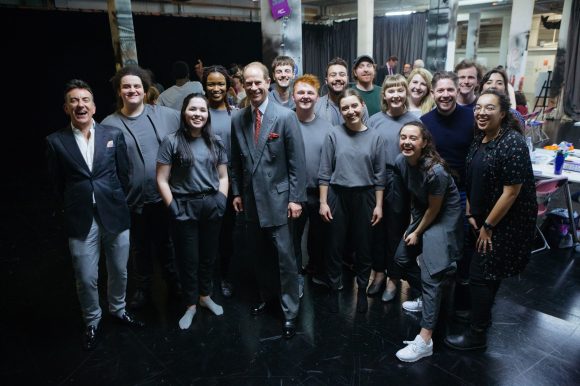
I really look forward to seeing what the National Youth Theatre of Great Britain bring out each year. It is always interesting and thought provoking. They rarely disappoint and this show is no exception. This is a triptych of plays with a common theme, aging and how we treat the aged. All three are written by James Fritz, they have funny and intelligent dialogue. Directed by Matt Harrison, the bed in the centre of the stage is the single focal point, it cleverly has different implications in each scene.

The first is the most conforming of the three, the story of a couple of horny teenagers who use an old man’s flat to have sex while he is away.  Jesse Bateson and Niyi Akin are both excellent, showing off teenage attitudes to old age, with humour and occasional compassion.

The second is also a two hander.  A couple age from teenage to late middle age in the course of twenty minutes, as they cope with looking after their son and an aging parent. Sophie Couch is really good, we are unsure of her actions without ever being unsure of her motives. Troy Richards as her partner does a great job of keeping us guessing as to whether he believes her because he trusts her or because he just chooses to without any real justification.

The third is set in an old peoples’ home, in a future where virtual assistant apps control the looking after and their only company is each other. The only outside human interaction appears to be a liaison officer, played with cool dispassion by Lucy Havard, offering voluntary euthanasia. Jamie Ankrah does a good job of playing the archetypal “Grumpy Old Man”.  Jamie Foulkes evokes compassion for his decision and Madeline Charlemagne is great as an octogenarian with a sense of fun. Josie Charles is fantastic as the last old person left, measuring out her days by turning on her room lights. Joshua Williams is excellent as the Nurse, one of the few people in the cast who gets to play his own age, whose job now is doling out death, but at least trying to do it with compassion.

Every year the NYT of GB do a season of shows in both off West End and West End theatres. This is the first time that they have been at the Southwark Playhouse, it is a venue that will work well for them, in that it is both intimate and adaptable. The plays put on by the National Youth Theatre are always innovative, interesting and entertaining and they are very competitively priced.  The production values are great and you are sure to see some stars of the future, either in acting, direction or choreography.

Categories
Theatre review

The Prudes, Jerwood Theatre Upstairs, Royal Court, Sloane Square, London SW1

prudes-007

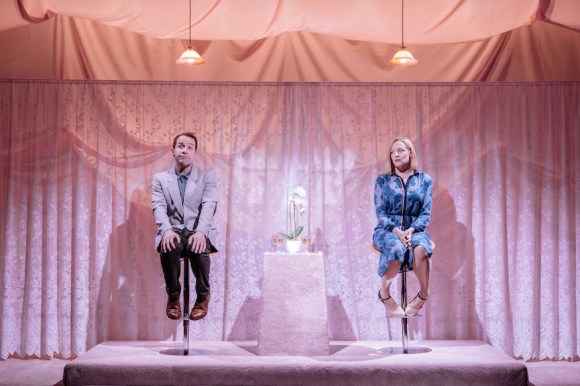
The Jerwood Theatre Upstairs holds less than 100 people and every seat has a good view of the stage. It is a small intimate theatre, although perhaps not intimate enough for the act that Jimmy and Jess assure us that they intend to carry out on stage during the play this evening. The set is pink, soft and fluffy, apart from the “Blind Date” style tall stools. Indeed, if Channel 5 were planning to have a competitive sex therapy show, they could come here for ideas.

The Prudes is a two hander about, Jess and Jimmy, a couple who have been together for nearly 10 years but who have not had sex for over a year. They are worried about the effect that this is having on their relationship and have come to the decision that they only thing they can do prevent their breakup is to have sex in front of us on stage tonight. We are not told how come they have reached this conclusion, but we are here now, let’s run with it.

What follows is a discussion about sexual politics, and how the #metoo movement has changed how we look at sex and power in sex. Jonjo O’Neill and Sophie Russell are excellent as Jimmy and Jess, they interact with the audience, they ask for affirmation of their most embarrassing confessions, they are funny and likeable and we can feel their warmth for each other through their difficulties.

The play is witty, it certainly captures the zeitgeist and it poses many questions that are brought to mind by the sexual harassment cases that have been in the news over the past months. I think we are still too close to the events to have a good perspective on how they will change our attitudes, and writer Anthony Neilson doesn’t even attempt to look for answers. This leads to a play that is enjoyable to watch but lacks a little punch in the consummation.


Categories
Exhibition

Rodin and the Art of Ancient Greece, British Museum, London

Gates of Hell

Rodin and the Art of Ancient Greece is a fantastic exhibition, in terms of both content and context. The Parthenon marbles, which used to be known as the Elgin Marbles, are always in the British museum collection but exhibiting them with the Rodin sculptures, for which they provided inspiration, adds a frame of reference to both.

Elgin Marble 2

We see the timelessness in the Greek pieces where the damage of 2500 years only adds to their beauty.  In Rodin’s sculptures, the incompletion is intentional, but the pieces are no less pleasing because of that.  The show cleverly depicts both sets of pieces as individual parts of a larger work. Elgin removed decorations from the Parthenon in Athens and Rodin’s sculptures are part of his, never fully finished, Gates of Hell. It is very informative to see the representation of the wall near each piece which shows exactly whereabouts in the wall it came from.

Rodin 4


The room is big and impact on entry is impressive. There is a large collection of Rodin’s works here, mostly on loan from Musee Rodin in Paris. We have Athena (Pallas), The Kiss, The Thinker, The Walking Man, The Age of Bronze, even The Burghers of Calais has been brought in from Victoria Tower Gardens. The Parthenon Marbles are interspersed among them and seeing, for example, the two intertwined headless Goddesses in the background of  The Athena with the Parthenon in her hair, adds to the attraction of both.

Rodin 1

The ancient Greeks, Phaedias mostly here, tended to use an idealised form of the body in sculpture and frieze, whereas Rodin veered more toward realism in his, but this show brings attention to the association between the piece of art and its inspiration. This is its real success.

Rodin 3

The British Museum holds one of the greatest art collections in the world, but surprisingly, it does not have any Rodin in its permanent collection, so if you did need an extra excuse to visit, this is it. Also, for the first time, photography was allowed in this exhibition.

Categories
Restaurant review

Langan’s Brasserie, Stratton Street, London W1

Langans

Langan’s Brasserie has been in Stratton Street since 1976. It was a favourite of mine in the 1980s but I think I haven’t been in over 25 years. I am surprised how little has changed in that time and more surprised at how that pleased me, it was like unexpectedly bumping into an old friend in the street.

Langan’s is smart without being pretentious, don’t expect anything big or flashy, but they do what they do very well. It is the perfect restaurant for a special occasion, or if there is a large group meeting for a meal. On arrival, we were shown to a lounge area, to order a drink while we awaited the rest of our party. When everyone had arrived, the Maître D’ showed us to our table while the waiter transferred our drinks.

The décor, if my memory is accurate, is still as it was in the 1980s. This consists of plain cream walls covered in mixed photos, paintings and magazine sketches. One wall has many large windows, making the room bright and airy at lunch or in the early evening. The tables are set with white linen tablecloths, good quality crockery and glassware. The room feels smart when you enter. The menu is a mixture of French and English dishes all well known. The soufflé with anchovy sauce is wonderful and the Caesar salad is excellent. Both of these are quite substantial for starters. The main course portion sizes are big too, there is nothing too unusual on the list but we had five different main dishes at our table and each one was prepared very well.

langans 2

The wine list is extensive, a surprising amount of them are served by the glass. The service was really very good, there are plenty of staff, they seemed unhurried but were always there when we needed them. The actual menu itself is attractive, designed by David Hockney. The restaurant was quite full and, although we ate early, we never felt rushed, or that the table would be needed again at a certain time, I believe that we would been allowed to linger as long as we wished.

Langan’s is not cheap, but it is very centrally located and the food, service and ambience are reliably good. It is the perfect example of a great 1980s London/Paris Brasserie and long may it continue to be so. I hope that I will not have so long between visits in future.

Categories
Attractions

Love London Part 2. Trafalgar Square, George IV, Victorian generals and the Fourth plinth.

DSC_5727

The painting above is of the NE corner of Trafalgar Square and St. Martin-in-the-Fields in 1888.  It hangs in Tate Britain and it is by William Logsdail. In case you missed it, the first part of my paean to Trafalgar Square is here: Love London, Part 1. Trafalgar Square, Nelsons Column and Charles I, London WC2.

2014-11-29 13.12.54

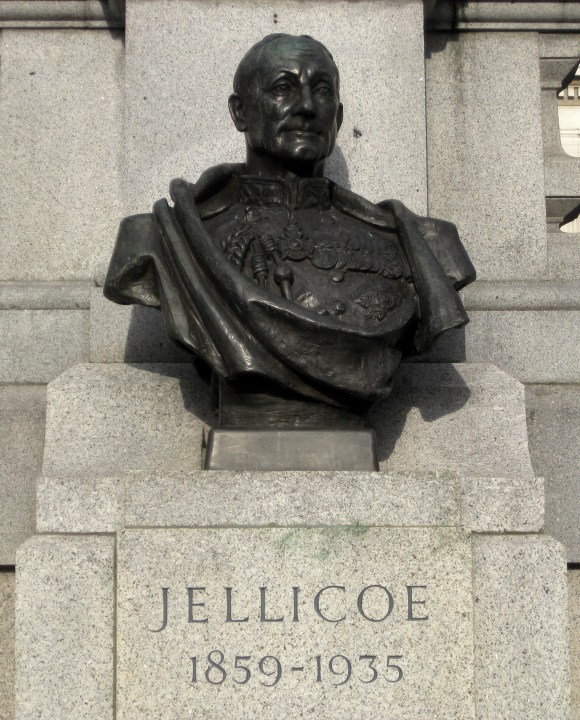
On the lower northern wall of the square are busts of three First Admirals of the fleet; Cunningham,  Jellicoe and Beatty. Admiral Andrew Cunningham was distinguished veteran of WWII and his bust was added after the other two in 1967. Jellicoe and Beatty are Admirals of WWI and their busts were placed in 1948, facing Nelson, “Hero of the fleet”. I hope it is true that they both admired Nelson as much as they are supposed to, because upon their deaths, in late 1935 and early 1936, they were both entombed in St Paul’s Cathedral, also facing his tomb.

standards-of-length-trafalgar-square

Also on the lower northern wall of square is an often overlooked historical treasure “The Trafalgar Square Standards”. They are low down along the steps and in the wall behind the seats. These were the official British Imperial measurements of length until we adopted the metric units of measurement in 1995. These were set into stone, by the Standards Department of The Board of Trade, in 1876 and if you suspected that any measuring implements were incorrect you could bring them here to settle the argument. There are three sets of these official standards, the others are in the Royal Observatory in Greenwich and in the Great Hall of the Guildhall in the city. The official measures included are; the inch, foot, yard, link, chain, perch and pole.

imperial-yard-trafalgar-square

There are four plinths built to contain statues in the square. The two on the south side of the square contain statues of Victorian Major Generals, Napier and Havelock. They both served with distinction in the campaigns in India. The third plinth is occupied by an equestrian statue of George IV. It was commissioned by the King himself and depicts him riding bareback, without stirrups and in ancient Roman dress. He intended it to be placed on the top of the Marble Arch, but it was put here in 1843.

IMG_2012

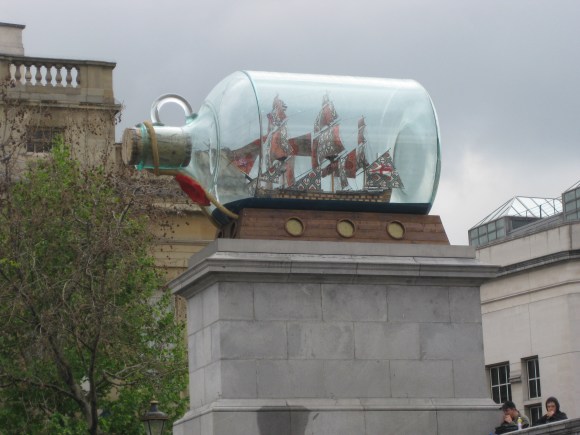
The fourth plinth was intended to hold a statue of William IV. It was empty for over 150 years until 1999 when it was decided to put a succession of works of art on the plinth, each occupying it for a limited amount of time. These art pieces have generated a great deal of debate over that past twenty years and, in that respect, the concept has certainly been a success. All of them have been controversial, most of them have been innovative and some of them have been attractive. Among the more memorable are; Anthony Gormley’s “One & Other” where over the course of 100 days, 2400 different people each spent one hour on top of the plinth, Marc Quinn’s “Alison Lapper Pregnant” and Yinka Shonibare’s “Nelson’s ship in a Bottle”. The current incarnation, Michael Rakowitz’s “The invisible enemy should not exist” is a recreation of a sculpture of a Lamassu (a winged bull and protective deity) that stood at the entrance to Nineveh from 700 B.C. It was destroyed in 2015 and this piece is made completely from empty Iraqi date syrup cans. I find it beautiful.

Lamassu

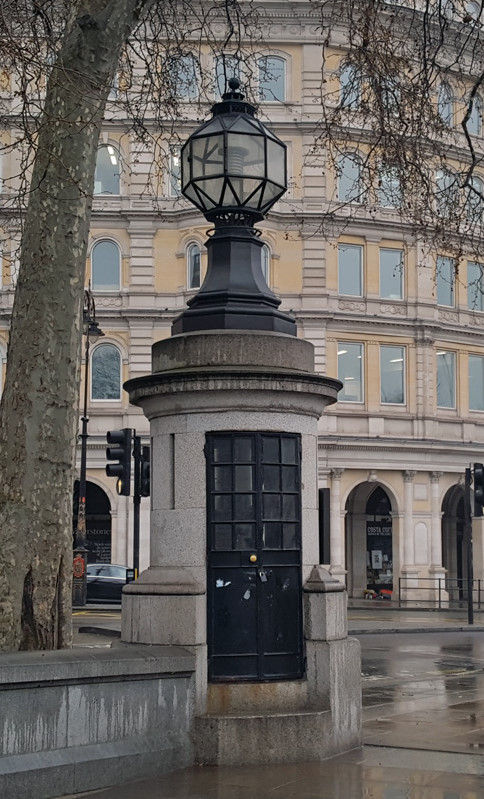
On the South Eastern corner of the Square is a round edifice with a light on top. This is claimed, by some, to be the smallest police station in the world. Put in temporarily in WWI but made permanent during the general strike of 1926, it is a raised room from which a policeman could stand and watch the square in order to phone Scotland Yard, if a demonstration in the square showed signs of becoming dangerous. When the light was changed from gas to electric, the light used to flash when the phone rang, in case the assigned policeman was patrolling the square.

trafalgar-square-police-box

I have a couple of pieces other random trivia about Trafalgar Square. The north side of the square is substantially higher than the south. This slope is not natural, the south end was lowered in order to made the National Gallery building more imposing. The earth was used to level St James’ Park.  Adolf Hitler planned to remove Nelson’s column and statue from Trafalgar Square when Germany conquered Britain. His intention was to place them in Berlin as a victory trophy.


DSC_5034
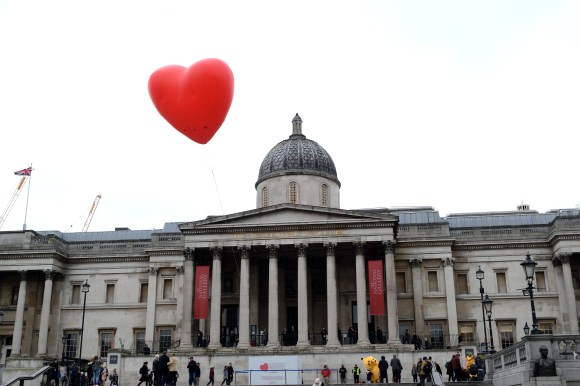
National Gallery from Trafalgar Square


While you visit Trafalgar Square, you should visit St Martin-in-the-fields on the NE corner and the National Gallery. I plan to do separate pieces about these. I will put links here when I have completed them.  Also, on the South side, between Whitehall and The Mall,  there is an unobtrusive hotel called The Trafalgar. This is a smart hotel and if you go to the back you can catch a lift up to a rooftop bar. The cocktails are central London prices, but they are good and the roof terrace has lovely views over the square.


Categories
Attractions

Love London, Part 1. Trafalgar Square, Nelsons Column and Charles I, London WC2


DSC_2999Trafalgar Square is a tourist attraction that is packed with both dramatic architecture and history.  It has a claim to be the centre of London, in both a physical and psychological sense. Other places have claims also; Bank, Buckingham Palace, Piccadilly Circus even Hyde Park Corner, but there are a couple of good arguments in favour of Trafalgar Square.
2014-11-29 13.12.11


It has been  the scene of major British public gatherings and demonstrations from soon after its opening right until the present day. It was the backdrop to the Poll Tax demonstrations in the 1990s, CND rallies in the 1960s and ’70s, Chartist gatherings of the nascent Labour movement in the late 1800s and more recently campaigns against Climate Change and the wars in Afghanistan and Iraq.

overview

Over the Christmas period it holds London’s most famous Christmas tree, a gift from Norway every year since 1947, as a thank you for Britain’s support during WWII. It was also the traditional gathering place for London’s New Year celebrations until the crowds became too big and deemed too dangerous to have at a single venue.

Trafalgar Square was designed in 1826 by architect John Nash, it did not really begin to take shape until the late 1830s when the National Gallery was built in 1838. It is named after the battle of Trafalgar, a famous 1805 victory over Napoleon.

Nelson


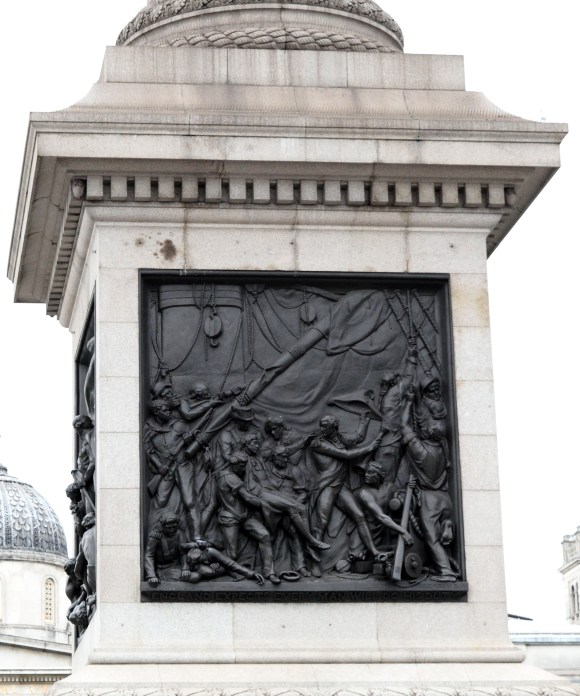
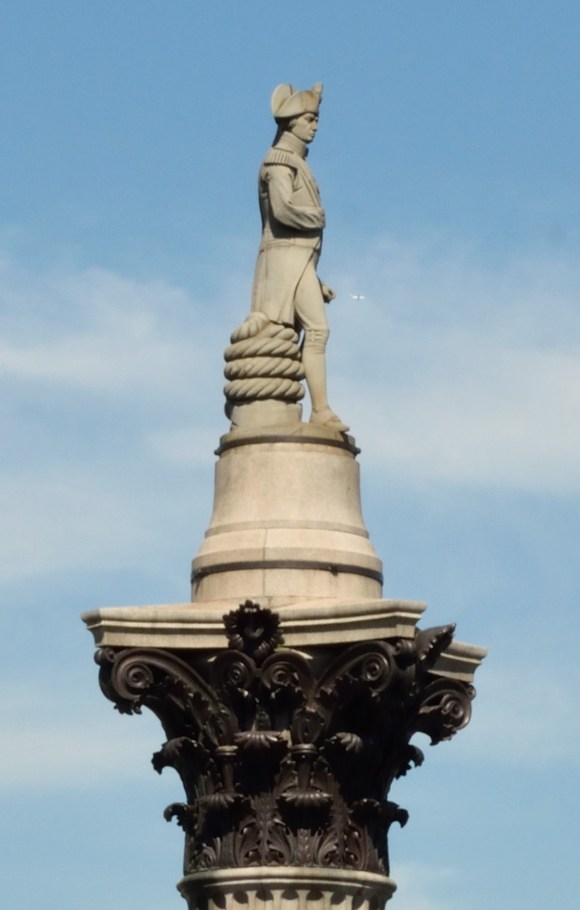
The centrepiece of the square is Nelson’s Column; a monument to the leader in that battle. This was erected in 1843 just before the square became a public area. It is a 43metre high, granite column with a 7metre statue of Horatio Nelson on top. The column itself is a Corinthian column, having an ornamental top. This ornament is made from British cannons.  There are also bas-reliefs on each side of the column at the bottom, depicting earlier famous British war victories and these are made from the melted down remains of weapons captured from the French and Spanish armies. Famously, the stonemasons who built the column are reputed to have had dinner served on its top, before the statue was placed.

DSC_3001

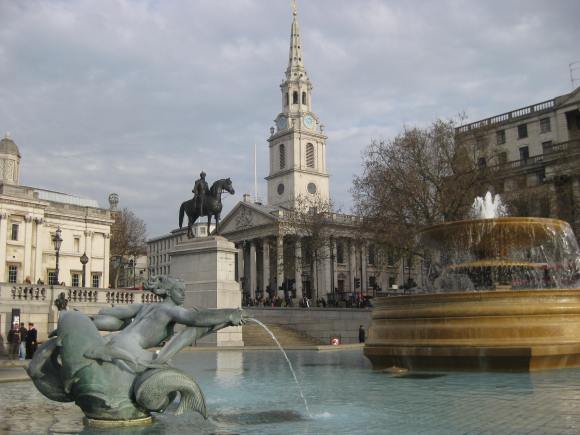
The Lions at each corner of the column were designed by Edwin Landseer and were installed in 1867. They are made of bronze and each one weighs over 6000kg. The fountains at either side of the column, were added later. The current fountains were designed by Edwin Lutyens and added just before the start of WWII. Trafalgar Square as a whole is Grade I listed, which is the highest level of architectural protection in the U.K. awarded only to buildings of exceptional interest.

2014-11-29 13.17.22

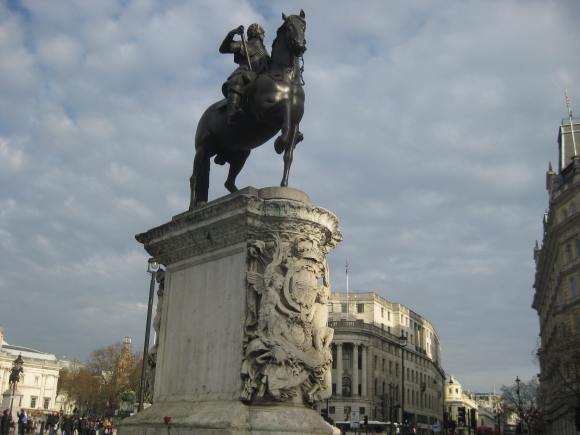
The oldest statue is to the South of the square. It depicts Charles I on a horse. This was made in 1633 and sent to be melted down after the abolition of the monarchy in 1653. The brazier to whom it was given, made his fortune selling trinkets made from the melted down statue, but he had kept it intact to return to the crown on their reinstatement. This is also what Trafalgar Square its claim to be the physical centre of London, as it is to the base of this statue that official distances to London are historically measured.

You may have heard that all the distances to London are measured from Charing Cross. This is true. The Charing Cross was one of 12 crosses placed by Edward I in memory of his wife Eleanor. It was originally in the spot currently occupied by the equestrian statue of Charles I. It was destroyed by order of Parliament after the civil war. A replacement cross was built and placed in front of Charing Cross station during the reign of Victoria. There is an original Eleanor cross still standing, from 1294, in Waltham Cross.

Part 2 of the Trafalgar Square post is here: Love London Part 2. Trafalgar Square, George IV, Victorian generals and the Fourth plinth.