Langan’s Brasserie has been in Stratton Street since 1976. It was a favourite of mine in the 1980s but I think I haven’t been in over 25 years. I am surprised how little has changed in that time and more surprised at how that pleased me, it was like unexpectedly bumping into an old friend in the street.
Langan’s is smart without being pretentious, don’t expect anything big or flashy, but they do what they do very well. It is the perfect restaurant for a special occasion, or if there is a large group meeting for a meal. On arrival, we were shown to a lounge area, to order a drink while we awaited the rest of our party. When everyone had arrived, the Maître D’ showed us to our table while the waiter transferred our drinks.
The décor, if my memory is accurate, is still as it was in the 1980s. This consists of plain cream walls covered in mixed photos, paintings and magazine sketches. One wall has many large windows, making the room bright and airy at lunch or in the early evening. The tables are set with white linen tablecloths, good quality crockery and glassware. The room feels smart when you enter. The menu is a mixture of French and English dishes all well known. The soufflé with anchovy sauce is wonderful and the Caesar salad is excellent. Both of these are quite substantial for starters. The main course portion sizes are big too, there is nothing too unusual on the list but we had five different main dishes at our table and each one was prepared very well.
The wine list is extensive, a surprising amount of them are served by the glass. The service was really very good, there are plenty of staff, they seemed unhurried but were always there when we needed them. The actual menu itself is attractive, designed by David Hockney. The restaurant was quite full and, although we ate early, we never felt rushed, or that the table would be needed again at a certain time, I believe that we would been allowed to linger as long as we wished.
Langan’s is not cheap, but it is very centrally located and the food, service and ambience are reliably good. It is the perfect example of a great 1980s London/Paris Brasserie and long may it continue to be so. I hope that I will not have so long between visits in future.
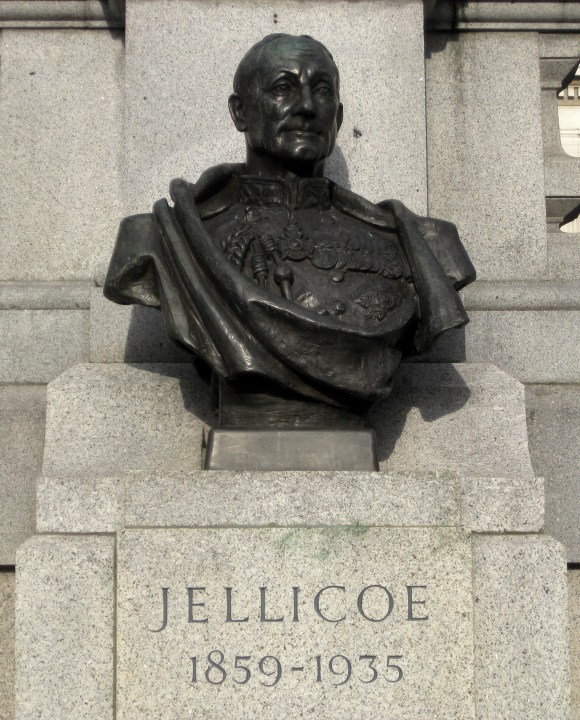
On the lower northern wall of the square are busts of three First Admirals of the fleet; Cunningham, Jellicoe and Beatty. Admiral Andrew Cunningham was distinguished veteran of WWII and his bust was added after the other two in 1967. Jellicoe and Beatty are Admirals of WWI and their busts were placed in 1948, facing Nelson, “Hero of the fleet”. I hope it is true that they both admired Nelson as much as they are supposed to, because upon their deaths, in late 1935 and early 1936, they were both entombed in St Paul’s Cathedral, also facing his tomb.
Also on the lower northern wall of square is an often overlooked historical treasure “The Trafalgar Square Standards”. They are low down along the steps and in the wall behind the seats. These were the official British Imperial measurements of length until we adopted the metric units of measurement in 1995. These were set into stone, by the Standards Department of The Board of Trade, in 1876 and if you suspected that any measuring implements were incorrect you could bring them here to settle the argument. There are three sets of these official standards, the others are in the Royal Observatory in Greenwich and in the Great Hall of the Guildhall in the city. The official measures included are; the inch, foot, yard, link, chain, perch and pole.
There are four plinths built to contain statues in the square. The two on the south side of the square contain statues of Victorian Major Generals, Napier and Havelock. They both served with distinction in the campaigns in India. The third plinth is occupied by an equestrian statue of George IV. It was commissioned by the King himself and depicts him riding bareback, without stirrups and in ancient Roman dress. He intended it to be placed on the top of the Marble Arch, but it was put here in 1843.
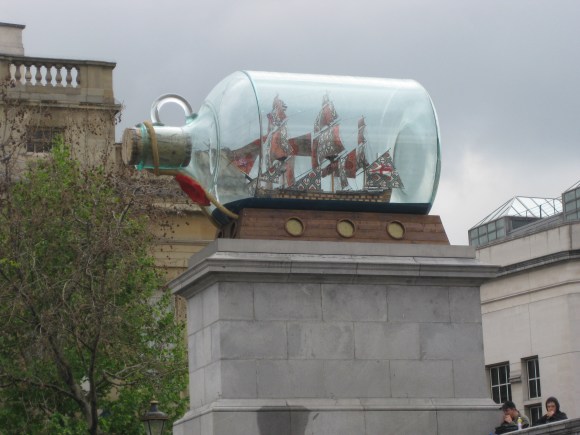
The fourth plinth was intended to hold a statue of William IV. It was empty for over 150 years until 1999 when it was decided to put a succession of works of art on the plinth, each occupying it for a limited amount of time. These art pieces have generated a great deal of debate over that past twenty years and, in that respect, the concept has certainly been a success. All of them have been controversial, most of them have been innovative and some of them have been attractive. Among the more memorable are; Anthony Gormley’s “One & Other” where over the course of 100 days, 2400 different people each spent one hour on top of the plinth, Marc Quinn’s “Alison Lapper Pregnant” and Yinka Shonibare’s “Nelson’s ship in a Bottle”. The current incarnation, Michael Rakowitz’s “The invisible enemy should not exist” is a recreation of a sculpture of a Lamassu (a winged bull and protective deity) that stood at the entrance to Nineveh from 700 B.C. It was destroyed in 2015 and this piece is made completely from empty Iraqi date syrup cans. I find it beautiful.
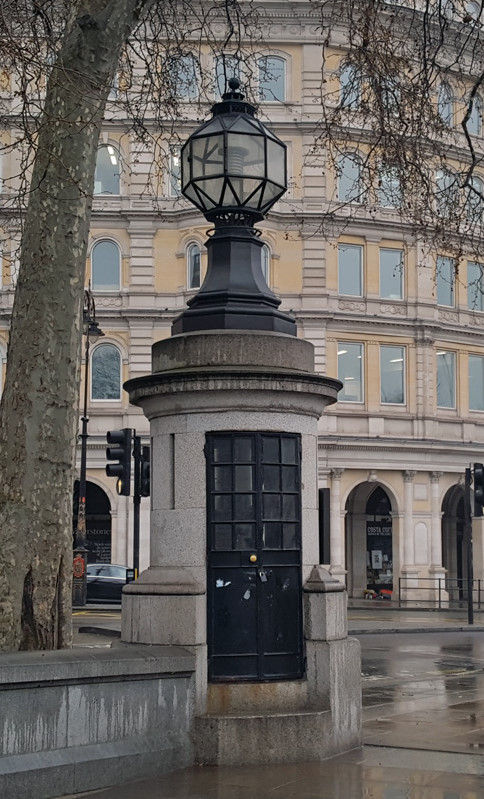
On the South Eastern corner of the Square is a round edifice with a light on top. This is claimed, by some, to be the smallest police station in the world. Put in temporarily in WWI but made permanent during the general strike of 1926, it is a raised room from which a policeman could stand and watch the square in order to phone Scotland Yard, if a demonstration in the square showed signs of becoming dangerous. When the light was changed from gas to electric, the light used to flash when the phone rang, in case the assigned policeman was patrolling the square.
I have a couple of pieces other random trivia about Trafalgar Square. The north side of the square is substantially higher than the south. This slope is not natural, the south end was lowered in order to made the National Gallery building more imposing. The earth was used to level St James’ Park. Adolf Hitler planned to remove Nelson’s column and statue from Trafalgar Square when Germany conquered Britain. His intention was to place them in Berlin as a victory trophy.
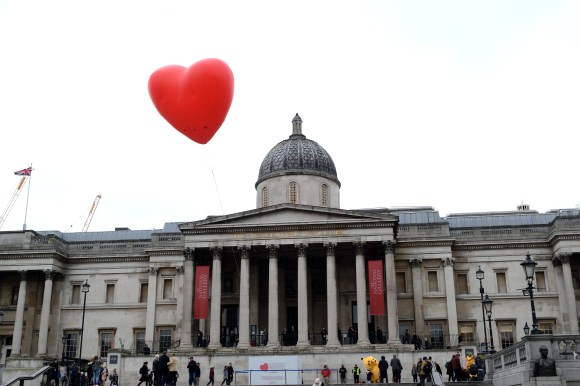
National Gallery from Trafalgar Square
While you visit Trafalgar Square, you should visit St Martin-in-the-fields on the NE corner and the National Gallery. I plan to do separate pieces about these. I will put links here when I have completed them. Also, on the South side, between Whitehall and The Mall, there is an unobtrusive hotel called The Trafalgar. This is a smart hotel and if you go to the back you can catch a lift up to a rooftop bar. The cocktails are central London prices, but they are good and the roof terrace has lovely views over the square.
Trafalgar Square is a tourist attraction that is packed with both dramatic architecture and history. It has a claim to be the centre of London, in both a physical and psychological sense. Other places have claims also; Bank, Buckingham Palace, Piccadilly Circus even Hyde Park Corner, but there are a couple of good arguments in favour of Trafalgar Square.
It has been the scene of major British public gatherings and demonstrations from soon after its opening right until the present day. It was the backdrop to the Poll Tax demonstrations in the 1990s, CND rallies in the 1960s and ’70s, Chartist gatherings of the nascent Labour movement in the late 1800s and more recently campaigns against Climate Change and the wars in Afghanistan and Iraq.
Over the Christmas period it holds London’s most famous Christmas tree, a gift from Norway every year since 1947, as a thank you for Britain’s support during WWII. It was also the traditional gathering place for London’s New Year celebrations until the crowds became too big and deemed too dangerous to have at a single venue.
Trafalgar Square was designed in 1826 by architect John Nash, it did not really begin to take shape until the late 1830s when the National Gallery was built in 1838. It is named after the battle of Trafalgar, a famous 1805 victory over Napoleon.
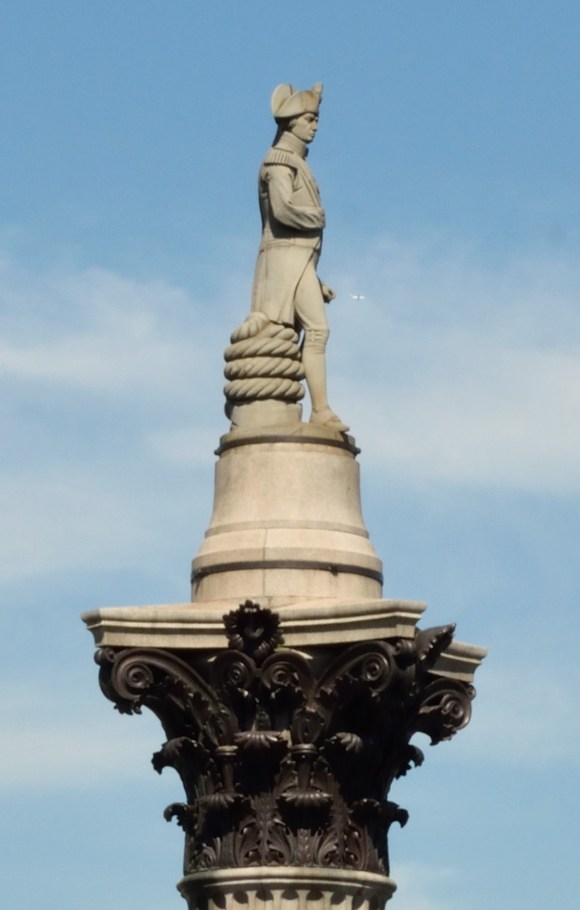
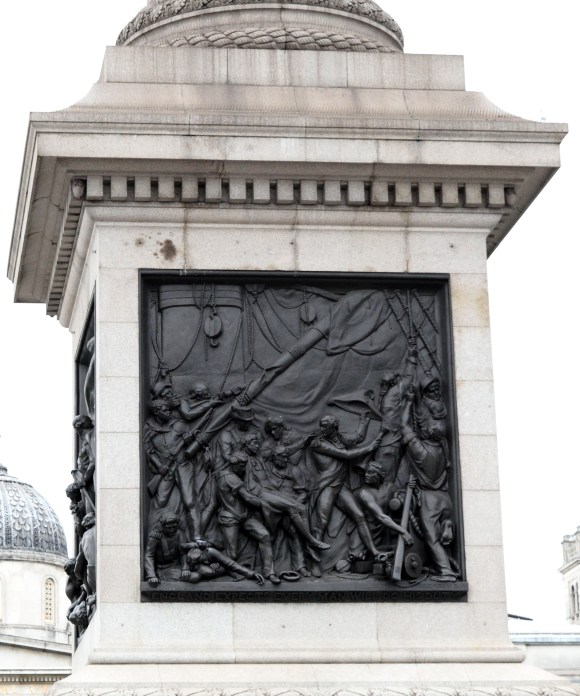
The centrepiece of the square is Nelson’s Column; a monument to the leader in that battle. This was erected in 1843 just before the square became a public area. It is a 43metre high, granite column with a 7metre statue of Horatio Nelson on top. The column itself is a Corinthian column, having an ornamental top. This ornament is made from British cannons. There are also bas-reliefs on each side of the column at the bottom, depicting earlier famous British war victories and these are made from the melted down remains of weapons captured from the French and Spanish armies. Famously, the stonemasons who built the column are reputed to have had dinner served on its top, before the statue was placed.
The Lions at each corner of the column were designed by Edwin Landseer and were installed in 1867. They are made of bronze and each one weighs over 6000kg. The fountains at either side of the column, were added later. The current fountains were designed by Edwin Lutyens and added just before the start of WWII. Trafalgar Square as a whole is Grade I listed, which is the highest level of architectural protection in the U.K. awarded only to buildings of exceptional interest.
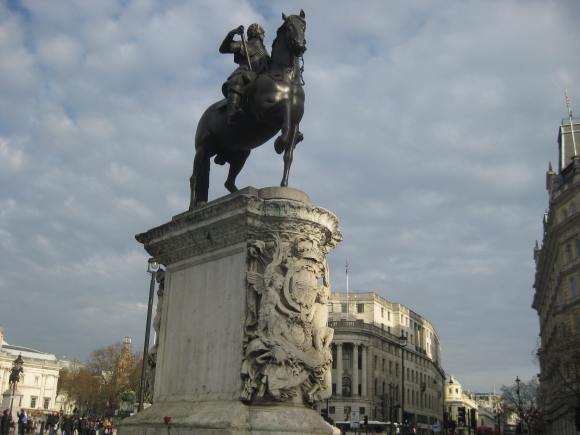
The oldest statue is to the South of the square. It depicts Charles I on a horse. This was made in 1633 and sent to be melted down after the abolition of the monarchy in 1653. The brazier to whom it was given, made his fortune selling trinkets made from the melted down statue, but he had kept it intact to return to the crown on their reinstatement. This is also what Trafalgar Square its claim to be the physical centre of London, as it is to the base of this statue that official distances to London are historically measured.
You may have heard that all the distances to London are measured from Charing Cross. This is true. The Charing Cross was one of 12 crosses placed by Edward I in memory of his wife Eleanor. It was originally in the spot currently occupied by the equestrian statue of Charles I. It was destroyed by order of Parliament after the civil war. A replacement cross was built and placed in front of Charing Cross station during the reign of Victoria. There is an original Eleanor cross still standing, from 1294, in Waltham Cross.
Fanny and Alexander is a play to luxuriate in. Sit back, relax – and let three and a half hours of rich storyline, beautifully performed, draw you away into another world. Don’t feel guilty about it, for – as the moral of this tale has it – it is good for the soul to give in to pure pleasure occasionally.
The acting in this show is a wonder to behold, it is full of larger than life characters, but there is never a hint of pantomime or showboating. The play (and the audience too, on the day I attended) is crammed with the best actors that London has to offer. Penelope Wilton is amazing as the matriarch with a past, holding the family together. Jonathan Slinger is excellent as a slightly sleazy but unapologetic sybarite. Kevin Doyle brings out the best (and worst) in the ascetic bishop. Michael Pennington is fabulous as Isaac, the puppet master bringing the action together, seemingly from the periphery, but not as detached as he appears. Guillermo Bedward played Alexander in the show I watched and he was very good, both funny and serious.
Much of this play is set around various dinner tables, often accompanied by a list of the food on the menu. Fanny and Alexander itself is a feast of all the best that London theatre has to offer. You will be transported, indulged and you can wallow in an evening of rich extravagant entertainment. The set is simple but clear, I really liked the austerity of the room in the second act. The choreography is clever, just organising the many scene changes with such a large cast must have taken careful organising. It was a pleasure to watch great theatre unfold before your very eyes. I loved this show and the time flew, it was one of the most rewarding afternoons that I have ever wasted!
Out of the System, part of a three year project from London’s Dance Umbrella Festival, is curated by Freddie Opoku-Addaie and runs at Rich Mix 16-17 October.
Made up of three very different dance pieces, there is something here for all tastes. The first piece “Clay” is a flamenco based collaboration between two dancers and a guitarist, the dancing is fantastic, filled with action and humour. I loved the way the two dancers played off each other and the way they slowly drew the guitarist in.
The second is a more interpretive piece, evocative, using symbolist props and occasional filmed backdrop. I have to admit that some of the symbolism went over my head, but the dancing is eloquent and emotional.
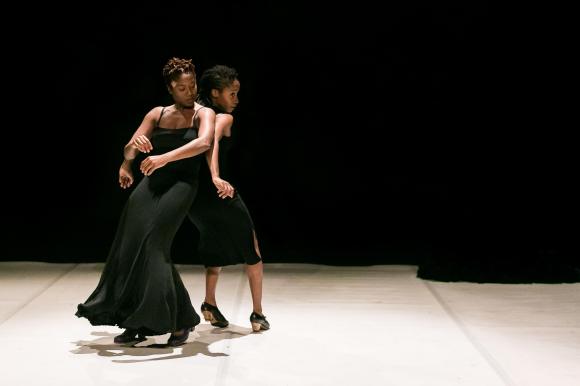
The third “Ven” is a double hander, with two harmonious dancers intertwining to dance almost as one person, clever and moving. The trust that the couple show in each other is beautiful, a truly symbiotic relationship.
The evening is finished off with a live band, The Afrobeat rhythms of Yaaba Funk had the whole audience dancing. All in all we had a very interesting evening in a great venue. The London Dance Umbrella Festival is running at different venues until the 28th of October and with the standard this high, I am looking forward to the other nights I have booked.
The Wallace Collection is a must see museum/gallery if you come to London. The items on show were bequeathed to the nation in the late 19th Century and have been on display here since 1900.
Van Dyck, The Shepherd Paris
The number and quality of the Old Masters from the 15th to the 19th century is amazing. It has some of the finest examples of 18th century French furniture in existence. There is also a rich assemblage of porcelain, sculpture and royal amour in the collection. One of the more unusual pieces is a particularly ornate cannon.
Many of the pieces were bought during the sales of art following the French revolution, which is why the collection is so strong in 18th Century French art. Such good examples of the Louis XV cabinets and marquetry cannot be seen anywhere else in the world.
A condition of the bequest was that none of the pieces ever left the collection, even to go out on loan. So if you ever wish to see, say, “The Laughing Cavalier” or Canaletto’s “View of the Grand Canal” you have to come here.
Canaletto, The Grand Canal
It is astounding to discover that it is free to visit this collection, although they do ask for a donation. It is also surprisingly quiet, compared to the other, bigger museums and galleries in London. This is presumably because it is not in the main exhibition area of town, although you could argue that, situated between Oxford Street, Baker Street and close to Selfridges, it is even more central than those in South Kensington.
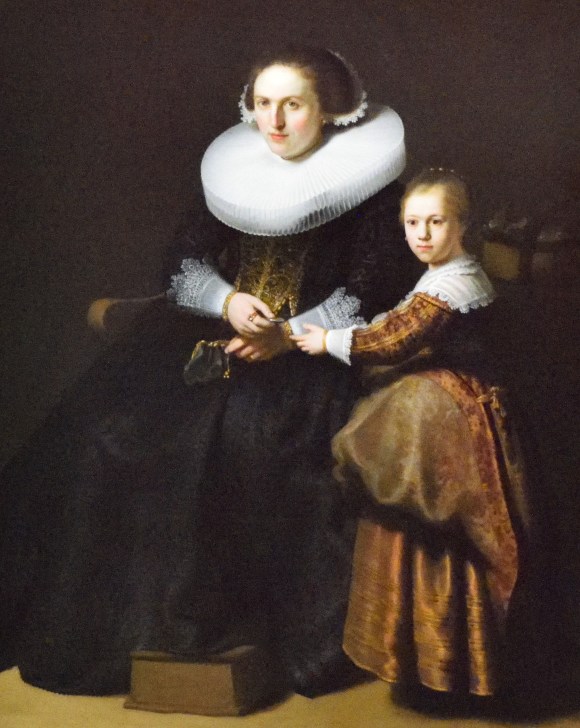
Rembrandt, Susanna Van Collen and her daughter Anna
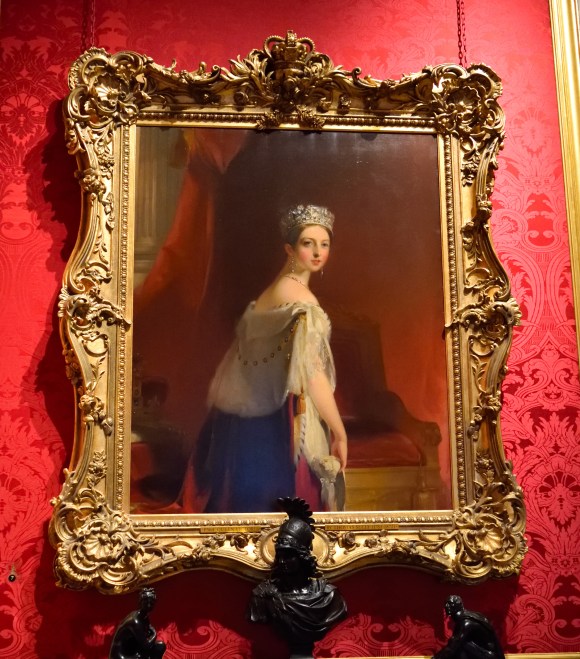
Notable among the Old Masters in the collection are 5 Rembrandt, 4 J. W. Turner, 8 Canaletto, 2 Titian, 12 Reynold, 5 Cuyp, 2 Gainsborough….. the list goes on, it is an amazingly rich and full list. There is even a wonderful portrait of Queen Victoria from 1837, when she was newly ascended to the throne.
The Wallace Collection should not be missed when visiting London. Bring your friends when you visit, and you will surprise them with both the quantity and the quality of the art here. Given how quiet it tends to be, even in the summer, I am going to count this as a hidden gem, and I recommend it heartily.
From the second the opening whistle sounds and the cast of 50 begin their football chants, the audience is dragged in – to a world of youth tribalism, disaffection and tough choices. Wilton’s Music Hall is the perfect size for this play, large enough that the cast doesn’t outnumber the audience, small enough that the cacophony of sound envelops you to feel part of the crowd.
Zigger Zagger is a late 20th century parable, ostensibly about football hooliganism but also about loyalty and fitting in. The protagonist, Harry Philton, excellently played by Josh Barrow, is a school leaver searching for belonging and is drawn to the local football terraces. He is aware of its limitations as a life choice so investigates the alternatives.
Among these are: Police, Army, Religion, Apprenticeship and, settling down. These options are caricatured, often in musical or poetic form. Adam Smart is particularly funny as the Youth Careers Officer. In between each option we are brought back to the terraces for a song and each time we feel the allure of being part of the crowd.
The soundtrack is great, T.Rex, Mud, Bay City Rollers even the Sex Pistols. The crowd songs are classical and traditional, with some chanting thrown in for good measure. Zigger Zagger is a boisterous and entertaining evening, with some great performances, and an interesting reminder of a specific moment in this country’s development.
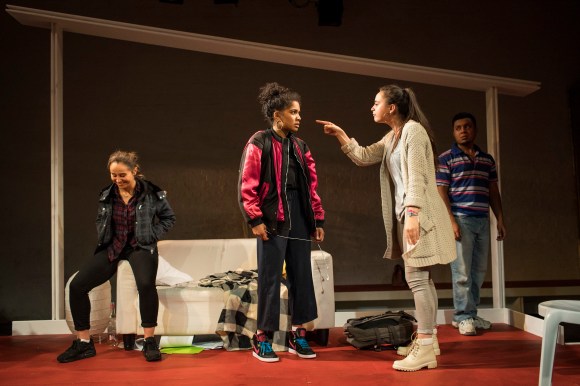
“The Host” is an up to the minute play, set in a council block in Croydon. Nominally about refugees and our response to them, it is also about the meaning of family, and about cultural identity.
It is a well written play with colourful, but current, language. It is excellently performed by the 5 member cast. Rebekah Murrell and Zakary Douglas-Zerouali have a great chemistry as the two leads Yasmin and Rabea. Rebekah plays Yasmin with a nervous intensity, full of (mostly) repressed anger. This is balanced well with Rabea’s more resigned accepting nature.
Nessah Muthy, the playwright, is on this year’s BBC new talent hotlist. On this form, you can see why, although some of the issues felt unresolved, and the finale felt a little like the end of the first act, the script is good and she has a great ear for the rhythms of conversation.
The set and direction are good, the messy, claustrophobic flat is simply set up and, having the offstage cast on view at the back made us feel that we were never far from our neighbours.
This is the final play in the National Youth Theatre of Great Britain’s enjoyable East End Season at the Yard Theatre. I hope they repeat the idea next year. However, they are doing a revival of “Zigger, Zagger”, the play about football hooliganism at the Wilton’s Music Hall early next month. I am looking forward to seeing it!
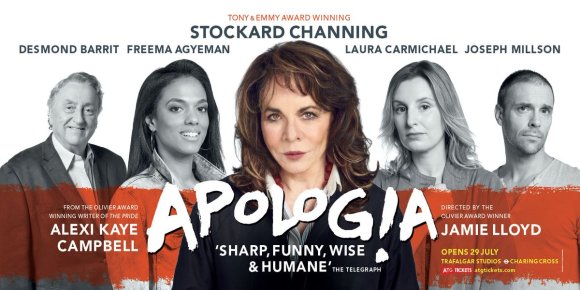
I went to the first night of the previews. I really enjoyed it. The action takes place over an evening birthday party and the morning after. It was a little slow to get started but after that, the first act is good; the script is funny, arch and sharp. It appears to be a play about nostalgia for the idealism of the 1960s and children with abandonment issues. However, the second act is transformative, I love how it turns your perspective on its head, we get to know the characters better and see their motivation differently. The play is really about women’s place in society, whether this has changed over the past 50 years and about the price people are willing to pay for attempting to bring about change.
The direction is simple, Jamie Lloyd lets the words speak for themselves. The set is clever, the stage is framed like a picture or perhaps the old photograph given as a birthday gift. The whole cast is good, but this play is really about the women, Laura Carmichael and Freema Agyeman are both outstanding and Stockard Channing is amazing.
The writing is great and I will be looking out for other plays by Alexi Kaye Campbell. I guess there will be a few tweaks before the general opening, but it got a full standing ovation on the night I went. I hope the critics like it as much as I did and that Apologia is a huge success.
The setting is idyllic. Even for hip and trendy Hoxton, this place has style. Ezra street is a small cobbled lane off Columbia Road. The restaurant itself is set in a Victorian terrace, it appears to have been converted from a shop or a terraced house. You will need to have your wits about you when looking for it, as the shop says S. Jones over the door and the name, Campania, is just written on the window.
The interior is decorated in washed plain wood, the crockery is old fashioned but pretty. It is mismatched, like the tables and chairs. It has a 1940s or 50s feel inside. The yard of the house has been covered over and holds a large benched table that seats about ten, this would be a good place to bring a big group. There are also seats outside on the street.
We found the service to be very good, our waitress explained the menu beautifully. The menu is short, but everything does feel home made. Our shared platter to start was lovely, it contained something for everyone. The pasta was made on the premises and it was nice, the risotto was good too. This being in the more fashionable part of town, the prices are at the top end of the price spectrum, without being excessive. The house rose wine, was not cheap, but it was delicious.
It was very busy, Luckily we had booked, as it is quite small, maybe 36 covers, and they appeared to be turning people away all evening. If you are planning to go for lunch or brunch, after visiting the flower market, on a Sunday, you will certainly need to reserve your table. The passageway down the side of the restaurant is pretty, with an old fashioned wooden sash window and a Victorian looking street lamp in a narrow, brick lined, cobbled street. It is very photogenic. If you are going out with visitors to London, this would be a charming, quirky place to take them.
We enjoyed our evening and would definitely return.





 Trafalgar Square is a tourist attraction that is packed with both dramatic architecture and history. It has a claim to be the centre of London, in both a physical and psychological sense. Other places have claims also; Bank, Buckingham Palace, Piccadilly Circus even Hyde Park Corner, but there are a couple of good arguments in favour of Trafalgar Square.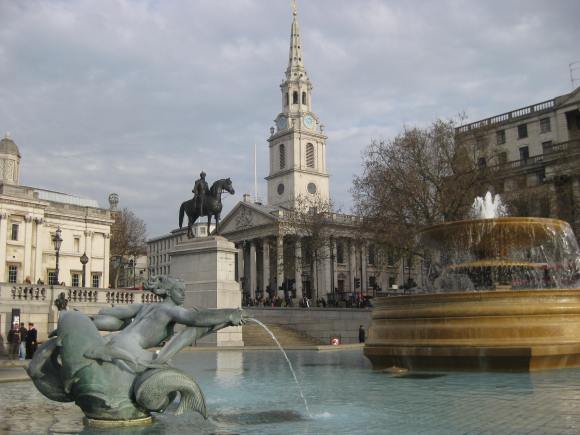







 The London Lark