Categories
Theatre review

Stories, National Theatre, South Bank London SE1

Stories

About a year ago. I saw Nina Raine’s last play, Consent, also at the Dorfman Theatre here at the National.  It was the strength of the writing in that production that drew me to see Stories. This is a play about Anna, a woman approaching 40, who is desperate to have a baby. She does not have a partner and she is investigating the options available to her as a would be single mother.

The Dorfman theatre is an intimate venue when laid out in the round, suited to the living room settings of this play. The show consists of multiple short scenes and the automated set changes where the sections of the floor rise to make a table or slide in to form a bed are very cleverly done. They contribute well to the maintaining the pace of the drama, through the constant scene changes. The clean IKEA lines also felt nicely contemporary.

Anna is played by Claudie Blakely with a controlled desperation, knowing that if she shows it too much, that she will frighten baby fathers off. Sam Troughton plays all the prospective sperm donors and he is almost too good at this, in that his changing performances are very funny and at times this becomes the focus of the play,  distracting your attention from the main storyline. Anna is the only person in the entire play that is one person playing one part and this diminishes the clarity of the piece somewhat.

Brian Vernel is excellent as Anna’s younger brother and Stephen Boxer is fantastic as her Dad. They have great lines and the spiky but caring relationship the three of them have is beautifully conveyed. The rest of the characters are less fully rounded and although they have some very funny lines, they are sometimes two dimensional ciphers. I found this particularly true of Natasha and Girl. I did realise, eventually, that they are meant to represent Anna’s inner child and inner parent, but I am not sure what they added to the story.

I think there might be brilliant play in here, but the story is not presented clearly enough to follow easily. Nina Raine is a fantastic author, there are probably few writers who can capture current bar and dinner table conversations as well or as wittily. This is not the ground breaking piece that she will one day write, but I enjoyed it well enough and I will continue to look out for shows that she writes in the future.

 

Categories
Theatre review

Pinter 3, Pinter at the Pinter Season, Pinter Theatre, London WC1

pinter-three-ot

Pinter at the Pinter is a season of all of Harold Pinter’s one act plays in 7 different programmes over a period of 6 months. Previously on this blog: Pinter 1, Pinter 2 and Pinter 4

The most well known pieces in this collection are “Landscape” and “A kind of Alaska”. These are the opening and closing items and they take up the greater part of the show. They are both interesting and have excellent performances from Tamsin Greig and Keith Allen. Tamsin Greig is spellbinding as a woman attempting to come to terms with the fact that she went to sleep at 16 years of age and only awakened 29 years later.

There are 9 other vignettes in the evening and although a couple might not do any favours to Pinter’s reputation, Jamie Lloyd has unearthed some absolute gems from among his lesser known pieces. Closing the fist half, Lee Evans does a piece called “Monologue” where he effectively has a conversation with an empty chair. This is funny and poignant, and Lee Evans’ uniquely physical delivery brings extra empathy to the character.

“Night” is very unusual amongst the Pinter work in that it is resolutely positive in tone. Meera Syal and Tom Edden make the most of the upbeat lines and portray a couple who patently care for each other, even at those times when their memories differ. This is a short sketch, perhaps only five minutes long, but it is sublime to see Pinter’s words made sweet.  “Trouble in the Works” is another short sketch, absurd abstract comedy, well done and very funny. It is like Monty Python in style but it was written in 1959, so it predates them by a whole decade.

Lee-Evans-and-Tom-Edden-in-Pinter-Three.-Photo-credit-Marc-Brenner.Pinter-Three-PROD-DRESS-1096

Great care has been taken in the direction of this presentation to make all the individual pieces link together, and the show certainly does not feel like it is made up of 11 discrete items. This is helped by the ingenious set design which is a slowly spinning living room, highlighting a different area each time it turns. Even though many of the sketches only have one or two of the actors actively involved, Jamie Lloyd has cleverly joined them up so the whole has the feel of a single ensemble piece. This is most apparent in the sketch “God’s District” which is a solo comedy item, delivered by Meera Syal, but by the end it has all 5 of the actors playing instruments or singing along.

Overall, the quality of the writing is very high and the acting is a joy to watch. A couple of the pieces have not aged well, perhaps we are more sensitive to hints of sexism now than we were when it was written. This is Pinter though, so it is hard to say for certain, and they could be seen as his comment on the times in which he lived. Having said that, this compilation is positively uplifting compared to some of his darker anthologies. After watching Pinter’s 1 and 4, I had begun to wonder whether I had the fortitude to watch the rest of the season, but now that I have seen this, I am looking forward to 5, 6. and 7 with a spring in my step.

Categories
Theatre review

Pinter 4, Pinter at the Pinter Season, Pinter Theatre, London WC1


Pinter 4

Pinter at the Pinter is a season of all of Harold Pinter’s one act plays in 7 different programmes over a period of 6 months. Previously on this blog: Pinter 1 and Pinter 2

Pinter 4 consists of 2 plays.  Moonlight which was first presented on stage in 1993. Night School was originally a a TV play from 1960 with Milo O’Shea as Walter. The programme notes date it as 1979, perhaps they are referring to the first live performance.

Moonlight is a kind of abstract drama. It has some funny lines and some, quite dark, humour but I would hesitate to call it a comedy. It is about a man on his deathbed waiting for his sons to visit him. In his lucid moments he is reminiscing with his wife. In his more clouded times he imagines his sons to be there, but their conversation is intermingled with discussions about him, his memories from work and sometimes their sister is there, perhaps calling him over. I guess the moonlight is the, not quite dark not quite light, gap between life and death. This is the classic oblique writing for which Pinter is notorious. Atmospheric words with ethereal meaning.

The acting is phenomenal. Robert Glenister and Brid Brennan are brilliant as the truculent husband and wife, the definition of tough love. The direction is restrained, Lyndsey Turner keeps it unobtrusive and allows the words to do all the work. The set is low-key too, an old mans bedroom in muted tones. If you want to see Pinter at his most “Pinteresque” then this is probably the one.

Night School is a comedy. First shown in 1960 it feels its age. It is funny and the use of language is clever and witty. It was probably a little bit shocking and regarded as slightly off colour when it was first shown, but that frisson has gone now. Wally returns from prison to find that his aunts have rented out his room while he was away. The new tenant is a pretty young night school teacher…..

The sets for this play are representational, a tea trolley depicts the living room, a chair and door make up the bedroom and shiny curtains portray the nightclub. This play is directed by Ed Stambollouian, with a drummer and drumkit on stage throughout, playing drumrolls at dramatic moments. I’m interested to know whether this is specified by Pinter in the staging notes, I have looked online but can’t find any reference to it. It made the play slightly reminiscent of, John Osborne’s, The Entertainer from 1957.

The acting is the best thing about Night School. The Aunts, Annie and Milly are very funny. Janie Dee is as different as it is possible to be from her role as Phyllis in Follies, but still brilliant as she always is. Al Weaver is obviously the man of the moment, he is on TV in Press on the BBC and in the cinema in Peterloo. Here he is excellent as the funny, but menacing, petty crook Walter. He might not be classroom clever, but he is nobody’s fool.

For me, Moonlight stands up the better of the two plays, although the Aunts in Night School are the funniest characters. It is worth going to see for the acting but,this is really a combination for the Pinter completists.

Categories
Theatre review

Romeo & Juliet, RSC Barbican Season, Barbican, London EC2

RSC_FEB18_BarbicanSeason_R_J_1900x584

Romeo and Juliet was written roughly 420 years ago, but this production makes it feel as though it was taken from stories that we see on the news today. Director Erica Whyman has made bold decisions and taken calculated risks in order to emphasise the similarities and the differences in society in the intervening time.

This is a Romeo and Juliet that deals with gang culture and knife crime. Romeo, Juliet and their friends are young teens dealing with self image, perception and how they wish to be seen. This production highlights how young they are, Shakespeare wrote Juliet as a fourteen year old and I have never before seen a version where I was so aware of their youth and inexperience. Romeo, Mercutio and Benvolio are schoolkids trying to look hard in a world where they and all their peers carry knives.

Karen Fishwick is convincing as Juliet – a feisty teenager, used to getting her own way and not above a fit of defiance when she does not. She is surprised by her depth of feeling for Romeo but trusts it completely. Bally Gill is excellent as a contemporary Romeo. At the start he is mooning over his unrequited love for Rosalind but within a day he is head over heels in love with Juliet, the most beautiful girl he has ever seen. He squeezes comedy out of dramatic text. They make a credible young couple, each feeding off the others love.

The director has made a couple of other interesting decisions too. She has changed the gender of Escalus and Mercutio. Both bring something new to the text, The Prince of Verona being a woman brings new light to the speeches about the posturing of men in order to appear powerful. Mercutio’s change is double edged, she is more aggressive because she has to prove herself in a man’s arena, thereby verifying the effect of the sexism she is trying to dispel. Josh Finan is fantastic as Benvolio, he plays him with a schoolboy crush on Romeo, a contemporary twist that fits the text surprisingly well.

The set is bare except for a metal cube. A very abstract idea, but quite practical. It works as a room, the balcony, a dais for the bed, a wall to hide behind….  Personally, I would have preferred a more specific setting, but it is clever and inventive, and it is always interesting to see new thought provoking designs.

Do not go to see this if you want a historic, late 16th Century, costume drama performed as it would have been when it was written.  Do go if you want to see why this play has endured and why a story written so long ago still has relevance to our society today. I know that this production will not be universally loved but I really enjoyed it. It brings new life to one of Shakespeare’s most well known plays.


Categories
Theatre review

Victoria’s Knickers, Soho Theatre, Dean Street, London W1.

Victorias-Knickers-presented-by-the-2018-NYT-REP-Company-at-Soho-Theatre

I love when the National Youth Theatre Rep Company’s West End season comes around. This year their shows are on at the Soho Theatre throughout November. Victoria’s Knickers is the second production of the season. Consensual began a week ago and you can still catch a performance of that if you are quick, I saw it last week and you can read what I thought of it here: Consensual.

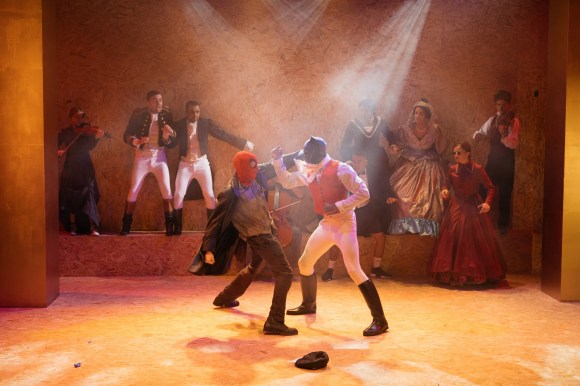
One of the things I really enjoy about the National Youth Theatre shows is that you often have absolutely no idea what kind of thing you are going to see until the curtain goes up. This particular show is a historical romp set in the early nineteenth century delivered in modern language with musical interludes and current world references. It is, very loosely, based on a real historical incident when a teenage boy repeatedly broke into Buckingham Palace. He was feted by the papers at the time, he was interviewed by Charles Dickens and it was even reported that on one occasion he was caught with a pair of Victoria’s Knickers.

NYT-REP-Company-in-NYTs-Victorias-Knickers-at-the-Soho-Theatre.-Credit-Helen-Murray

The story is delivered in a musical madcap romcom style, with a touch of 18th century political drama. The genre of the play changes from minute to minute and the musical styles vary from hip-hop, through Disney to Ed Sheeran and Adele. The plot line is full of holes, the story is ridiculous, the set is practically non-existent and it all adds up to a fantastic evenings entertainment, that the audience loved.

This show could not work without brilliant writing and direction. Josh Azouz on this showing is a very talented writer with a sharp eye for inventive situational comedy.  There are some great individual one line jokes in the script too. When Victoria tells Ed that she loves Albert, he replies conversationally “Of course you do, he’s your cousin”. Director, Ned Bennett does a brilliant job in drawing attention to the preposterous, and finding the humour in the clashes of cultures between all the different genres of theatre on show in this production. The set consists of unadorned MDF at the back, what looks like brown paper at the sides, and dozens of old random cardboard boxes that arrive on stage for most of the second half of the play.

NYT-REP-Company-in-NYTs-Victorias-Knickers-at-the-Soho-Theatre.-Credit-Helen-Murray-4

Alice Vilanculo is amazing as the soon to be Queen Victoria with a very 21st century sensibility, she makes you care for her situation while still having you laugh at it. Jamie Ankrah is excellent as Ed, 19th Century pauper, dreamer…. teenage lover. Aiden Chang has a fantastic role as Sasha, a soldier/torturer disguised as a lady of the court, he attacks the part with gusto and steals almost every scene in which he appears. Oseloka Obi is great as the rapping prince Albert, the acting throughout the company is brilliant and the show is littered with great cameos.

Victoria’s Knickers is difficult to describe and there are so many levels on which it should not work. However it is funny, inventive, musically clever and likeable. This is another success for the National Youth Theatre of Great Britain and for a writer and actors with big careers ahead of them.

Categories
Theatre review

Dein Perry’s Tap Dogs, The Peacock Theatre, London WC2


Tapdogs2.png

Dein Perry’s Tap Dogs was first performed twenty three years ago in Sydney and has been constantly touring the world since then. The reason for its success is that, in the words of a DIY product advertisement, “it does what it says on the tin”. The workman analogy is apt here. The dancers in this show are at pains to demonstrate that they are workmen, in work clothes and work boots, tap dancing on various parts of a construction site. They are rugged, rough and laddish as well as very talented tap dancers.

This show has much in common with a rock concert and that is only partly because of how loud it is. Most of the show they operate as a group but each routine has the opportunity for one of them to show off their skills in a solo performance. It has the energy and individual showmanship of a rock show.

The set is a construction site, with ladders and scaffolding, that they build and dismantle as they work through their routines. The show is high energy throughout, there is hardly a moment in the hour and a half when there is not at least one of them dancing at full tilt. They manage to keep the routines different and interesting with humour, competition and clever props. Torches, blowtorches, basketballs and water trays are all used to great effect and I would be surprised if the front rows don’t leave a lot damper than when they arrived.

There are two drummers who perform for part of the show but mostly the percussion is provided by the tap dancing. A particularly clever routine is one where they dance on drum machines, with each making a different percussive resonance. The dancers are all very talented and all of the routines are either very fast or technically difficult. Both their skill and their stamina is admirable, they do not let up for a minute during the entire show.

You won’t be surprised to hear that this show is loud. I think it is the loudest performance that I have ever seen – and I saw Status Quo and Simple Minds in the 1980s. If you like tap dancing, you will be hard pushed to find a show with a better demonstration of the skill. Dein Perry’s Tap Dogs has a winning formula and I would not be surprised to see it still touring in another twenty three years.


Categories
Theatre review

Consensual, Soho Theatre, Dean Street, London W1

NYT-REP2-Company-in-Consensual-at-the-Soho-Theatre.-Credit-Helen-Murray-4


Consensual is the latest production from the National Youth Theatre of Great Britain. Set in an urban modern school, it deals with very current issues. It was first performed three years ago, but following the rise of the #metoo movement in the intervening time, it catches the zeitgeist even more today than it did at the time.

The thrust of the play is about the what exactly constitutes consent and where the abuse of power begins. The play wastes no time getting into the subject matter.  A teacher is discussing the “Healthy Relationships” curriculum in  class, then after school, she is confronted by a relationship that she had with a student seven years earlier when she was a teaching assistant. She believes that the student took advantage of her naïveté at the time. He believes that she groomed him while he was underage.

consensual-at-the-soho-theatre-credit-helen-murray.jpg

These two, Diane and Freddie, nicely played by Marilyn Nnadebe and Fred Hughes-Stanton, are the main protagonists of the story. The are supported by a cast of pupils, teachers and family who highlight the blurring of the lines, between their opposing points of view. There is a host of great cameo performances among them, the play is sharply observed and cleverly written, so there are some nice characters and some excellent lines to be delivered. I particularly like Alice Vilanculo as Georgia, who manages to convey a begging for help by resolutely deny that she needs it. Jay Mailer is also outstanding in his one scene as Jake, Freddie’s brother, his exasperation giving way to  grudging support in the end.

The direction is clever, the dark subject matter and deep conversation is interspersed with musical breaks and funny moments.  The song where the school boys deliver a song in the manner of the Pussycat Dolls or Destiny’s Child is a highlight.  There are some very witty exchanges between classmates and these lines are delivered fast and the scenes are short. Jamie Ankrah, Muhammad Abubakar Khan, Olivia Dowd and Simran Hunjun deliver nice brashness and impudence, they keep the mood upbeat and the pace brisk.

NYT-REP-Company-in-Consensual-1

The set is sparse and inventive, allowing the direction and writing to shine. I did love the way the cast quickly make a car from school benches. Consensual is a thought provoking show, it tackles a difficult subject in an entertaining way. It could not be more topical.  It has some great acting, keep your eyes on the cast list – I’m sure we will be seeing more of these actors in the future!


Categories
Theatre review

Taj Express, The Peacock Theatre, London WC2

taj-express-review-peacock-theatre-london-818313

Taj Express is a jukebox musical with a Bollywood movie theme. About half the music comes from hits of the Indian film industry, half is written by musical director Abhijit Vaghani, who has composed the background score to over 50 films himself. My knowledge of this area is scant, to say the least, so I only recognised a couple of the songs, but this took nothing away from my enjoyment of the show.

This show is basically a set of twenty four dance routines with short breaks in between for the dancers to change costume and regain their breath. None of the dancers have spoken lines, there is a kind of narrator whose job it is to join the dances together, to propel the story forward and to inject some comedy into the proceedings.

There is a tradition in jukebox musicals for the storyline to be thin. It is basically a hook on which to hang the songs and dance routines. Here the story practically transparent, although cleverly they make this into a joke, so we can laugh at how unlikely a tale it is, and to be fair, the story is not what the audience have come to see.

taj-express-peacock-theatre-1

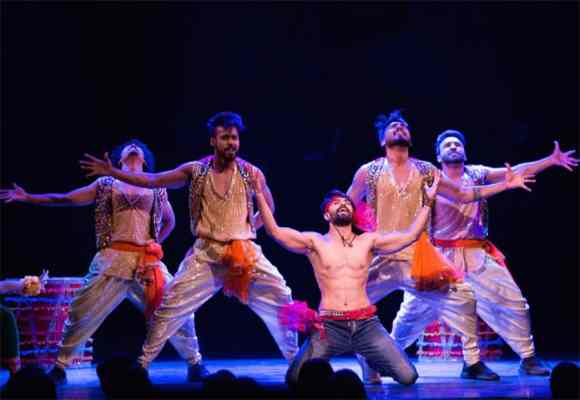
The dancing is spectacular. This show is an exhilarating riot of colour and energy. The variety in the music is surprising, there are elements of tango, salsa, mixed up with bhangra and rock. The opening of the second act even had a techno rave feel with its ultra-violet lights and dayglo costumes and props. Hiten Shah and Tanvi Patil play Arjun and Kareena, the shows romantic leads, their job is to relate the narrator’s story through their dance routines, a job they accomplish with considerable charm and allure. The ensemble as a whole are dazzling, full of acrobatic tumbling, gymnastic break dancing and twisting somersaults, their dynamic vigour is infectious and the audience is clapping along enthusiastically towards the end of may of the routines.

The set is simple but effective, a white backdrop leaves the stage completely clear for the main event, and pictures projected onto it provide the various settings in which the dancing is taking place. Bipin Tanna deserves special mention as the costume designer. They are a highlight of the show. To say they are bright and glittering is an understatement, they flow and shimmer with the dance moves, enhancing the movement of the dancers. They are vibrant and vivid, yet elegant and graceful when this is called for in the dance.

Taj Express is a show that you have to allow yourself to enjoy. It has elements of pantomime, don’t overthink – just let the pageant that unfolds onstage envelop you and  become swept up in the spectacle. By the end of the show much of the audience was up dancing in the aisles, a testament to the appeal of a most enjoyable evening.


Categories
Theatre review

Pinter 2, Pinter at the Pinter Season, Pinter Theatre, London WC1


lover-25-06-18-lead_1

In December 2018 it will be 10 years since the death of Harold Pinter. In celebration of his legacy, the Jamie Lloyd Company is producing a season of all 19 of his one act plays at the Pinter Theatre. There will be 7 different programmes each containing either 2, 3 or 4 of his pieces. The cast list for the season has to be seen to be believed, stellar is no over-estimate of their quality.

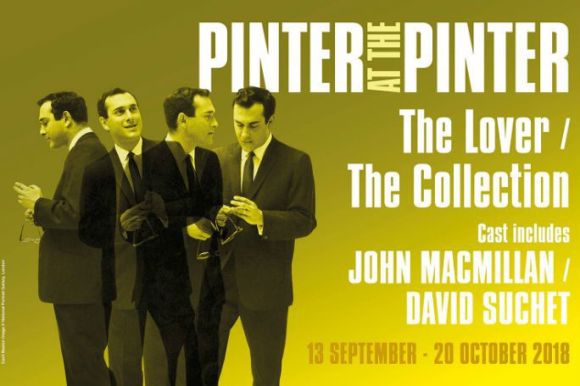
Pinter 2 contains two plays, The Lovers and The Collection, both comedies and both written in the early 1960s. The Lovers has John MacMillan, Hayley Squires and Russell Tovey. The Collection has these three and David Suchet. The Lovers is a one room play set over a couple of days in the living room of a married couple. The dialogue is, in true Pinter fashion, bright and stilted. The set and conversation are pastiche early TV sitcom. This works really well, it makes the subject matter funnier, darker and pinpoints it in time perfectly. John MacMillan and Hayley Squires are the husband and wife, Richard and Sarah. Their comic timing is impeccable. The piece lasts about 50 minutes, it starts off light an funny. The story is inventive and the writing witty. In short, this is classic Pinter done well.

The Collection is a four hander, this time about 2 couples, set in 2 living rooms. This one is more sinister, right from the start. It is still very funny though. David Suchet and Russell Tovey, play Harry and Bill, the other couple are Stella and James, played by Hayley Squires and John MacMillan. Although there is nothing explicit anywhere in this play, it must have been quite shocking when it was first performed in 1961, and I can imagine that the censor would have taken an interest in how it was produced. It is beautifully written, in that, there is nothing overt in the manner of their relationships, however we are in no doubt as to what is going on. For it to work this well, the actors have to be well attuned to the writing. All four of them are wonderful. David Suchet gives an acting masterclass in this play, he knows perfectly when to be larger than life and when to rein it in. Russell Tovey too, gave a nicely nuanced performance delivering funny double-entendres with an ominous undertone.

The set is simple and clever, spot lit areas move us from one scene to another. Jamie Lloyd directs both plays sympathetically, he allows the writing and acting to shine. This play is also just about an hour long. I am beginning to think this might be Pinter’s perfect length. This pair of plays are pure joy to watch and now I am left with the quandary of how to get hold of tickets for the other 6 in the season.

Categories
Theatre review

Hogarth’s Progress Part 2, The Taste of the Town, Rose Theatre, Kingston

New-Hogarth-Showpage

Nick Dear’s second part of Hogarth’s Progress is set thirty years on from part 1 which is reviewed here: Hogarth’s Progress Part 1, The Art of Success, Rose Theatre, Kingston. This second play is also a fictional story based around real events in the life of William Hogarth.  By this time he has enjoyed success, and he is serjeant painter to King George III. He has taken a house in the countryside, in Chiswick.

This story also takes place on a drunken day, although by now William Hogarth is something of a reformed character and one has the impression that days such as these are less frequent than in the past. Although the day itself is a fictional day, the characters in the play are real, and the people and events that they discuss are fact. Hogarth is worried that, although he is relatively rich and famous, his art is not given the gravitas it deserves. The play then, although it is a light comedy in style, has an underlying discussion about what exactly it is that constitutes success. It is a cleverly written piece and it works well on both levels.

The dialogue is crisp and funny. The characters have depth, we see their flaws and like them nevertheless. Mark Umbers is very good as David Garrick, the multi faced actor. He is smooth, accomplished and very aware that the whole world is a stage. The role of Horace Walpole is beautifully written and it is beautifully played Ian Hallard. His lines are witty, barbed, and perfectly delivered. He rips Hogarth to shreds so sweetly that the artist leaves his house almost believing that he has made a new best friend.

The acting throughout is superb. Sylvestra Le Touzel is wonderful as Lady Thornhill, arch and harsh, but knowing where her best interests lie. Jasmine Jones shines again, this time as Bridget. It is interesting to see the cast playing different parts in each play and I enjoyed the links between the two shows, although each is an independent narrative and works without any knowledge of the other.

Both of these shows are interesting and both are worth seeing. If you can only see one, the first is frenetic and explicit, the second is calmer and sharper but each one is funny in its own way, so it depends on how you like your comedy. If I had to choose, I think I would probably pick the second, simply for the wonderful characters Walpole and Garrick.