Categories
Theatre review

The Fall, National Youth Theatre of Great Britain, Southwark Playhouse, London

The Fall

I really look forward to seeing what the National Youth Theatre of Great Britain bring out each year. It is always interesting and thought provoking. They rarely disappoint and this show is no exception. This is a triptych of plays with a common theme, aging and how we treat the aged. All three are written by James Fritz, they have funny and intelligent dialogue. Directed by Matt Harrison, the bed in the centre of the stage is the single focal point, it cleverly has different implications in each scene.

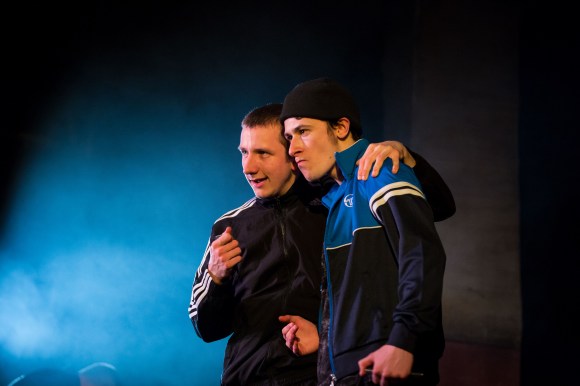
The first is the most conforming of the three, the story of a couple of horny teenagers who use an old man’s flat to have sex while he is away.  Jesse Bateson and Niyi Akin are both excellent, showing off teenage attitudes to old age, with humour and occasional compassion.

The second is also a two hander.  A couple age from teenage to late middle age in the course of twenty minutes, as they cope with looking after their son and an aging parent. Sophie Couch is really good, we are unsure of her actions without ever being unsure of her motives. Troy Richards as her partner does a great job of keeping us guessing as to whether he believes her because he trusts her or because he just chooses to without any real justification.

The third is set in an old peoples’ home, in a future where virtual assistant apps control the looking after and their only company is each other. The only outside human interaction appears to be a liaison officer, played with cool dispassion by Lucy Havard, offering voluntary euthanasia. Jamie Ankrah does a good job of playing the archetypal “Grumpy Old Man”.  Jamie Foulkes evokes compassion for his decision and Madeline Charlemagne is great as an octogenarian with a sense of fun. Josie Charles is fantastic as the last old person left, measuring out her days by turning on her room lights. Joshua Williams is excellent as the Nurse, one of the few people in the cast who gets to play his own age, whose job now is doling out death, but at least trying to do it with compassion.

Every year the NYT of GB do a season of shows in both off West End and West End theatres. This is the first time that they have been at the Southwark Playhouse, it is a venue that will work well for them, in that it is both intimate and adaptable. The plays put on by the National Youth Theatre are always innovative, interesting and entertaining and they are very competitively priced.  The production values are great and you are sure to see some stars of the future, either in acting, direction or choreography.
Categories
Theatre review

The Prudes, Jerwood Theatre Upstairs, Royal Court, Sloane Square, London SW1

prudes-007

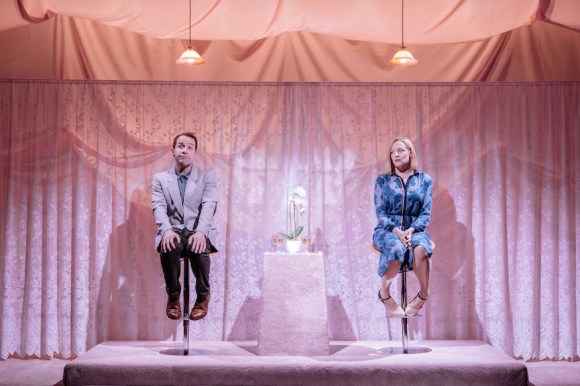
The Jerwood Theatre Upstairs holds less than 100 people and every seat has a good view of the stage. It is a small intimate theatre, although perhaps not intimate enough for the act that Jimmy and Jess assure us that they intend to carry out on stage during the play this evening. The set is pink, soft and fluffy, apart from the “Blind Date” style tall stools. Indeed, if Channel 5 were planning to have a competitive sex therapy show, they could come here for ideas.

The Prudes is a two hander about, Jess and Jimmy, a couple who have been together for nearly 10 years but who have not had sex for over a year. They are worried about the effect that this is having on their relationship and have come to the decision that they only thing they can do prevent their breakup is to have sex in front of us on stage tonight. We are not told how come they have reached this conclusion, but we are here now, let’s run with it.

What follows is a discussion about sexual politics, and how the #metoo movement has changed how we look at sex and power in sex. Jonjo O’Neill and Sophie Russell are excellent as Jimmy and Jess, they interact with the audience, they ask for affirmation of their most embarrassing confessions, they are funny and likeable and we can feel their warmth for each other through their difficulties.

The play is witty, it certainly captures the zeitgeist and it poses many questions that are brought to mind by the sexual harassment cases that have been in the news over the past months. I think we are still too close to the events to have a good perspective on how they will change our attitudes, and writer Anthony Neilson doesn’t even attempt to look for answers. This leads to a play that is enjoyable to watch but lacks a little punch in the consummation.


Categories
Theatre review

Ruthless! The Musical, Arts Theatre, London.

'Ruthless' Musical performed at the Arts Theatre, London, UK

Ruthless! The Musical, first opened off Broadway 26 years ago. It is the almost archetypal off-Broadway show. It makes the fact that it is a low budget show in a small theatre part of its appeal. So, I was worried that the Arts Theatre, although it is the smallest theatre in the West End, would be too big for it.

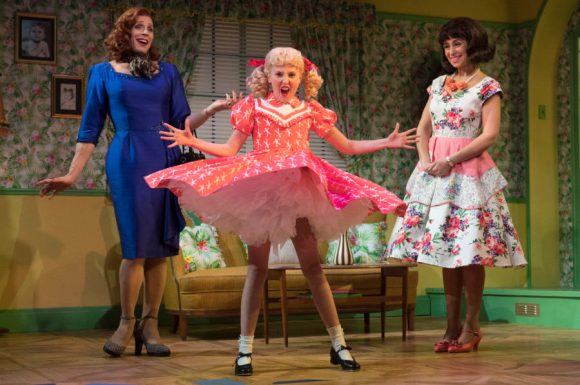
Having said that, Ruthless is a great show, with a wonderful part for an aspiring young actress as  the 8 year old, Tina.  Given the importance of understudies in the storyline, there is a wonderful irony in the fact that the first two understudies for Tina when the show opened in 1992 were Natalie Portman and Britney Spears. This being the UK, with child protection laws, we have 4 Tinas and no understudies. Anya Evans played Tina on the night I attended and she was very good, great dancing and a frighteningly bright smile.

It has become usual for the role of Sylvia St Croix to be played by a man and Jason Gardiner makes a good job of it here, his movement is excellent and he can certainly dance in heels. Kim Maresca is fantastic as Tina’s mother, very Stepford Wife in the first act and very Liza Minnelli in the second. In fact,  all the acting in this production is top notch, Tracie Bennett and Harriet Thorpe are both pantomime villain good as theatre critic Lita and drama teacher Myrna.

The musical numbers are mostly good, two standout songs are “I hate musicals” sung, with many funny reprises, by Lita and the title song, Ruthless! by the whole company. The set and costumes are both “fabulous dahling”, 1950’s crinoline petticoats in a 1960’s Formica living room.

The real stand out thing about this show is the references, Shirley Temple, All about Eve, Bob Fosse, interpretive dance, Judy Garland – far too many to list – all get a mention in some way. It’s enjoyable trying to spot them and there’s no way that you will get them all.  Everything about this show is kitsch, but if you didn’t know that before you arrived, you should have done more research before buying the ticket. The humour is camp and low brow, but still great fun. This is good production of a good show, perhaps it could have been even better in a more intimate theatre.


Categories
Theatre review

Lady Windermere’s Fan, Vaudeville Theatre, London 2018

lady w

This is the second play in Dominic Drumgoole’s Oscar Wilde season in the West End and it is directed by Kathy Burke. I attended this production with some trepidation because, although I really admire Oscar Wilde and find him very witty; his plays are full of arch bon mots, but this can make his characters cool and short on compassion. I often find myself laughing at what they say but I have little empathy for their plight.

However, Kathy Burke really brings out the difference between how the actions of men and the actions of women were perceived, by society, at the turn of the last century. She makes us aware of how sympathetic Oscar Wilde was to that difference. He demonstrates real dexterity in pinpointing this and he mocks it mercilessly. This is a  modern take on a play that is ultimately about the empowerment of women. Sam Spiro is excellent as Mrs Erlynne, the unrepentant scarlet woman, she perfected the brittle, sharp exterior protecting her secret and the emotions she did not wish to show.

Jennifer Saunders plays The Duchess of Berwick, in full-on dame mode. She sails into each scene with a new wonderful hat, drops her witty insights, sows the seeds of anarchy, and sails off. A wonderfully written cameo role, beautifully delivered.

It is the men in this play who are shallow. They are the real figures of fun, Joshua James is good as the insecure but supportive Lord Windermere.  Kevin Bishop is excellent as Lord Darlington; charming and in love, but likely untrustworthy. The scene with all the male characters, drunk, in the library is well done and very funny. This play is so full of famous lines that occasionally it feels like a litany of Wildean quotations.

lady w3


The set is cleverly done, all pastels and relatively simple, with echoes of the titular fan throughout – the shape of the windows and even the motif on the stage curtains. This is in contrast to the costumes.  The men are formal, I am convinced that Lord Darlington and Jacob Rees-Mogg have the same butler. The ladies are dressed in full rich concoctions designed to demonstrate a time when it was more important to show off ones wealth than ones taste.

Being a play in four acts, there is an entr’acte between the first and second and between the third and fourth. These were not written by Wilde and they felt out of place, the humour was crude by comparison, but they were common at the time of writing and it did give the production a period feel.

This was a very good production of a sparkling play, it made me see Wilde’s writing in a new light and I am looking forward to seeing the others in this promising season.


Categories
Theatre review

Antigone, Greenwich Theatre, London

anitgome_slide_drones

The Actors of Dionysus are touring the UK at the moment with this, a sci-fi tinged modern adaptation of Sophocles’ two and a half thousand year old play. Antigone, a Greek tragedy, has never really been an easy watch, but this adaptation has definitely made it more accessible.

Christopher Adams has written, a well thought out, updating of the play. I enjoyed the conceit of making the chorus of the original into the hive mind of linked computers. I thought the idea of making the soul into a chip that needed to be removed and uploaded worked well and gave us a good insight into Antigone’s motivation and into Creon’s harshness at refusing to allow it.

The stage setting is interesting, I guess touring made the set need to be as simple as it was, and I liked the current touches, the surveillance drones are particularly clever and fitted very well with the story and setting. The simplicity of the set did emphasise the universal themes of the play.

I found the acting good and I enjoyed the way each character pushed their agenda. I particularly liked the change in Creon from harsh dictator to broken soul. The well intentioned but misguided leader delivering tough love for the good of the populace can be a hard sell at times, but he brought it off well.

It is a Greek tragedy, so we cannot expect a happy or wholesome outcome, however it is a tribute to Antigone’s universal themes that it is still being performed over two millennia after it was written and this is as enjoyable and accessible a production as you are likely to see anywhere.  Thoroughly recommended.the

Categories
Theatre review

Othello, Ambassadors Theatre, London. National Youth Theatre of Great Britain.

The-cast-of-Othello-by-NYT-in-association-with-Frantic-Assembly-at-the-Ambassadors-Theatre-CREDIT-Helen-Murray

This is a fantastic production of Othello. The adaptation, by Frantic Assembly, was first performed by the National Youth Theatre in 1996 and this is an updated revival of that show.  The action has been brought into a contemporary setting, a dodgy looking pub where the tension and bravado are palpable and only the tough survive. Othello’s army is a neighbourhood gang. Shakespeare’s language fits in surprisingly well and the themes feel current and accessible.

The opening is a long wordless dance sequence that sets the scene. Its shows us the relationships between the various gang members, and their place in the hierarchy. The choreography is energetic and modern. The, usually awkward, fight scenes are handled with aplomb. The set looks simple but even this is extraordinary and comes into its own in moments of heightened tension.

Mohammed-Mansaray-in-Othello-by-NYT-in-association-with-Frantic-Assembly-at-the-Ambassadors-Theatre-CREDIT-Helen-Murray

Every actor is very good. Megan Burke is a hard-as-nails Emelia, who won’t be talked down when it comes to getting justice for her friend. Rebecca Hesketh-Smith is a sweet but upfront Desdemona. Curtis John Kemlo plays Roderigo as puny and weak, bringing an interesting new perspective to the role. Mohammed Mansaray, as Othello,  is tender in love and harsh in anger.  Jamie Rose steals the show as Iago, playing him as a shifty, cheeky chappie, with sly winks and gestures, letting the audience in on his secrets, while behaving abominably. I see a Bond villain in the making.


Jamie-Rose-and-Curtis-John-Kemlo-in-Othello-by-NYT-in-association-with-Frantic-Assembly-at-the-Ambassadors-Theatre-CREDIT-Helen-Murray
Photos courtesy of Helen Murray


The director is Simon Pittman, he has done a remarkable job, drawing clear and strong performances from all the characters. The tempo is quick and up to date, but he is not afraid to pause the action to press a point. The closing scene is masterful.

This production is playing selected dates between now and December. The future of British theatre is here and playing at the Ambassadors Theatre.

Categories
Film Review

The Pass (dir. Ben A. Williams) 2016

thepass-drink

The Pass is a film adaptation of a play that was a big hit when it played at the Royal Court Theatre in 2014. I have to imagine that it comes across better in the intimate surroundings of a small theatre. The premise is good, the timing is right for a movie about a closeted gay footballer, but this is not that movie. Had it been made in the 1970’s or 1980’s it would probably have been ground-breaking and interesting but at this moment we do not need a film about a selfish gay soccer star made bitter by the possibility that he might have missed out on true love.

The film is directed by Ben A. Williams and he sticks rigidly to the three act, three hotel room setting of the play. This increases the impression of it being a filmed version of a theatre play and puts another step between us and the action.

Although there are four characters in this film, two of them are two dimensional ciphers. The lap dancer, Lyndsey,  and the male groupie, Harry, are just there to use and be used. Ade, the player turned plumber, is well acted by Arinze Kene, but this film is ultimately about Jason, who is excellently portrayed by Russell Tovey. He develops into the true antihero, without a single redeeming feature. We watch him go from, a not particularly nice, 17 year old to, a harsh and vitriolic, 28 year old over the course of three acts. That is the real problem with this film, we never really liked him in the first place so we don’t really empathise with him.  He doesn’t care about anybody, he uses his wife, his child, his lap dancer, his fan and ultimately even his mate Ade. He chooses lifestyle over fulfilment, so when he is unfulfilled we aren’t particularly surprised or worried.

I had such high hopes for this film, it had so much going for it, and don’t let me take away from an outstanding performance by Russell Tovey, but so many movies made from the 1930s to the 1990s are full of flawed gay characters whose life is ruined by the fact that they can’t cope with the trauma of being queer, and I had hoped that we had moved on from that.

Categories
Theatre review

Jekyll and Hyde, National Youth Theatre, Ambassadors Theatre, London

©NOBBY CLARK
+44(0)7941-515770
+44(0)20-7274-2105
nobby@nobbyclark.co.uk

The National Youth Theatre’s production of Jekyll and Hyde is a deconstruction of the original novella by Robert Louis Stevenson, rebuilt with a modern feminist twist by writer Evan Placey. Combining Victorian settings and morals with modern day language and values adds a new dimension to the duality theme of the story.

The decision to have a female Jekyll is not only brave but astute, and this production perfectly captures the zeitgeist with the discussion about sexism in film and theatre so much in the news. The writing is forthright, the jolt of the coarse language spoken by the Victorian ladies near the start of the play becomes clear in the second act, there is no doubt that Evan Placey is a talented author, of whom we will hear more in the future.

Aside from the writing there is much to recommend in this production. The acting throughout is accomplished. Jennifer Walsh in particular is excellent as Florence, a young adult coming to terms with the fact that although no one else is going to stand up for her, she has the power to stand up for herself.  Elizabeth McCafferty confidently makes the transitions between Jekyll and Hyde both striking and convincing. Mohammed Mansaray has a funny scene as a priest, which he delivers very well.

©NOBBY CLARK
+44(0)7941-515770
+44(0)20-7274-2105
nobby@nobbyclark.co.uk

The direction is brisk and contemporary, so that even in the midst of 19th century London, we feel linked to the current day. The director, Roy Alexander Weise, is not afraid to be confrontational, daring to breach our comfort zone in order that we feel the characters’ anger. The costume design is remarkable and clever, the ensemble changes from church house to flop house in the blink of an eye.


©NOBBY CLARK+44(0)7941-515770
+44(0)20-7274-2105
nobby@nobbyclark.co.uk
Pictures courtesy of Nobby Clark


Jekyll and Hyde has a few rough edges, but challenging, thought provoking productions like this are exactly the remit of The National Youth Theatre and I have to say that I thoroughly enjoyed this show.

Categories
Theatre review

Hershey Felder, Our Great Tchaikovsky, The Other Palace, Victoria, London

Hershey-Felder-as-Our-Great-Tchaikovsky_3

Hershey Felder has spent the last two decades recreating, on stage, the lives of great composers, while playing their music to highlight salient moments from those lives. Tchaikovsky is the sixth in this series. The genre is part biography, part piano recital.

The stage is set to resemble a room in his dacha in Klin, with rugs, cabinets and a baby grand piano. There is a large portrait over a writing table, whose likeness changes to whoever he is speaking about. The backdrop to the set also has illustrations which change to reflect different periods of his life.

Felder begins the show by coming on to the stage with a letter he has received from the Russian Government inviting him to bring his story of the life their greatest composer to be performed in his home country. He asks the audience whether he should do this.  This is a rhetorical question, as the difference between his account of Tchaikovsky’s life and the official Russian version is vast, and it seems unlikely that Hershey Felder’s telling of events would prove popular there.

Tchaikovsky’s story is told by picking out individual snippets of his life, mostly in chronological order, and combining them with music that he was writing or performing at the time. The effect is like an entertaining lesson combined with a piano recitation by an inventive and musically talented professor; imagine one of the best university lectures that you have attended and you won’t be far wrong.

Hershey-Felder-in-Our-Great-Tchaikovsky_4

Hershey Felder has chosen which events to recreate, so we are given the narrative from his point of view, and he makes us aware that others may look upon his life differently. For me, who liked Tchaikovsky’s music, but who knew hardly anything about his life, it was a perfect combination. I was given an insight into the man while listening to an accomplished pianist playing his greatest hits.review

Categories
Theatre review

Follies, National Theatre, Southbank, London.

ntgds_lr_follies_editorial_lores_rgb-xlarge_trans_nvbqzqnjv4bqrztbxiabcvehja2lncrbaqctb0fis-lilonsyie-xyy

Follies is probably Sondheim’s most traditional musical, in that it has set pieces, dance routines, show girls and, separate songs that don’t bleed into each other. However, it is still complex; the story has great depth and some of the songs are operatic in nature.

It is expensive and complicated to produce, it has a large company, with demanding roles throughout the cast. It needs an orchestra. Full productions of Follies are rare, the last proper one in London was thirty years ago, so when there is a high quality, committed revival such as this on offer, the opportunity needs to be grabbed.

It’s Sondheim, so the material is fantastic. It has some of his most famous songs, the storyline is elegant, and it is almost upbeat for Sondheim, (that means everyone in the cast isn’t going to live out the rest of their lives in abject misery!). It’s the National Theatre, so the production values are top notch. Dominic Cooke and Bill Deamer as director and choreographer have both done a wonderful job. I particularly loved the way each dancer at the reunion had their younger version dancing with them. I also loved the way all the mature dancers paraded down the stairs in a dignified manner wearing evening gowns, while their younger incarnations scrambled in over the rubble at the back of the stage, in their high heels, basques and feathers.

Imelda Staunton, Janie Dee, Philip Quast and Peter Forbes are the four leads, so the acting and singing are outstanding. Imelda Staunton does an emotionally draining rendition of “Losing My Mind” and Philip Quast’s voice is as amazing as it always is. It has Tracie Bennett and Geraldine Fitzgerald in supporting roles so it has incredible strength in depth. Tracie Bennett is in full on scene stealing mode with “I’m Still Here” sung with a mixture of pain and defiance.

Follies at the National Theatre is fantastic, and given all the elements that went into making it, there was never any doubt that it would be.