Categories
Attractions

Love London, Part 1. Trafalgar Square, Nelsons Column and Charles I, London WC2


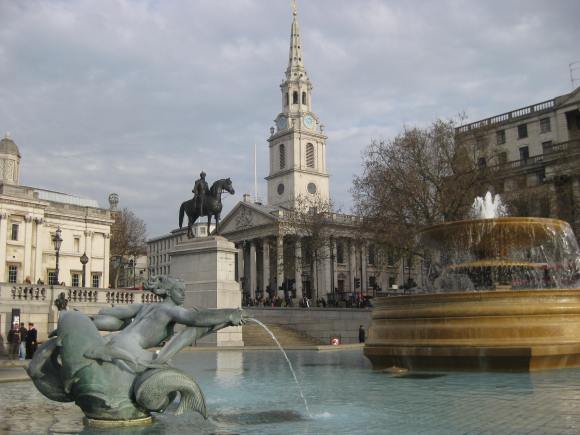
DSC_2999Trafalgar Square is a tourist attraction that is packed with both dramatic architecture and history.  It has a claim to be the centre of London, in both a physical and psychological sense. Other places have claims also; Bank, Buckingham Palace, Piccadilly Circus even Hyde Park Corner, but there are a couple of good arguments in favour of Trafalgar Square.
2014-11-29 13.12.11


It has been  the scene of major British public gatherings and demonstrations from soon after its opening right until the present day. It was the backdrop to the Poll Tax demonstrations in the 1990s, CND rallies in the 1960s and ’70s, Chartist gatherings of the nascent Labour movement in the late 1800s and more recently campaigns against Climate Change and the wars in Afghanistan and Iraq.

overview

Over the Christmas period it holds London’s most famous Christmas tree, a gift from Norway every year since 1947, as a thank you for Britain’s support during WWII. It was also the traditional gathering place for London’s New Year celebrations until the crowds became too big and deemed too dangerous to have at a single venue.

Trafalgar Square was designed in 1826 by architect John Nash, it did not really begin to take shape until the late 1830s when the National Gallery was built in 1838. It is named after the battle of Trafalgar, a famous 1805 victory over Napoleon.

Nelson


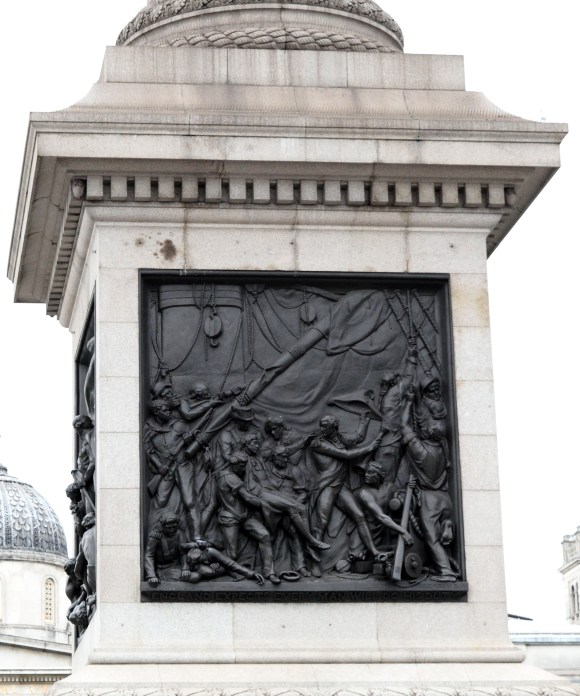
The centrepiece of the square is Nelson’s Column; a monument to the leader in that battle. This was erected in 1843 just before the square became a public area. It is a 43metre high, granite column with a 7metre statue of Horatio Nelson on top. The column itself is a Corinthian column, having an ornamental top. This ornament is made from British cannons.  There are also bas-reliefs on each side of the column at the bottom, depicting earlier famous British war victories and these are made from the melted down remains of weapons captured from the French and Spanish armies. Famously, the stonemasons who built the column are reputed to have had dinner served on its top, before the statue was placed.
DSC_3001

The Lions at each corner of the column were designed by Edwin Landseer and were installed in 1867. They are made of bronze and each one weighs over 6000kg. The fountains at either side of the column, were added later. The current fountains were designed by Edwin Lutyens and added just before the start of WWII. Trafalgar Square as a whole is Grade I listed, which is the highest level of architectural protection in the U.K. awarded only to buildings of exceptional interest.
2014-11-29 13.17.22

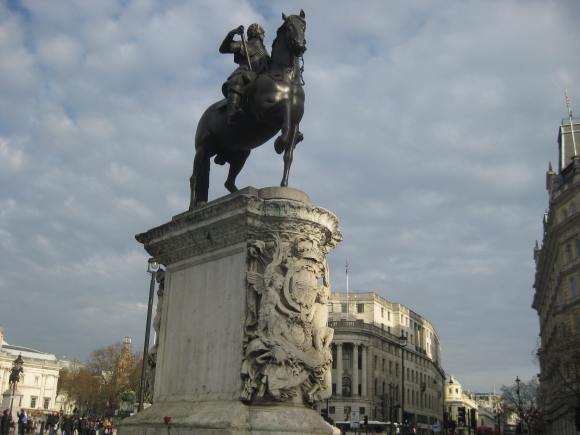
The oldest statue is to the South of the square. It depicts Charles I on a horse. This was made in 1633 and sent to be melted down after the abolition of the monarchy in 1653. The brazier to whom it was given, made his fortune selling trinkets made from the melted down statue, but he had kept it intact to return to the crown on their reinstatement. This is also what Trafalgar Square its claim to be the physical centre of London, as it is to the base of this statue that official distances to London are historically measured.

You may have heard that all the distances to London are measured from Charing Cross. This is true. The Charing Cross was one of 12 crosses placed by Edward I in memory of his wife Eleanor. It was originally in the spot currently occupied by the equestrian statue of Charles I. It was destroyed by order of Parliament after the civil war. A replacement cross was built and placed in front of Charing Cross station during the reign of Victoria. There is an original Eleanor cross still standing, from 1294, in Waltham Cross.

Part 2 of the Trafalgar Square post is here: Love London Part 2. Trafalgar Square, George IV, Victorian generals and the Fourth plinth.


Categories
Theatre review

Lady Windermere’s Fan, Vaudeville Theatre, London 2018

lady w

This is the second play in Dominic Drumgoole’s Oscar Wilde season in the West End and it is directed by Kathy Burke. I attended this production with some trepidation because, although I really admire Oscar Wilde and find him very witty; his plays are full of arch bon mots, but this can make his characters cool and short on compassion. I often find myself laughing at what they say but I have little empathy for their plight.

However, Kathy Burke really brings out the difference between how the actions of men and the actions of women were perceived, by society, at the turn of the last century. She makes us aware of how sympathetic Oscar Wilde was to that difference. He demonstrates real dexterity in pinpointing this and he mocks it mercilessly. This is a  modern take on a play that is ultimately about the empowerment of women. Sam Spiro is excellent as Mrs Erlynne, the unrepentant scarlet woman, she perfected the brittle, sharp exterior protecting her secret and the emotions she did not wish to show.

Jennifer Saunders plays The Duchess of Berwick, in full-on dame mode. She sails into each scene with a new wonderful hat, drops her witty insights, sows the seeds of anarchy, and sails off. A wonderfully written cameo role, beautifully delivered.

It is the men in this play who are shallow. They are the real figures of fun, Joshua James is good as the insecure but supportive Lord Windermere.  Kevin Bishop is excellent as Lord Darlington; charming and in love, but likely untrustworthy. The scene with all the male characters, drunk, in the library is well done and very funny. This play is so full of famous lines that occasionally it feels like a litany of Wildean quotations.

lady w3


The set is cleverly done, all pastels and relatively simple, with echoes of the titular fan throughout – the shape of the windows and even the motif on the stage curtains. This is in contrast to the costumes.  The men are formal, I am convinced that Lord Darlington and Jacob Rees-Mogg have the same butler. The ladies are dressed in full rich concoctions designed to demonstrate a time when it was more important to show off ones wealth than ones taste.

Being a play in four acts, there is an entr’acte between the first and second and between the third and fourth. These were not written by Wilde and they felt out of place, the humour was crude by comparison, but they were common at the time of writing and it did give the production a period feel.

This was a very good production of a sparkling play, it made me see Wilde’s writing in a new light and I am looking forward to seeing the others in this promising season.


Categories
Theatre review

Bat Out of Hell – The Musical, Dominion Theatre, London 2018

Bat-Out-Of-Hell-Cast

Bat Out Of Hell – The Musical is a full-on, no holds barred show. It is not afraid to take risks, it is prepared to appear ridiculous and one has to admire that bravery. Sometimes these bets pay off and there are moments of stupendous, over-the-top brilliance. Most of these come in the songs that are on the Bat out of Hell album, when the spectacle and choreography seem to step up a gear. The original LP was about forty minutes long and this show runs a little under three hours including the interval.

All the tracks from 1977 are done well, and some of Jim Steinman’s other early songs fit in well. Surprisingly “It’s all coming back to me now” made famous by Celine Dion is a real highlight. However some of the other songs are saccharine, subpar Disney, teenage angst repackaged for the late middle aged.

The storyline is poor, difficult to follow and uninventive. The characters are all two dimensional, composite caricatures. Despite this, some of the performances are outstanding. Andrew Polec has the perfect rock bearing as Strat. Christina Bennington, who plays Raven, has a lovely voice and can act well, a more traditional musical might suit her talents better, I’d love to see her sing Sondheim.  Rob Fowler is outstanding as Falco; a camp, overblown baddie – who can really sing. Perhaps it’s true that the devil has all the best tunes. Danielle Steers steals the show as Zahara, she has an amazing rock voice and rock attitude, she commands the stage whenever she sings.

The set is excellent, the huge stage at the Dominion allowing it to be up to four different areas, all at the same time. The special effects are among the best I have ever seen in a stage musical, although I suspect that those who sit in the front few rows miss parts of the show because of the amount of dry ice rolling off the front of the stage. The choreography is mostly wonderful, especially in the big set pieces and the songs that end each half ensure that you leave the auditorium on a high.

The audience adored it. The cheering began when the first backing singer arrived on stage, even before the start of the show and there was an instant standing ovation at the end. I can understand why it is such a hit wherever it goes, it is a big overblown, melodramatic rock opera and it does that wonderfully well. I think it could have been even better if it cut the emotionally manipulative ballads and ran maybe an hour shorter.


Categories
Theatre review

Young Frankenstein, Garrick Theatre, London, 2018

Young Frank

Young Frankenstein is written by Mel Brooks and based on his 1974 film starring Gene Wilder, so don’t go in expecting any deep insights into the nature of the world. What you get is a smutty, slapstick, laugh-a-minute show, full of quick, clever, off-colour punchlines. It is packed with song and dance routines, which come along so swiftly that you haven’t time to notice the poor ones before you are being entertained by the next one which might be more to your taste.

There are some good performances, Hadley Fraser shows that he can do farce in a rare comedic role. His voice is excellent as you would expect from an actor who has previously been in “Les Miserables” and “Phantom of the Opera”. Lesley Joseph is as good as Frau Blucher, hamming it up just enough, without going too pantomime. Cory English has taken over from Ross Noble as Igor and he is very good indeed, his experience of playing the role on Broadway working to his advantage.

The jokes are sometimes obvious and often telegraphed but the direction is clever in making us enjoy the expectation of the punchline as much as the delivery itself. This is particularly evident in the scene involving the monster and the blind hermit. There are also nice homages to bygone musicals in the songs, “there ain’t nothing like a brain” and “the Liths in Lithuania, do it” are two lines that spring to mind. The show stopping number however, is the one song that is not an original. Irving Berlin’s “Puttin’ on the Ritz” is fantastically choreographed, inventive, surprising and funny; it will have you smiling at odd times for hours after you leave the theatre, remembering the routine.

Young Frankenstein is not profound, it is not ground-breaking, it is not even particularly original, but it is funny, it is fast and it is a very good evenings entertainment. I enjoyed it and judging by the reaction at the close, the rest of the audience enjoyed it too. Recommended.

Categories
Theatre review

Fanny and Alexander, The Old Vic, London SE1

the-cast-of-fanny-alexander-the-old-vic-photo-manuel-harlan-045

Fanny and Alexander is a play to luxuriate in. Sit back, relax – and let three and a half hours of rich storyline, beautifully performed, draw you away into another world. Don’t feel guilty about it, for – as the moral of this tale has it – it is good for the soul to give in to pure pleasure occasionally.

The acting in this show is a wonder to behold, it is full of larger than life characters, but there is never a hint of pantomime or showboating. The play (and the audience too, on the day I attended) is crammed with the best actors that London has to offer. Penelope Wilton is amazing as the matriarch with a past, holding the family together. Jonathan Slinger is excellent as a slightly sleazy but unapologetic sybarite. Kevin Doyle brings out the best (and worst) in the ascetic bishop. Michael Pennington is fabulous as Isaac, the puppet master bringing the action together, seemingly from the periphery, but not as detached as he appears. Guillermo Bedward played Alexander in the show I watched and he was very good, both funny and serious.

Much of this play is set around various dinner tables, often accompanied by a list of the food on the menu. Fanny and Alexander itself is a feast of all the best that London theatre has to offer. You will be transported, indulged and you can wallow in an evening of rich extravagant entertainment. The set is simple but clear, I really liked the austerity of the room in the second act. The choreography is clever, just organising the many scene changes with such a large cast must have taken careful organising. It was a pleasure to watch great theatre unfold before your very eyes. I loved this show and the time flew, it was one of the most rewarding afternoons that I have ever wasted!

Categories
Theatre review

Everybody’s Talking about Jamie, Apollo Theatre, London

01-everybodys-talking-about-jamie-john-mccrea-and-company-c-alistair-muir

All the publicity that goes with “Everybody’s talking about Jamie” mentions what an  uplifting feel good story line it has, and that it taps into the current zeitgeist, and to be fair they are right but, really it has so much more than just that.

The songs are brilliant, “It means beautiful” will surely win an award for best new song in a musical. “He’s my boy”, “Work of Art” and “If I met myself again” are also wonderful, I think Dan Gillespie Sells is going to be a huge success as a songwriter for musicals. The lyrics are lovely too and are written by Tom Macrae, so perhaps this is a new partnership to look out for.

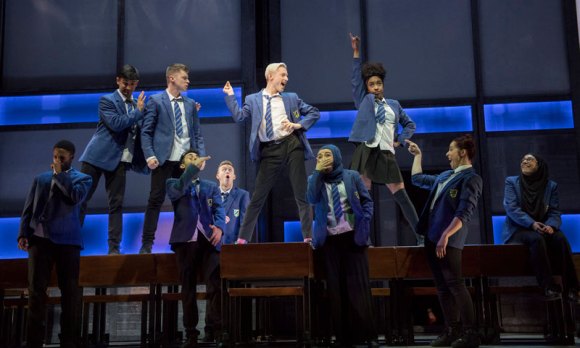
The whole cast is great. Obviously John McCrea is excellent as Jamie, a strong voice and a big stage presence. There are also outstanding performances from Josie Walker as his Mum, who has two big songs and a spectacular voice with which to deliver them, and from Lucie Shorthouse, who has an endearing part as his BFF, Pritti. I enjoyed Phil Nichol’s portrayal of Hugo Battersby too.

I also really liked the choreography, it is vibrant and up to date, break dancing with a hint of Justin Beiber video. The set design is good as well, a great mixture of simple, clever and efficient. She show finishes very well, the audience loved it and left the theatre wanting more.

I thoroughly enjoyed this show and I hope it is a huge success!

Categories
Gigs

Shoreditch Takeover, Shoreditch Town Hall, London

DU17-Lisbeth-Gruwez-1-Credit-Luc-Depreitere

Shoreditch is the centre of cool in London at the moment, so you would expect its contribution to the Dance Umbrella Festival 2017 to be cutting edge and innovative. On both these counts it certainly delivers. Shoreditch Takeover is made up of four very different pieces, happening in separate spaces within the beautiful old building that is Shoreditch Town Hall. Twenty first century art within nineteenth century architecture.

First is Rays, Sparks and Beating Glows. This is choreographed by Julie Cunningham and is an intense piece, about gender and feminism, for four dancers. It is performed without music, although there is some spoken word towards the end.

Next is Vanessa Kinsuule, who is a wonderful poet. She is, witty, insightful, nostalgic and honest. She has a winning personality, who can really involve an audience and the introductions to the poems are almost as good as the poems themselves.  Her whole set is great and the poem about an evening, dancing at a nightclub, is a highlight.

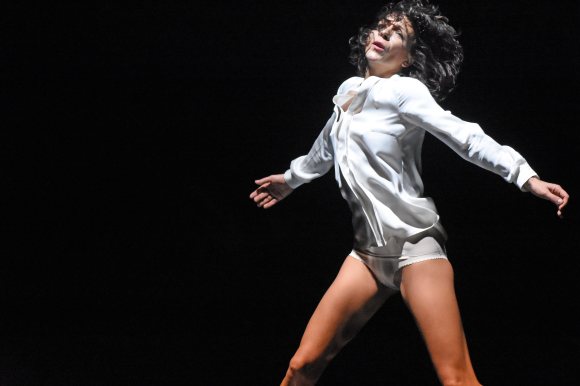
The third set is Lizbeth Gruwez dances Bob Dylan, a personal interpretation, exploring the edges of dance. For “Knockin’ on Heavens Door”, Lizbeth stands with her back to the audience at the front of the stage and walks, slowly and beautifully, to the back. You haven’t seen minimalism in dance until you have watched this. The Bob Dylan tracks are played on vinyl and are quite scratchy at times, invoking images of drunk and stoned nights in 70’s bedsits.

The final work is a film, The Shadow Drone Project, cleverly filmed from above, where the actual bodies of the dancers can hardly be seen, but instead we watch their shadows interact with each other. Some of this appears choreographed and some not, blurring the line between formal dance and how our brains make patterns.

All in all, a varied and interesting night in a lovely venue, a good addition to the Dance Umbrella Festival 2017.

Categories
Theatre review

Othello, Ambassadors Theatre, London. National Youth Theatre of Great Britain.

The-cast-of-Othello-by-NYT-in-association-with-Frantic-Assembly-at-the-Ambassadors-Theatre-CREDIT-Helen-Murray

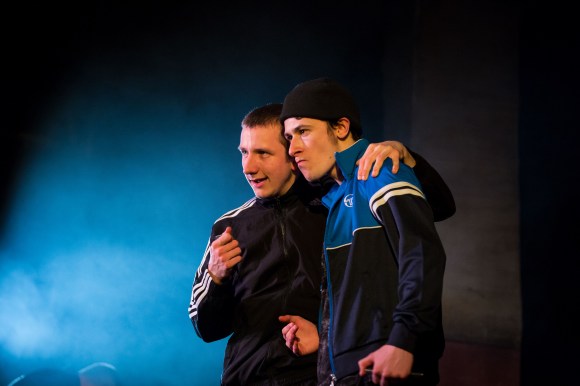
This is a fantastic production of Othello. The adaptation, by Frantic Assembly, was first performed by the National Youth Theatre in 1996 and this is an updated revival of that show.  The action has been brought into a contemporary setting, a dodgy looking pub where the tension and bravado are palpable and only the tough survive. Othello’s army is a neighbourhood gang. Shakespeare’s language fits in surprisingly well and the themes feel current and accessible.

The opening is a long wordless dance sequence that sets the scene. Its shows us the relationships between the various gang members, and their place in the hierarchy. The choreography is energetic and modern. The, usually awkward, fight scenes are handled with aplomb. The set looks simple but even this is extraordinary and comes into its own in moments of heightened tension.

Mohammed-Mansaray-in-Othello-by-NYT-in-association-with-Frantic-Assembly-at-the-Ambassadors-Theatre-CREDIT-Helen-Murray

Every actor is very good. Megan Burke is a hard-as-nails Emelia, who won’t be talked down when it comes to getting justice for her friend. Rebecca Hesketh-Smith is a sweet but upfront Desdemona. Curtis John Kemlo plays Roderigo as puny and weak, bringing an interesting new perspective to the role. Mohammed Mansaray, as Othello,  is tender in love and harsh in anger.  Jamie Rose steals the show as Iago, playing him as a shifty, cheeky chappie, with sly winks and gestures, letting the audience in on his secrets, while behaving abominably. I see a Bond villain in the making.


Jamie-Rose-and-Curtis-John-Kemlo-in-Othello-by-NYT-in-association-with-Frantic-Assembly-at-the-Ambassadors-Theatre-CREDIT-Helen-Murray
Photos courtesy of Helen Murray


The director is Simon Pittman, he has done a remarkable job, drawing clear and strong performances from all the characters. The tempo is quick and up to date, but he is not afraid to pause the action to press a point. The closing scene is masterful.

This production is playing selected dates between now and December. The future of British theatre is here and playing at the Ambassadors Theatre.

Categories
Buildings

Rich Mix, 35-47 Bethnal Green Road, London E1

main20space2028theatre20style29

Rich Mix is a flexible, interesting venue, very handily located less than 100metres from Shoreditch High Street Overground Station. It has a theatre space and a bar on the 4th floor, holding around 100 people comfortably. The ground floor has a licensed bar in a space suitable for theatre, dance or live music and this area can accommodate many more. The first floor is a mezzanine, looking down over the stage. There are three cinema screens on the floors in between and there is also an Indian restaurant/café on the premises.

What really makes this venue, is the variety and diversity of the cultural events that are put on here. If you look at the programme for the coming month alone, there is theatre, dance, live bands, open mic nights, story-telling evenings, political events, family events, not to mention the films showing in the cinema, where it is one of the venues hosting the London Film Festival. It is also a venue for London Dance Umbrella Festival.

dz546937_942long

There mezzanine doubles as an art gallery and currently hosts a multimedia exhibition: Black Pride.  Among upcoming exhibitions are “Hard to Read” bringing together art and poetry, and another depicting illustrations of Syrian refugees. There are weekend markets with different themes, one in December is specifically for independent potters and ceramicists.

An adaptable venue, embracing the local community, accommodating the art scene and enhancing London’s rich cultural diversity.

Categories
Theatre review

Trois Grandes Fugues, Lyon Opera Ballet, Sadler’s Wells, Islington, London

du17-trois-grandes-fugues-childs-2-photo-stofleth

Trois Grandes Fugues is a simple but clever idea. Three different choreographers take the same piece of music, in this case Beethoven’s “Die Grosse Fuge”, and bring their interpretation of it, to the stage. I came to the show not knowing the music and uninformed with regard to the language of dance.

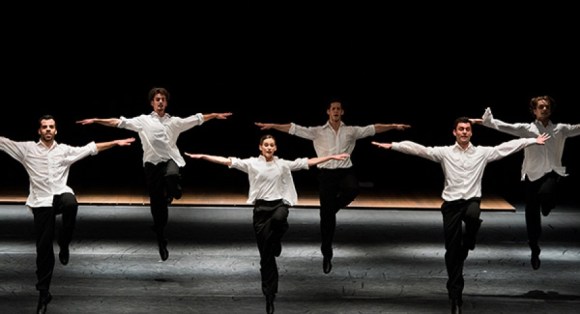
The three dances are all completely different. The first is the most traditionally classical in its form. Lucinda Childs has six couples investigate the geometric patterns in the music. The dancers are dressed in simple grey figure hugging body suits, the dance is graceful, formal, mathematical and balletic.

4617

The next, Anne Teresa De Keersmaeker, has her 8 dancers, 6 men and 2 women, in dark suits with open necked white shirts. Formally dressed at first the jackets are removed and some of the shirts are opened as the dance moves on. Each dancer appears to be linked to different sections of the orchestra and they move across the stage, together or apart, each seemingly linked to their own particular instrument.

The final piece by Maguy Marin, has her dancers less formally dressed, in shades of red, and her interpretation is wilder, more emotional, and the four dancers emphasise the dramatic and canonical motifs. They follow each other round the stage in more staccato movements, showing the fierce energy and strife in Beethoven’s work.

du17-trois-grandes-fugues-marin-3-photo-bernard-stofleth-x

I like Beethoven, usually his pastoral pieces are more to my taste, having heard this 20 minute work three times, each time I enjoyed it more, and I will look out for it, to listen to at home. I had a fantastic evening and I felt like I had been given an introductory lesson into both classical music and dance.