Categories
Attractions Buildings Days Out

Hyde Park Corner, London W1.

Hyde Park Corner

Hyde Park Corner has a lot going on, for what is, ultimately, the central reservation of the busiest traffic roundabout in London.

Peace in a Quadriga

There is Wellington Arch in the centre, which used to house the second smallest police station in Britain until 1992, it is now a museum and open to the public.  It is called the Wellington Arch because the top of it used to be crowned by a 40 ton Statue of the Duke of Wellington – the largest statue of a man on a horse that has ever been made. It was moved to Aldershot in 1912 and the arch now has a statue of a winged charioteer driving four horses on it top. This is the largest bronze statue in Europe.

Australian War memorial

The grassed over island also has the Australian war memorial in the South Western corner and the New Zealand war memorial on the North Eastern corner. These are 21st century memorials built in 2003 and 2006 respectively and commemorating antipodean deaths in the two world wars. They are both moving pieces of public art.
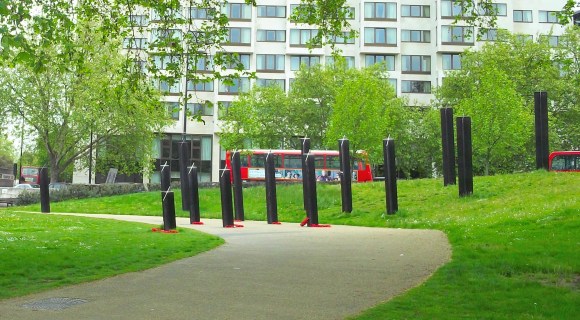
New Zealand War memorial

It also contains the Machine Gun Corps Memorial and the Royal Artillery Memorial, two more pieces commemorating casualties of the World Wars. These are both interesting in their own ways. I’m not sure why the Machine Gun Corps is commemorated by a statue of a young man with one hand on his hip and the other on a large sword, but it is beautiful, nonetheless. The Royal Artillery Memorial has more of a Great War atmosphere, it resembles soldiers guarding a tomb, with a cannon on its top.
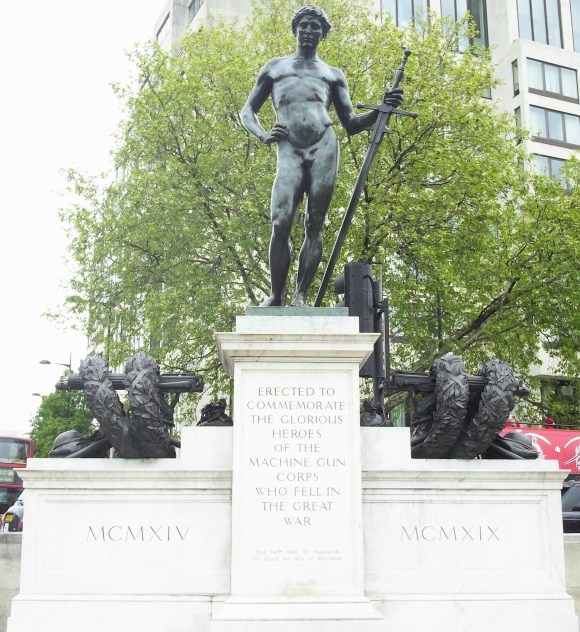
Machine gun corps

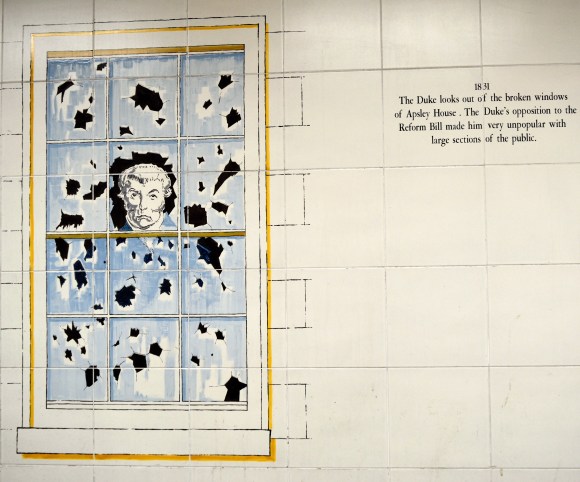
There is also a statue of Lord Byron and a large bronze of The 1st Duke of Wellington sitting on a horse. The equestrian duke statue is a smaller copy of the one that used to be atop the Wellington Arch. The best way to reach the central reservation avoiding the traffic is by one of many underground passageways. These are bright and well kept and have tiled depictions of the history of the area. I can’t believe that I am recommending  visiting the underground pathways to a traffic island, but these are quite interesting in themselves and definitely deserve a view if you have an interest in the history of the area.

Hyde Park

Not only is the junction itself full of interest but, there are many places very close by. There is Apsley House, the home of the Dukes of Wellington, and Hyde Park itself to the north. The wall across the road on the southern edge is Buckingham Palace garden. Green Park is on the east, and the Old St Georges hospital, now the Lanesborough Hotel, reputedly the most expensive in London, is to the west. Plus, of course underneath all this is Hyde Park Corner tube station.

Apsley House

In short, if you are to visit any traffic island in central London, then this should be the one!

Categories
Attractions Days Out

Apsley House, Hyde Park Corner, London

Apsley House.JPG

Apsley House is the smart, columned building on the north side of Hyde Park Corner. It has been the home of the Wellington family since the 18th Century, and it is open to the public Wednesday to Sunday during the summer months. It is a stunning Grade 1 listed building, and many of the interiors are kept in the style of decoration that they would have had at the time they were built. It is unlikely that there is a better maintained aristocratic home in Central London.

The decoration is interesting, there is some of Roberts Adam’s 18th century classical interior design remaining. It was renovated in the early 19th Century when Wellington was living in Downing Street as Prime Minister. The Waterloo Gallery was added at this time to commemorate his victory over Napoleon, and to this day, there is a banquet held annually on 18th June to celebrate this.

Wellington Shield

There is also an amazing art collection, made up of gifts from grateful war allies, or items acquired as the spoils of war during the defeat of Napoleon. There are paintings by Titian, Van Dyke, Rubens, Goya and Velazquez and many others. You can even see the original painting that contained the image of Wellington, that was used on our old five pound note.

Wellington Window.JPG

The are many other items of historical interest. It holds the oldest grand piano in England. There are two beautiful porcelain dinner services on display; The Waterloo Meissen Banquet service, painted with scenes of his greatest victories, and the Josephine Egyptian dessert service given by Napoleon to his wife as a divorce gift.  Another highlight is the wonderful 3.5metre nude statue of “Napoleon as Mars the God of Peace” by Canova.

Meissen Plate.JPG

The property is run by English Heritage, so it is free to enter if you are a member, but chargeable otherwise. The entry fee includes a touchscreen audio tour, this is very informative and there are seats in some of the rooms, where you can sit and listen to descriptions of the paintings and decoration. The no photographs rule is disappointing. The pictures here are from the tiled passageways under Hyde Park Corner.  The building is nice and cool on a warm summer day. It is also surprisingly quiet given its position, right in the centre of London.

If you are looking for a break from the more crowded tourist attractions in central London, Apsley House is well worth a visit.

Categories
Books

Northanger Abbey, Jane Austen, 1818

e3ecdb6b12c681b8471d33b4fb041008

Northanger Abbey was actually written in the final years of the 18th Century but was not published until after her death in 1817. Although it has similarities in style and content to “Sense & Sensibility” and “Pride & Prejudice” there are also some major differences.

It is a comedy of manners, but it is more a satire of the gothic novels that were fashionable at the time. So, it does make gentle fun of the contemporary styles of the day, but this book is more specific in its target than her first two novels. This is not to say that she is not just as funny when pointing out the differences between what is said and what is meant in genteel society at that point in history, but this is not the main thrust of the novel.

The story is laid out in the style of a gothic horror novel, with many things foreshadowing dark happenings in the imagination of Catherine, our heroine. These intrigues usually turn out to be much more mundane, such as her discovering that the scrolls found in the desk are only an old laundry list. The books mentioned in the Northanger Abbey are real novels that were popular at the time and, Austen’s knowledge of their content and style shows that, she must have enjoyed reading them herself.

Catherine Morland is much more the ingénue than the usual lead character in a Jane Austen novel, she takes longer to notice when people are behaving badly towards her. This gives the author the opportunity to write some particularly materialistic and vain characters, she is merciless and sharp with these.

This book feels much less a Regency romantic comedy and more the story of an imaginative 17 year old girl leaving home for the first time. Catherine comes of age by realising that the world she has read about in her books is not quite the same as the world she occupies in real life. This gives it a universal truth that is just as true today as it was when it was first written.

In conclusion, although Northanger Abbey, would probably not be my first recommendation as an introduction to the novels of Jane Austen, it is nevertheless, a fine book and worthy of its place as a classic of English literature.


Categories
Books

Pride and Prejudice, Jane Austen, 1813

prideprejudice_200yrspost

“It is a truth universally acknowledged, that a man in possession of a good fortune must be in want of a wife” is probably the most famous opening line to a novel in the whole of the English language.

Pride and Prejudice is one of the most loved books as well, it recently came second in a BBC poll of Britain’s best loved books and first in a major Australian poll of theirs. It was the second of Jane Austen’s novels to be completed and it is even wittier than Sense and Sensibility, her first.

Jane Austen gives a great idea of what it was like to be middle class in England in the late 18th century. She manages to portray the hopes and aspirations of the time, while gently poking fun at them. She has a fantastic talent for writing characters and, even though every one of them is slightly caricatured, we care about them despite their faults. She has a wonderful art of showing how people fool themselves into believing what they wish to believe, and this has a timeless quality, just as true today as it was over 300 years ago.

First and foremost, Pride and Prejudice is a romantic novel and there are 4 wonderfully different romances going on here, from the quite inappropriate, through the mildly shocking, to the wildly romantic and we have insight, as it also a comedy of formal manners, into how polite society looks upon them all.

The language is relatively concise, less of the longwinded descriptive prose that was fashionable at the time and more of the pithy epigram. It is easy to read, the story pulls you along, each chapter leaves you wanting to know what will happen next. The ending is wonderful and I’m sure this novel is at least partly responsible for the popularity of costume drama even today.

There are many good reasons why this is still one the most popular books written in English and, if you wish to become acquainted with classic English Literature, there is no better place to start.

oct-16-prideprejudice