Categories
Theatre review

Kiss Me Kate, Opera North, London Coliseum, London WC2

kiss me kate

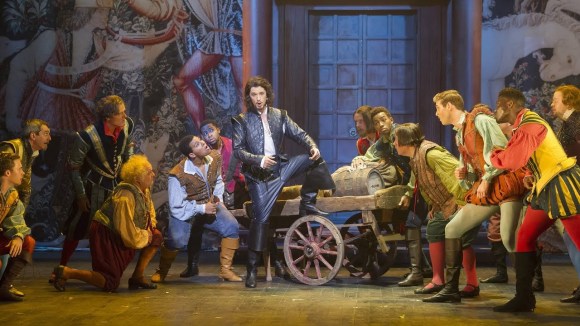
Cole Porter’s 1948 musical, Kiss Me Kate is a complex show, some of its numbers are  classic Broadway showtunes, while others have a light opera edge. It has complicated, full company dance routines as well as individual virtuoso displays. It also has a couple of good comedy roles that require great timing and delivery. On top of this, the Coliseum itself, has a big stage that needs a large company to fill. All in all, this is a show, in a venue, which will test every part of the company putting it on, to the fullest degree. I have to say that Opera North have passed this test with honours.

The two operatic leads, Quirijn de Lang and Stephanie Corley, as Fred/Petruchio and Lilli/Kate both have splendid voices, suited to their roles.  Zoe Rainey and Alan Burkitt, as Lois and Billy, carry the more standard musical numbers perfectly. Each of the four of them has at least one great song to show of their respective talent. Lois has possibly the most famous songs in “Always true to you in my fashion” and “Tom, Dick or Harry” but Kate’s “I hate men” and Petruchio’s “Where is the life that I led” are really great songs that show of their vocal abilities. The show’s biggest song, of course, “Too Darn Hot” is sung by the chorus, and the dancers, particularly Aiesha Pease and Stephane Anelli, deliver a truly show stopping performance to this number.

Kiss me kate 2

Joseph Shovelton and John Savournin play the comedy roles of first and second Gunman. They work very well together, their interaction is excellent and they make the most of their comedy duet “Brush up your Shakespeare” – a song more full of puns than I had previously realised. The company as a whole is excellent and you realise that this is going to be a show full of movement and vigour, right from the first song of “Another Op’nin’, Another Show”.

Kiss Me Kate is a big show, and this is a big full-on production of it. The costumes are bright and lavish.  The choreographer has a tough job, with so many people on stage at once, however the dance routines are vivacious and have lovely shape. The set design needs ingenuity too, and is very clever at swapping from front of stage to back of house in seconds.

The director, Jo Davies, has taken the bold decision not to update the show in any obvious way. At times, it felt like you were actually watching a show made in the 1940s, giving the show an interesting post-war period feel. The tap routine, in particular, had a dated, black and white movie quality, which suited the production very nicely. This is a lush and exuberant production of a distinguished show and it fully deserved the love it received from the packed audience at curtain down.
 

Categories
Theatre review

The Prime of Miss Jean Brodie, Donmar Warehouse, London WC2

jean B

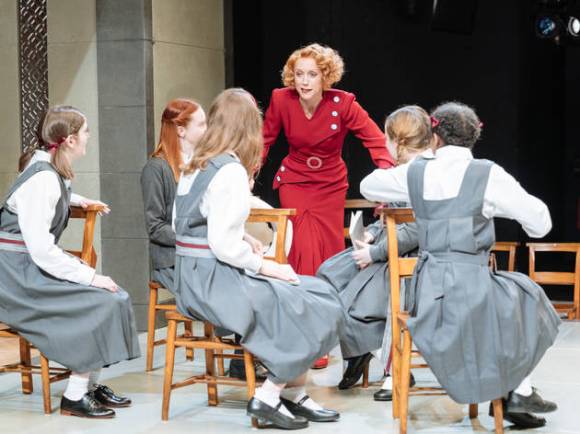
This is a new adaptation of Muriel Spark’s novel. David Harrower has changed the telling of the story, in some ways it is closer to the book than any of the previous adaptations have been. It is told in flashback rather than the flashforward of the book, but the main roles from the book are all here and their character foibles are more to the fore than in the 1969 film starring Maggie Smith.

The Jean Brodie of this play is more obviously manipulative, but still charismatic. She is a talented teacher, hugely influential, on the children she teaches. However, with great power comes great responsibility and the story is really about whether her personality allows her to use her talent to its best effect. There is no doubt that Jean Brodie is a fantastic role, although Maggie Smith – with her best actress Oscar for the part, makes it a brave soul who would be prepared to take it on. Lia Williams is amazing in the role, she really makes it her own. She shows us why the girls are so in her thrall, and she gives us an insight into why this is not necessarily always in their best interests.

The cast is small and all are good. Angus Wright is excellent, as usual, as Gordon Lowther, the music teacher whose love for Jean Brodie is not returned. His part, in particular, is more compassionately written here than in other versions, this works well as a contrast to the more dissolute role of Teddy Lloyd.   I really enjoyed seeing the role of Joyce Emily brought forward in this adaptation. Nicola Coughlan is really good in the part, I think we will be hearing that name much more in the future.

The set is simple with clean lines and cool colours, reminiscent of Rennie Mackintosh. There is also a kind of Japanese Shinto influence with different bells arranged around the set, ringing intermittently before the start and during the interval, ensuring that we are all in a state of relaxation before the action begins.

The Prime of Miss Jean Brodie is a great book and this is a lovely new adaptation of it. The dialogue is crisp and clear, the characters are sympathetically written, and the acting is top class. It is playing until the end of July, I know the Donmar has a tendency to sell out very quickly, but if you can get your hands on a ticket, then I would recommend that you do.

Categories
Theatre review

Translations, National Theatre, Southbank, London SE1

translations-5997-680x297-20180223

Translations is set in Donegal in the 1830s. Ireland is under British control, but most of the population do not speak English. It is at a time before the famine has set in, but people know of the blight and are aware of the damage that a potato crop failure can do to a  community. Ordinance Survey has sent teams of men to map the countryside and to standardise place names. Education had not been allowed for Catholics, so the practice of illegal hedge schools operated throughout Ireland. One of these schools is the precise setting of this play.

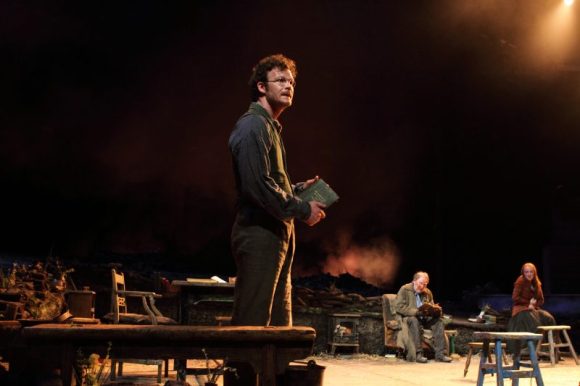
This is a play about language, the effect language can have on culture, how we can communicate with it and also about how we can communicate without it. This makes it quite an intimate piece and the Oliver Theatre, The National Theatre’s largest space and stage, does not appear to be a natural home for it. However, Rae Smith, the set designer has done an amazing job and used the space to great advantage. The hedge school is a small, low walled area right at the front of the stage and the rest of the area is peat bog stretching out into the distance, covered by the gently rolling mist that is prevailing climate of the region. Thus, we have the intimacy of the small school and the expanse of the area that is in the process of being mapped.

Seamus-OHaraManusDermot-CrowleyJimmy-Jack-Michelle-FoxSarah-in-Translations-image-Catherine-Ashmore-e1527175613872

Brian Friel was, he died in 2015, a wonderful playwright and Translations is a virtuoso display of his skills. The play itself may be about the power of words but the main love scene is between two people without a common language. It consists mostly of lists of place names, and is still a very moving piece of theatre. The director, Ian Rickson, has taken great care of the action, every entry and exit feels considered and the lines are all delivered deliberately, making you feel that each word has been carefully chosen.

The acting is of the highest calibre, Ciaran Hinds is as good as you would expect – and those expectations are high indeed. Colin Morgan is also very good, showing that he is aware that he is taking both sides, while denying it to all. Dermot Crowley, as Jimmy Jack Cassie, is a revelation, in a part as a humorous fantasist, who has to be credible to be funny. I also loved Michelle Fox, who managed to get us to feel a wide range of emotions even though her part has very few lines.

The thing that makes this production stand out for me, though, is the extraordinary way that Ian Rickson handles the final scene. The mechanism he employs, comes out of the blue and is gone in a flash, it adds a current reference to the play and suits it well. All in all, this is a beautiful piece of writing, beautifully presented and performed and I will consider myself to be very lucky if I see anything as good this year.


Categories
Attractions

Love London, Part 1. Trafalgar Square, Nelsons Column and Charles I, London WC2


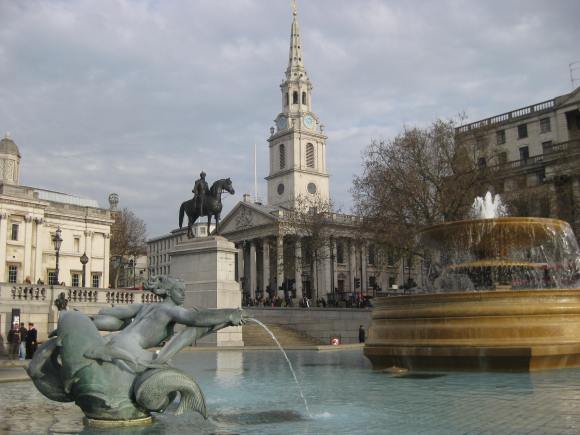
DSC_2999Trafalgar Square is a tourist attraction that is packed with both dramatic architecture and history.  It has a claim to be the centre of London, in both a physical and psychological sense. Other places have claims also; Bank, Buckingham Palace, Piccadilly Circus even Hyde Park Corner, but there are a couple of good arguments in favour of Trafalgar Square.
2014-11-29 13.12.11


It has been  the scene of major British public gatherings and demonstrations from soon after its opening right until the present day. It was the backdrop to the Poll Tax demonstrations in the 1990s, CND rallies in the 1960s and ’70s, Chartist gatherings of the nascent Labour movement in the late 1800s and more recently campaigns against Climate Change and the wars in Afghanistan and Iraq.

overview

Over the Christmas period it holds London’s most famous Christmas tree, a gift from Norway every year since 1947, as a thank you for Britain’s support during WWII. It was also the traditional gathering place for London’s New Year celebrations until the crowds became too big and deemed too dangerous to have at a single venue.

Trafalgar Square was designed in 1826 by architect John Nash, it did not really begin to take shape until the late 1830s when the National Gallery was built in 1838. It is named after the battle of Trafalgar, a famous 1805 victory over Napoleon.

Nelson


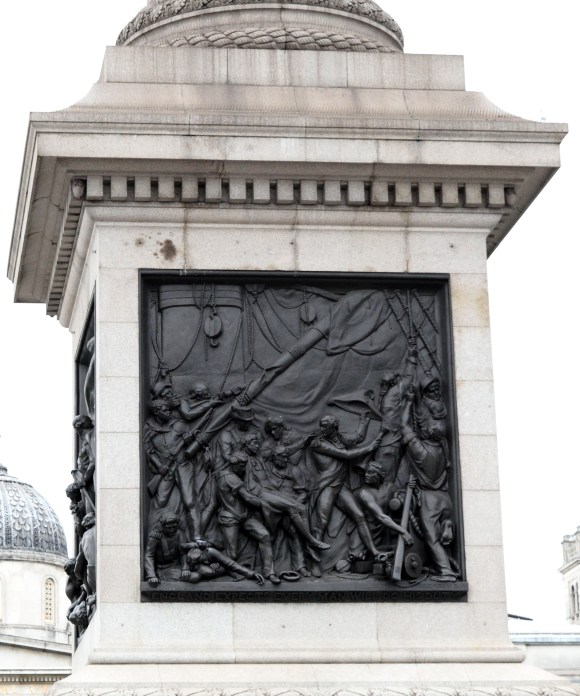
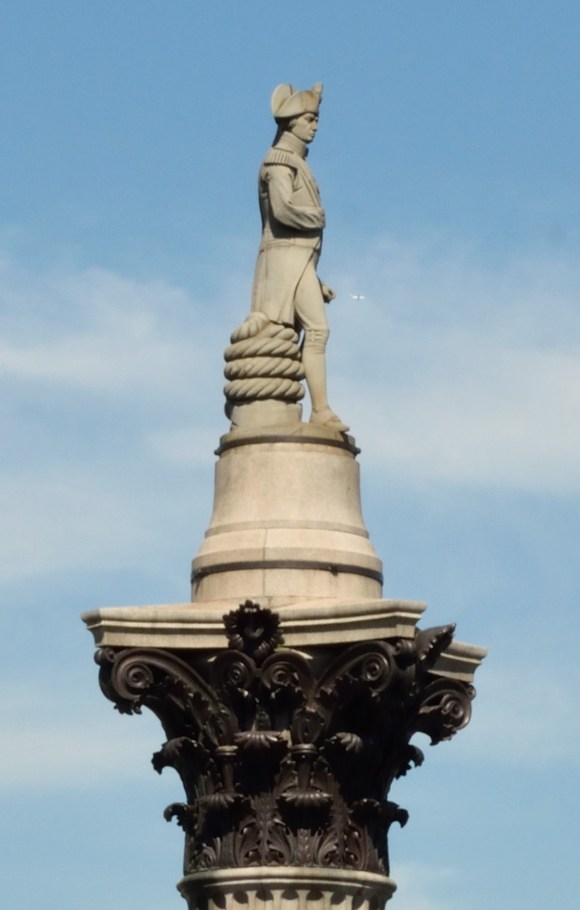
The centrepiece of the square is Nelson’s Column; a monument to the leader in that battle. This was erected in 1843 just before the square became a public area. It is a 43metre high, granite column with a 7metre statue of Horatio Nelson on top. The column itself is a Corinthian column, having an ornamental top. This ornament is made from British cannons.  There are also bas-reliefs on each side of the column at the bottom, depicting earlier famous British war victories and these are made from the melted down remains of weapons captured from the French and Spanish armies. Famously, the stonemasons who built the column are reputed to have had dinner served on its top, before the statue was placed.

DSC_3001

The Lions at each corner of the column were designed by Edwin Landseer and were installed in 1867. They are made of bronze and each one weighs over 6000kg. The fountains at either side of the column, were added later. The current fountains were designed by Edwin Lutyens and added just before the start of WWII. Trafalgar Square as a whole is Grade I listed, which is the highest level of architectural protection in the U.K. awarded only to buildings of exceptional interest.

2014-11-29 13.17.22

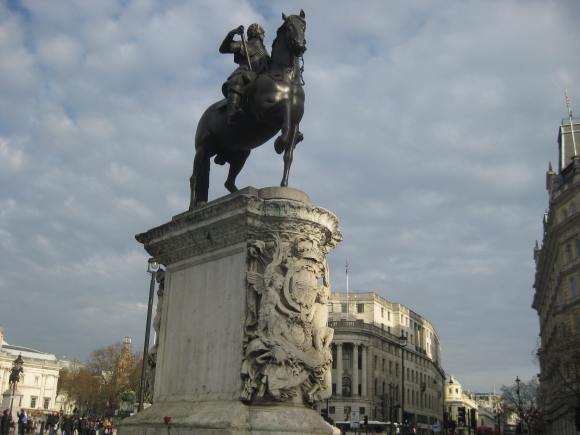
The oldest statue is to the South of the square. It depicts Charles I on a horse. This was made in 1633 and sent to be melted down after the abolition of the monarchy in 1653. The brazier to whom it was given, made his fortune selling trinkets made from the melted down statue, but he had kept it intact to return to the crown on their reinstatement. This is also what Trafalgar Square its claim to be the physical centre of London, as it is to the base of this statue that official distances to London are historically measured.

You may have heard that all the distances to London are measured from Charing Cross. This is true. The Charing Cross was one of 12 crosses placed by Edward I in memory of his wife Eleanor. It was originally in the spot currently occupied by the equestrian statue of Charles I. It was destroyed by order of Parliament after the civil war. A replacement cross was built and placed in front of Charing Cross station during the reign of Victoria. There is an original Eleanor cross still standing, from 1294, in Waltham Cross.

Part 2 of the Trafalgar Square post is here: Love London Part 2. Trafalgar Square, George IV, Victorian generals and the Fourth plinth.


Categories
Theatre review

Antigone, Greenwich Theatre, London

anitgome_slide_drones

The Actors of Dionysus are touring the UK at the moment with this, a sci-fi tinged modern adaptation of Sophocles’ two and a half thousand year old play. Antigone, a Greek tragedy, has never really been an easy watch, but this adaptation has definitely made it more accessible.

Christopher Adams has written, a well thought out, updating of the play. I enjoyed the conceit of making the chorus of the original into the hive mind of linked computers. I thought the idea of making the soul into a chip that needed to be removed and uploaded worked well and gave us a good insight into Antigone’s motivation and into Creon’s harshness at refusing to allow it.

The stage setting is interesting, I guess touring made the set need to be as simple as it was, and I liked the current touches, the surveillance drones are particularly clever and fitted very well with the story and setting. The simplicity of the set did emphasise the universal themes of the play.

I found the acting good and I enjoyed the way each character pushed their agenda. I particularly liked the change in Creon from harsh dictator to broken soul. The well intentioned but misguided leader delivering tough love for the good of the populace can be a hard sell at times, but he brought it off well.

It is a Greek tragedy, so we cannot expect a happy or wholesome outcome, however it is a tribute to Antigone’s universal themes that it is still being performed over two millennia after it was written and this is as enjoyable and accessible a production as you are likely to see anywhere.  Thoroughly recommended.the

Categories
Theatre review

Jekyll and Hyde, National Youth Theatre, Ambassadors Theatre, London

©NOBBY CLARK
+44(0)7941-515770
+44(0)20-7274-2105
nobby@nobbyclark.co.uk

The National Youth Theatre’s production of Jekyll and Hyde is a deconstruction of the original novella by Robert Louis Stevenson, rebuilt with a modern feminist twist by writer Evan Placey. Combining Victorian settings and morals with modern day language and values adds a new dimension to the duality theme of the story.

The decision to have a female Jekyll is not only brave but astute, and this production perfectly captures the zeitgeist with the discussion about sexism in film and theatre so much in the news. The writing is forthright, the jolt of the coarse language spoken by the Victorian ladies near the start of the play becomes clear in the second act, there is no doubt that Evan Placey is a talented author, of whom we will hear more in the future.

Aside from the writing there is much to recommend in this production. The acting throughout is accomplished. Jennifer Walsh in particular is excellent as Florence, a young adult coming to terms with the fact that although no one else is going to stand up for her, she has the power to stand up for herself.  Elizabeth McCafferty confidently makes the transitions between Jekyll and Hyde both striking and convincing. Mohammed Mansaray has a funny scene as a priest, which he delivers very well.

©NOBBY CLARK
+44(0)7941-515770
+44(0)20-7274-2105
nobby@nobbyclark.co.uk

The direction is brisk and contemporary, so that even in the midst of 19th century London, we feel linked to the current day. The director, Roy Alexander Weise, is not afraid to be confrontational, daring to breach our comfort zone in order that we feel the characters’ anger. The costume design is remarkable and clever, the ensemble changes from church house to flop house in the blink of an eye.


©NOBBY CLARK+44(0)7941-515770
+44(0)20-7274-2105
nobby@nobbyclark.co.uk
Pictures courtesy of Nobby Clark


Jekyll and Hyde has a few rough edges, but challenging, thought provoking productions like this are exactly the remit of The National Youth Theatre and I have to say that I thoroughly enjoyed this show.

Categories
Theatre review

Hershey Felder, Our Great Tchaikovsky, The Other Palace, Victoria, London

Hershey-Felder-as-Our-Great-Tchaikovsky_3

Hershey Felder has spent the last two decades recreating, on stage, the lives of great composers, while playing their music to highlight salient moments from those lives. Tchaikovsky is the sixth in this series. The genre is part biography, part piano recital.

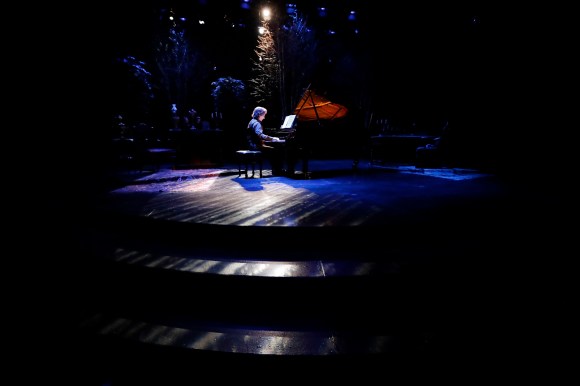
The stage is set to resemble a room in his dacha in Klin, with rugs, cabinets and a baby grand piano. There is a large portrait over a writing table, whose likeness changes to whoever he is speaking about. The backdrop to the set also has illustrations which change to reflect different periods of his life.

Felder begins the show by coming on to the stage with a letter he has received from the Russian Government inviting him to bring his story of the life their greatest composer to be performed in his home country. He asks the audience whether he should do this.  This is a rhetorical question, as the difference between his account of Tchaikovsky’s life and the official Russian version is vast, and it seems unlikely that Hershey Felder’s telling of events would prove popular there.

Tchaikovsky’s story is told by picking out individual snippets of his life, mostly in chronological order, and combining them with music that he was writing or performing at the time. The effect is like an entertaining lesson combined with a piano recitation by an inventive and musically talented professor; imagine one of the best university lectures that you have attended and you won’t be far wrong.

Hershey-Felder-in-Our-Great-Tchaikovsky_4

Hershey Felder has chosen which events to recreate, so we are given the narrative from his point of view, and he makes us aware that others may look upon his life differently. For me, who liked Tchaikovsky’s music, but who knew hardly anything about his life, it was a perfect combination. I was given an insight into the man while listening to an accomplished pianist playing his greatest hits.review

Categories
Attractions Exhibition

The Wallace Collection, Manchester Square, London WC1.


Franz Hals, the Laughing Cavalier
The Laughing Cavalier


The Wallace Collection is a must see museum/gallery if you come to London. The items on show were bequeathed to the nation in the late 19th Century and have been on display here since 1900.

The Shepherd, Van Dyck.JPG
Van Dyck, The Shepherd Paris

The number and quality of the Old Masters from the 15th to the 19th century is amazing. It has some of the finest examples of 18th century French furniture in existence. There is also a rich assemblage of porcelain, sculpture and royal amour in the collection. One of the more unusual pieces is a particularly ornate cannon.


Cannon

Many of the pieces were bought during the sales of art following the French revolution, which is why the collection is so strong in 18th Century French art. Such good examples of the Louis XV cabinets and marquetry cannot be seen anywhere else in the world.

Vases

A condition of the bequest was that none of the pieces ever left the collection, even to go out on loan. So if you ever wish to see, say, “The Laughing Cavalier” or Canaletto’s “View of the Grand Canal” you have to come here.


Canaletto, the Grand Canal
Canaletto, The Grand Canal


It is astounding to discover that it is free to visit this collection, although they do ask for a donation. It is also surprisingly quiet, compared to the other, bigger museums and galleries in London. This is presumably because it is not in the main exhibition area of town, although you could argue that, situated between Oxford Street, Baker Street and close to Selfridges, it is even more central than those in South Kensington.


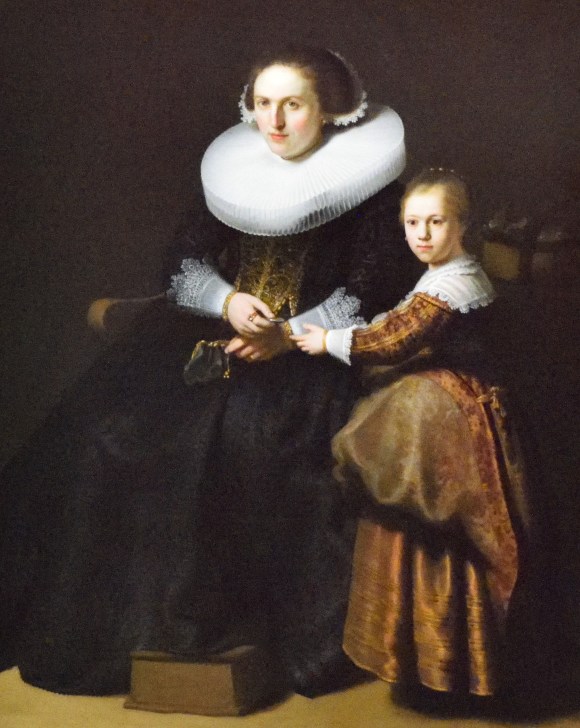
Rembrandt, Susanna van Collen and Anna
Rembrandt, Susanna Van Collen and her daughter Anna


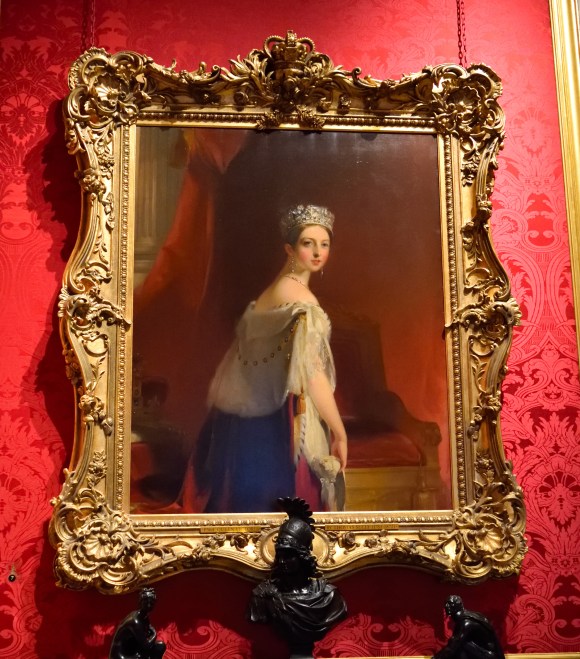
Notable among the Old Masters in the collection are 5 Rembrandt, 4 J. W. Turner, 8 Canaletto, 2 Titian, 12 Reynold, 5 Cuyp, 2 Gainsborough….. the list goes on, it is an amazingly rich and full list. There is even a wonderful portrait of Queen Victoria from 1837, when she was newly ascended to the throne.

Queen Victoria 1837.JPG

The Wallace Collection should not be missed when visiting London. Bring your friends when you visit, and you will surprise them with both the quantity and the quality of the art here. Given how quiet it tends to be, even in the summer, I am going to count this as a hidden gem, and I recommend it heartily.

Categories
Attractions Days Out

Southwark Cathedral, London SE1


Wooden effigy of Unknown Knight
Reputedly the oldest wooden effigy in Britain


Literally a few steps away from the hustle of Borough Market is the calm oasis of Southwark Cathedral. It is a wonderful mixture of old and new. It contains a wooden effigy of a knight from the 13th Century, reputedly the oldest in Britain and its Northern cloister was opened in 2001 by Nelson Mandela.

Shakespeare

There are monuments and memorials from many time periods in between. There is a stained glass window and bas-relief dedicated to Shakespeare, his brother Edmund is buried here. The Cathedral is on the South Bank of the Thames where many of the theatres used to be in Shakespeare’s time.


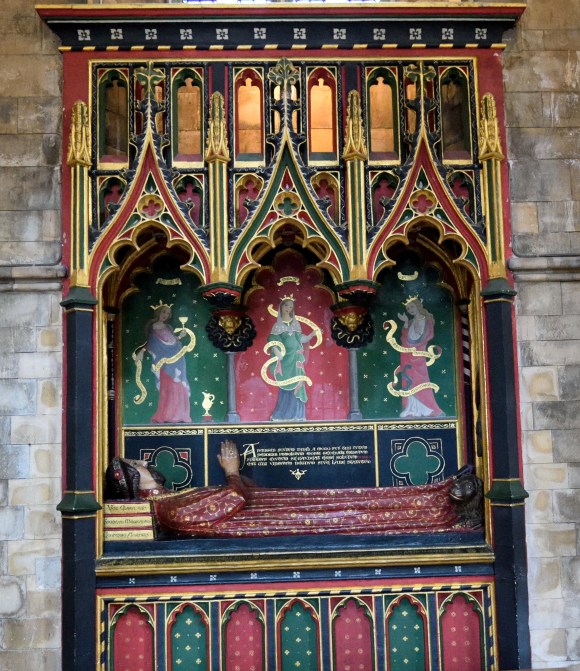
Tomb of Thomas Gower


There are tombs of quite different types, from the multi-coloured wooden one of the poet, Thomas Gower, a contemporary of Chaucer, to the more austere and eerie one of Thomas Cure, a 16th Century parliamentarian.


Thomas Cure
Tomb of Thomas Cure


There are memorials to those who lost their lives in both the first and second world wars, victims of the Marchioness sinking in 1986 and Isabella Gilmore, the first deaconess of Southwark. There are also monuments to both Nelson Mandela and Desmond Tutu.

Deaconess memorial

While you are here don’t forget to look at the fixtures and fittings in the building. The black marble font and outrageously ornate wooden cover, at the nave of the church is one highlight, the eagle lectern, near the altar is another.

Lectern

Added to all this is the architectural splendour of the Cathedral. There are details here from a whole range of different engineering periods. The vaulted ceilings in the main church are beautiful, but the marble bricked ceilings in the naves are equally so.

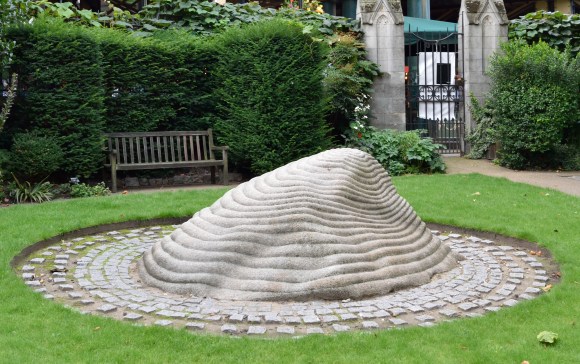
Sculpture
Walk through the church into the garden and you can sit in verdant peace, with the noise of the market in the background. There are a couple of unusual sculptures here, but the flowers are beautiful. An often overlooked gem in the heart of tourist London, just the place to dip in to, if you feel the need to step out of the boisterous city for a quiet break.

DSC_3270

Categories
Theatre review

Blue Stockings, The Yard Theatre, London E9

The-cast-of-the-National-Youth-Theatre-production-of-Blue-Stockings-at-the-Yard-Theatre-CREDIT-Helen-Murray

It is a shocking fact that women were not allowed to graduate from Cambridge University until 1948. This play is set 50 years earlier and concerns four ladies who attended Girton College, Cambridge at the end of the 19th Century. It is a well written and cogent drama about the beginnings of the women rights movement. it gives voice to all points of view at that time, ranging from those who believed that education would distract women from being good wives to those who thought that noisy demonstration calling for immediate emancipation was the only way forward.

The Yard is an interesting theatre space, the seats are close to the action, but the wide stage and high ceilings make it very open. I really like the apparent simplicity of the direction, schoolroom projectors set the scenes, blackboard writings mark us as being in a classroom, a pictures of an orchard or Van Gogh’s night sky move us outdoors. This is inventive and effective.

The quality of the acting is very high and there are nice performances even in the smaller parts. Mischa Jones is fabulous as Tess, she brings a nice balance of intelligence and innocence to her role. Laura Trosser has a great part as Miss Blake, resolutely playing the long game in the fight for equality and she plays it perfectly. I really liked Quinton Arigi as Will, whose position changes as the story develops.

Blue Stockings is part of the National Youth Theatre of Great Britain’s East End season at The Yard Theatre. It is a sterling production of a very good play, in an engaging venue. I will be looking out for more Jessica Swale written plays. It has also made me look forward to seeing the next play in the season, “The Host” and their revival of “Zigger Zagger” at the Wilton Music Hall, next month.

A thoroughly enjoyable evening. Recommended.