Categories
Theatre review

Who’s Afraid of Virginia Woolf, Harold Pinter Theatre, 2017

35425_full

Who’s afraid of Virginia Woolf perfectly illustrates the difference between the questions “Was it good?” and “Did you enjoy it?”

This is a fantastic play, and a wonderful production of it. The acting was immense from all four characters. Imelda Staunton was as brilliant as you would expect, there is nobody better at making you understand the frailty of a dark, flawed individual, and she can change from a vicious harridan to a seductive, provocative vamp in the blink of an eye.  Conleth Hill was a revelation, he lives that part – how he can keep up that intensity for three hours per performance is incredible.

The direction is sparse, keeping you focussed on the people and the set is simple but effective. Three hours is long for such heightened emotions but the time flew by because of the compelling nature of the character interaction. However, it is comparable to watching a car crash in slow motion because, the farther you move into the play, the stronger the realisation becomes – that there can be no happy conclusion here. The only option is to sit and watch in morbid fascination, to see just how bad the casualties will be.

So, I did not enjoy it very much, it wasn’t written for enjoyment, but this does not prevent it being one of the best plays on in London at the moment.

The audience really appreciated their effort, it is a rare thing these days to see the whole audience stand in ovation from curtain down, but they did here, and this was truly deserved.

If you get the opportunity to see this production, I recommend that you gird your loins, prepare yourself mentally, but definitely go.

Categories
Film Review music

20th Century Women (dir. Mike Mills) 2016

centurywomenposter

20th Century Women is an interesting dissertation on motherhood – from the point of view of a son.

It is thoughtful and thought provoking. It has three strong female characters all of them well rounded and likeable. All three of them are excellently played and I am surprised that none of them were nominated for an Academy Award. The male characters on the other hand are less fully built and a little more caricatured.

I enjoyed the direction of the movie, Mike Mills made the narrative almost unimportant compared to the development of the characters, but completed their arc by giving a short profile of each character as they were introduced and a short synopsis of their life after the movie at the conclusion. I found this satisfying.

The Soundtrack is an odd, but not unpleasant, combination of new wave, punk and easy listening. It has been nominated for an Academy Award for Best Original Screenplay, and, you never know, it could win. The screenplay is funny. I liked this film, it passed two hours very pleasantly. I suspect though, that in 5 years time, it’s one of those movies that I will sit on front of, on Netflix, and say “Oh yes, I’ve seen this, and I think it was good!”


Categories
Books

Sense and Sensibility, Jane Austen, 1811

sense-and-sensibility

Jane Austen was one the early successes of the self-publishing phenomenon. Sense and Sensibility was her first novel to be published and she underwrote the not inconsiderable costs of the first print run of 750 copies herself. Luckily they all sold and she made a reasonable profit.

Sense and Sensibility is a romantic novel about the coming of age of two sisters at the end of the eighteenth century. It gives a very good insight into the manners and the lives of the rich and of the upper middle class of that time.

This book is easy to read, it eschews the flowery, verbose writing of the time and is succinct and to the point. It is surprisingly funny; Jane Austen pokes gentle fun at the attitudes of her characters and she demonstrates very cleverly, how they convince themselves of their prejudices.

I enjoyed this book as well for its historical information on London. I loved that it is possible to tell which areas and streets were fashionable and which ones were more racy, in the 1790s, by the characters that lived there.

The language has changed slightly in the 200 years since it was written, but Jane Austen’s thoughts are simply put, so the differences are interesting to notice rather than difficult to understand. A case in point is the word sensibility in the title; this is a word that not much used any more, we would be more likely to use the word sensitivity, these days.

As an introduction to classic writing of the late 18th century, Jane Austen is as easy and enjoyable a venture as you are likely to find. I am looking forward to reading her next novel, Pride and Prejudice, and to watching a film adaptation to this one.

Categories
Restaurant review

The Café in the Crypt, St-Martin-in-the-Fields, Trafalgar Square, London

st_johns_crypt_cafe

If you are near Trafalgar Square, Charing Cross, St Martins Lane or the National Gallery, there is a lovely little hidden café underneath the St Martin-in-the-Fields church.

You enter by going downstairs in a circular glass structure in the wide alley just to the North of the church.

Once you are downstairs you will be in a large atmospheric crypt with beautiful arched vaulted ceilings. The acoustics are great, even when it is full you can hear your party’s conversation without difficulty.

The floor is flagged with large stones and some very old gravestones. There are busts of famous ancient Londoners  dotted throughout, in hidden alcoves.

It serves very good food; soup made on the premises, nice hot dishes that change from day to day, lovely cakes and biscuits and it is licensed, if you fancy a glass of wine with your lunch.

There is a good choice for vegetarians too.

If you a looking for somewhere that is right in the centre of tourist London that, perhaps, most tourists might miss, then this is just the place.

A real hidden gem!

10049088

The picture above is of the entrance, in case you miss it. It has Jazz evenings on Wednesdays. Oh and the church that it is beneath, St Martin-in-the-Fields, is not to shabby either!

Categories
Exhibition

Picasso Portraits, National Portrait Gallery, London 2016/7

pablo-picasso-self-portraits-chronology-7

There are a lot of pieces of art in this exhibition, and many pieces that I haven’t seen before. Picasso was prolific, he had a very long productive span and it is interesting to see pieces here from each part of it.

His portraits are representative of his career in general, in that some of them appear disposable, some are sublime, but all are interesting. Some are interesting because they show his amazing technique, others because they give us insight into the character of the model and some because they shed light on his own disposition.

There are probably close to 100 portraits here. A cubist bust of Fernande Olivier is technically wonderful, a childlike painting of his daughter, Maya, at 2 is moving. A metal 2 dimensional bust of Jaqueline is clever and inventive.

There are many portraits of Olga, his wife, showing varying aspects of their relationship. The most famous of these is probably “Woman in a Hat” painted towards the end of their marriage which manages to be both beautiful and cruel.

There is also a doctored photograph of Esther Williams that is misogynistic and insulting.

I left the exhibition thinking that I really like Picasso the artist, but I doubt that I would have liked him in person.

Perhaps, this is what made him a great artist – he was able to display to us how he felt, but did not care how we felt about him.

It is a show that I would consider returning to, but £17.50 (without the expected £2 donation) a time, would discourage repeat visits. However, I felt it worth the money overall.  The National Portrait Gallery is free (expected £2 donation) for general entry and is packed with lovely stuff.

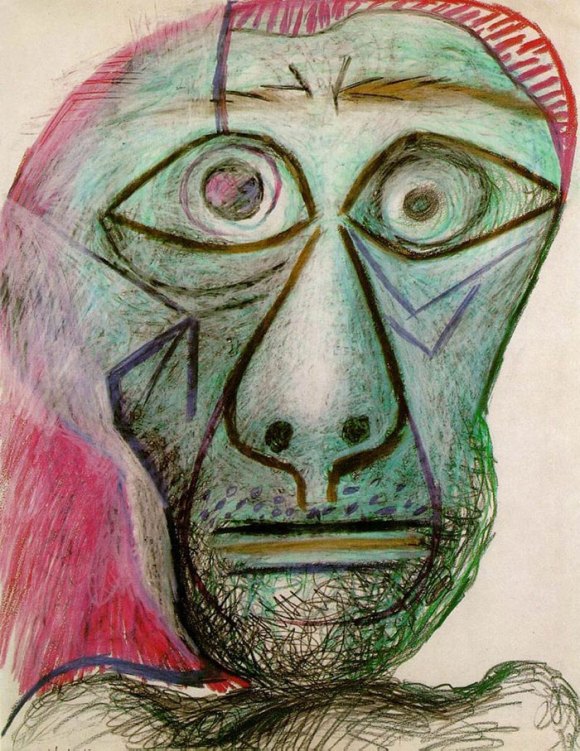
The pictures at the head and foot of this article are self-portraits, at 15 and at 90.

pablo-picasso-self-portraits-chronology-4


Categories
Film Review

Locke (dir. Steven Knight) 2013

stevenknightlocke-poster

This is basically a single-room, dialogue only film. Except that the room is a car being driven from the Birmingham to London, and there is only one person in the car.

Tom Hardy plays Ivan Locke, a man organising change on his phone after making a life altering decision.

The concept does not sound promising but Steven Knight shows off his immense skill as a scriptwriter here and Tom Hardy turns in a monumental and understated performance, making this a movie that will stay with you long after the titles roll.

This is not a film to get you in the mood to go out or even to see with a group of friends and pizza, because it is not a light easy watch.

If you are in an introspective mood and want to see a thought provoking film, this will repay your time many times over.

Great writing and a great performance. I really enjoyed this.

Categories
Theatre review

“Art”, The Old Vic, London 2016/7

4809

I saw Art in 1996 when it first played the West End. Back then I loved it and gave it 5 stars. It is still a really good show, discussing interesting themes; aging, friendship and art. It has dated a little bit, some of the references are old fashioned, a couple of the arguments are a less convincing now, society is less in awe of money than it was then. Having said that, most of the lines are still funny and none of the questions it raises have been resolved.

This production is (if I remember correctly) almost identical to the one from the 1990s and might have benefited from a couple of small tweaks. The acting is good, Paul Ritter as Marc was wonderfully aggressive and argumentative, I was less convinced of Rufus Sewell’s love of his painting and Tim Key played it for laughs and was genuinely funny.

Overall, I enjoyed this production and will happily go to see it again in another 20 years!

Categories
Attractions Exhibition

The Royal Academy of Arts, Piccadilly, London

hobpyhisarfjseeyayaq

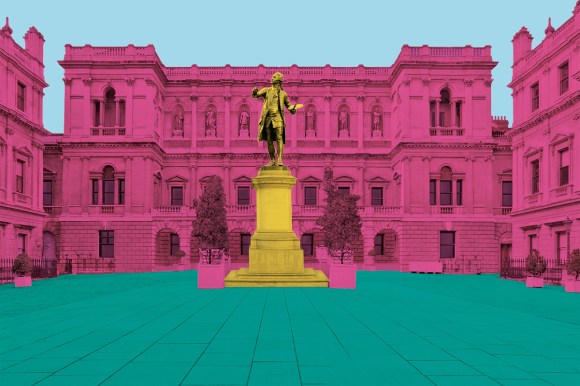
The Royal Academy of Arts’ gallery is on Piccadilly, it is directly across the road from Fortnum & Mason.

The Academy was founded in 1768 by King George III. They have many varied exhibitions throughout the year. These include single artist exhibitions, for example, Hockney and Ai Wei Wei have been on so far this year. There are also themed shows containing many different artists. “Painting the Modern Garden” included works by Kandinsky, Monet and Matisse. Next years “Revolution: Russian Art 1917-1932” will have Chagall, Rodchenko and Eisenstein among others.

The highlight of their year is the Summer Exhibition, on open submission exhibition, to showcase the talent of emerging and established artists. The first one was in 1769 and it has run every one of the 248 years since. This is a huge and wide ranging exhibition usually holding over 1000 pieces, of every shape, size and medium. Most of the works are for sale differing in price from a hundred pounds to hundreds of thousands.

The gallery is nominally free, but most of the exhibitions are charged, so choose what you wish to see.

The Summer Exhibition is good value, although I take off the voluntary donation and only buy one list of works for the whole party, the cost of these is automatically added unless you ask for them to be removed.

The Royal Academy is  self funded so do as your conscience sees fit!  Personally, I don’t feel too guilty as they charge 30% commission on any work sold.

Categories
Exhibition

82 portraits and 1 still life, David Hockney, Royal Academy, 2016 London

01_hockney

This exhibition is like a scientific experiment into the nature of portrait painting.

All the portraits are exactly the same size and shape. They are all full body portraits of a subject sitting in the same, yellow cushioned, wooden chair. They all have roughly the same, green and blue, background and each one was painted over the course of 3 days. They are all very recent – some only painted in February and March this year. There are 83 paintings crammed together in 3 small rooms, the walls painted in a matt magenta. A couple of people are pictured twice and one person three times over the course of the exhibition.

The individual portraits themselves are very good; Hockney is a fine portrait artist, but this is a single piece of work and it is seeing the whole exhibition as a unit that transforms this into an exceptional show. The uniformity of the portraits in terms of size, colour, and time, makes one notice the differences between them; the pose, the clothes, the gaze.

I don’t think of it as 83 individual pictures, I see it as one portrait of 83 individual sittings.

This is David Hockney at his best; confident, relaxed, colourful, witty and experimental.

I left very happy.

Categories
Attractions

The Hive, Kew Gardens, London, 2016

IMG_0909.JPG the hive

The Hive is a work of art that has come to Kew Gardens for a visit form Milan. It is an interactive piece and it is unique in that it allows the visitor to interact with bees. These bees are in a hive somewhere else in the gardens and their activity alters the look and sound of the installation.

It is an impressive structure from the distance. As you approach, it looks a little like a huge rectangular swarm of bees hovering over the park. When you get closer, you can see and hear its vibrancy and as you walk inside, it hums, throbs and gently changes colour with 1000 LED lights flickering. The work also contains an area where you can put a lollipop like stick into your mouth in order to mimic the method of communication of bees.

The Hive is both informative and interesting. It is also strangely relaxing in the way it filters the light as you sit inside sheltering form the sun on a warm London day. I would recommend not to rush through the artwork, it repays time spent there. The summer wildflower meadow on the walk up is beautiful too.