Categories
Theatre review

Lady Windermere’s Fan, Vaudeville Theatre, London 2018

lady w

This is the second play in Dominic Drumgoole’s Oscar Wilde season in the West End and it is directed by Kathy Burke. I attended this production with some trepidation because, although I really admire Oscar Wilde and find him very witty; his plays are full of arch bon mots, but this can make his characters cool and short on compassion. I often find myself laughing at what they say but I have little empathy for their plight.

However, Kathy Burke really brings out the difference between how the actions of men and the actions of women were perceived, by society, at the turn of the last century. She makes us aware of how sympathetic Oscar Wilde was to that difference. He demonstrates real dexterity in pinpointing this and he mocks it mercilessly. This is a  modern take on a play that is ultimately about the empowerment of women. Sam Spiro is excellent as Mrs Erlynne, the unrepentant scarlet woman, she perfected the brittle, sharp exterior protecting her secret and the emotions she did not wish to show.

Jennifer Saunders plays The Duchess of Berwick, in full-on dame mode. She sails into each scene with a new wonderful hat, drops her witty insights, sows the seeds of anarchy, and sails off. A wonderfully written cameo role, beautifully delivered.

It is the men in this play who are shallow. They are the real figures of fun, Joshua James is good as the insecure but supportive Lord Windermere.  Kevin Bishop is excellent as Lord Darlington; charming and in love, but likely untrustworthy. The scene with all the male characters, drunk, in the library is well done and very funny. This play is so full of famous lines that occasionally it feels like a litany of Wildean quotations.

lady w3


The set is cleverly done, all pastels and relatively simple, with echoes of the titular fan throughout – the shape of the windows and even the motif on the stage curtains. This is in contrast to the costumes.  The men are formal, I am convinced that Lord Darlington and Jacob Rees-Mogg have the same butler. The ladies are dressed in full rich concoctions designed to demonstrate a time when it was more important to show off ones wealth than ones taste.

Being a play in four acts, there is an entr’acte between the first and second and between the third and fourth. These were not written by Wilde and they felt out of place, the humour was crude by comparison, but they were common at the time of writing and it did give the production a period feel.

This was a very good production of a sparkling play, it made me see Wilde’s writing in a new light and I am looking forward to seeing the others in this promising season.



Categories
Theatre review

Fanny and Alexander, The Old Vic, London SE1

the-cast-of-fanny-alexander-the-old-vic-photo-manuel-harlan-045

Fanny and Alexander is a play to luxuriate in. Sit back, relax – and let three and a half hours of rich storyline, beautifully performed, draw you away into another world. Don’t feel guilty about it, for – as the moral of this tale has it – it is good for the soul to give in to pure pleasure occasionally.

The acting in this show is a wonder to behold, it is full of larger than life characters, but there is never a hint of pantomime or showboating. The play (and the audience too, on the day I attended) is crammed with the best actors that London has to offer. Penelope Wilton is amazing as the matriarch with a past, holding the family together. Jonathan Slinger is excellent as a slightly sleazy but unapologetic sybarite. Kevin Doyle brings out the best (and worst) in the ascetic bishop. Michael Pennington is fabulous as Isaac, the puppet master bringing the action together, seemingly from the periphery, but not as detached as he appears. Guillermo Bedward played Alexander in the show I watched and he was very good, both funny and serious.

Much of this play is set around various dinner tables, often accompanied by a list of the food on the menu. Fanny and Alexander itself is a feast of all the best that London theatre has to offer. You will be transported, indulged and you can wallow in an evening of rich extravagant entertainment. The set is simple but clear, I really liked the austerity of the room in the second act. The choreography is clever, just organising the many scene changes with such a large cast must have taken careful organising. It was a pleasure to watch great theatre unfold before your very eyes. I loved this show and the time flew, it was one of the most rewarding afternoons that I have ever wasted!

Categories
Gigs

Shoreditch Takeover, Shoreditch Town Hall, London

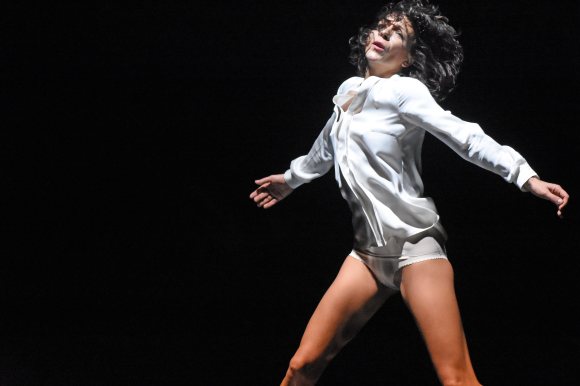
DU17-Lisbeth-Gruwez-1-Credit-Luc-Depreitere

Shoreditch is the centre of cool in London at the moment, so you would expect its contribution to the Dance Umbrella Festival 2017 to be cutting edge and innovative. On both these counts it certainly delivers. Shoreditch Takeover is made up of four very different pieces, happening in separate spaces within the beautiful old building that is Shoreditch Town Hall. Twenty first century art within nineteenth century architecture.

First is Rays, Sparks and Beating Glows. This is choreographed by Julie Cunningham and is an intense piece, about gender and feminism, for four dancers. It is performed without music, although there is some spoken word towards the end.

Next is Vanessa Kinsuule, who is a wonderful poet. She is, witty, insightful, nostalgic and honest. She has a winning personality, who can really involve an audience and the introductions to the poems are almost as good as the poems themselves.  Her whole set is great and the poem about an evening, dancing at a nightclub, is a highlight.

The third set is Lizbeth Gruwez dances Bob Dylan, a personal interpretation, exploring the edges of dance. For “Knockin’ on Heavens Door”, Lizbeth stands with her back to the audience at the front of the stage and walks, slowly and beautifully, to the back. You haven’t seen minimalism in dance until you have watched this. The Bob Dylan tracks are played on vinyl and are quite scratchy at times, invoking images of drunk and stoned nights in 70’s bedsits.

The final work is a film, The Shadow Drone Project, cleverly filmed from above, where the actual bodies of the dancers can hardly be seen, but instead we watch their shadows interact with each other. Some of this appears choreographed and some not, blurring the line between formal dance and how our brains make patterns.

All in all, a varied and interesting night in a lovely venue, a good addition to the Dance Umbrella Festival 2017.

Categories
Theatre review

Othello, Ambassadors Theatre, London. National Youth Theatre of Great Britain.

The-cast-of-Othello-by-NYT-in-association-with-Frantic-Assembly-at-the-Ambassadors-Theatre-CREDIT-Helen-Murray

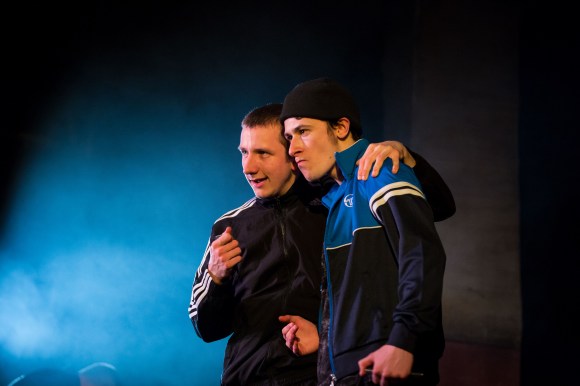
This is a fantastic production of Othello. The adaptation, by Frantic Assembly, was first performed by the National Youth Theatre in 1996 and this is an updated revival of that show.  The action has been brought into a contemporary setting, a dodgy looking pub where the tension and bravado are palpable and only the tough survive. Othello’s army is a neighbourhood gang. Shakespeare’s language fits in surprisingly well and the themes feel current and accessible.

The opening is a long wordless dance sequence that sets the scene. Its shows us the relationships between the various gang members, and their place in the hierarchy. The choreography is energetic and modern. The, usually awkward, fight scenes are handled with aplomb. The set looks simple but even this is extraordinary and comes into its own in moments of heightened tension.

Mohammed-Mansaray-in-Othello-by-NYT-in-association-with-Frantic-Assembly-at-the-Ambassadors-Theatre-CREDIT-Helen-Murray

Every actor is very good. Megan Burke is a hard-as-nails Emelia, who won’t be talked down when it comes to getting justice for her friend. Rebecca Hesketh-Smith is a sweet but upfront Desdemona. Curtis John Kemlo plays Roderigo as puny and weak, bringing an interesting new perspective to the role. Mohammed Mansaray, as Othello,  is tender in love and harsh in anger.  Jamie Rose steals the show as Iago, playing him as a shifty, cheeky chappie, with sly winks and gestures, letting the audience in on his secrets, while behaving abominably. I see a Bond villain in the making.


Jamie-Rose-and-Curtis-John-Kemlo-in-Othello-by-NYT-in-association-with-Frantic-Assembly-at-the-Ambassadors-Theatre-CREDIT-Helen-Murray
Photos courtesy of Helen Murray


The director is Simon Pittman, he has done a remarkable job, drawing clear and strong performances from all the characters. The tempo is quick and up to date, but he is not afraid to pause the action to press a point. The closing scene is masterful.

This production is playing selected dates between now and December. The future of British theatre is here and playing at the Ambassadors Theatre.

Categories
Theatre review

Trois Grandes Fugues, Lyon Opera Ballet, Sadler’s Wells, Islington, London

du17-trois-grandes-fugues-childs-2-photo-stofleth

Trois Grandes Fugues is a simple but clever idea. Three different choreographers take the same piece of music, in this case Beethoven’s “Die Grosse Fuge”, and bring their interpretation of it, to the stage. I came to the show not knowing the music and uninformed with regard to the language of dance.

The three dances are all completely different. The first is the most traditionally classical in its form. Lucinda Childs has six couples investigate the geometric patterns in the music. The dancers are dressed in simple grey figure hugging body suits, the dance is graceful, formal, mathematical and balletic.

4617

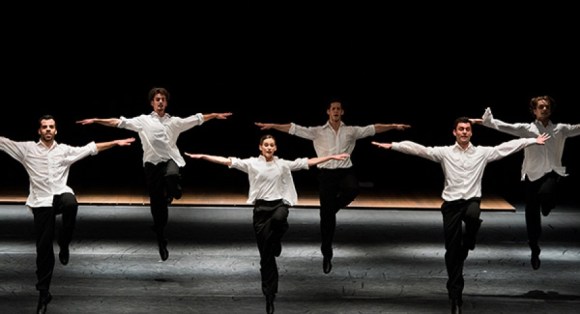
The next, Anne Teresa De Keersmaeker, has her 8 dancers, 6 men and 2 women, in dark suits with open necked white shirts. Formally dressed at first the jackets are removed and some of the shirts are opened as the dance moves on. Each dancer appears to be linked to different sections of the orchestra and they move across the stage, together or apart, each seemingly linked to their own particular instrument.

The final piece by Maguy Marin, has her dancers less formally dressed, in shades of red, and her interpretation is wilder, more emotional, and the four dancers emphasise the dramatic and canonical motifs. They follow each other round the stage in more staccato movements, showing the fierce energy and strife in Beethoven’s work.

du17-trois-grandes-fugues-marin-3-photo-bernard-stofleth-x

I like Beethoven, usually his pastoral pieces are more to my taste, having heard this 20 minute work three times, each time I enjoyed it more, and I will look out for it, to listen to at home. I had a fantastic evening and I felt like I had been given an introductory lesson into both classical music and dance.

Categories
Attractions Exhibition

The Wallace Collection, Manchester Square, London WC1.


Franz Hals, the Laughing Cavalier
The Laughing Cavalier


The Wallace Collection is a must see museum/gallery if you come to London. The items on show were bequeathed to the nation in the late 19th Century and have been on display here since 1900.

The Shepherd, Van Dyck.JPG
Van Dyck, The Shepherd Paris

The number and quality of the Old Masters from the 15th to the 19th century is amazing. It has some of the finest examples of 18th century French furniture in existence. There is also a rich assemblage of porcelain, sculpture and royal amour in the collection. One of the more unusual pieces is a particularly ornate cannon.


Cannon

Many of the pieces were bought during the sales of art following the French revolution, which is why the collection is so strong in 18th Century French art. Such good examples of the Louis XV cabinets and marquetry cannot be seen anywhere else in the world.

Vases

A condition of the bequest was that none of the pieces ever left the collection, even to go out on loan. So if you ever wish to see, say, “The Laughing Cavalier” or Canaletto’s “View of the Grand Canal” you have to come here.


Canaletto, the Grand Canal
Canaletto, The Grand Canal


It is astounding to discover that it is free to visit this collection, although they do ask for a donation. It is also surprisingly quiet, compared to the other, bigger museums and galleries in London. This is presumably because it is not in the main exhibition area of town, although you could argue that, situated between Oxford Street, Baker Street and close to Selfridges, it is even more central than those in South Kensington.


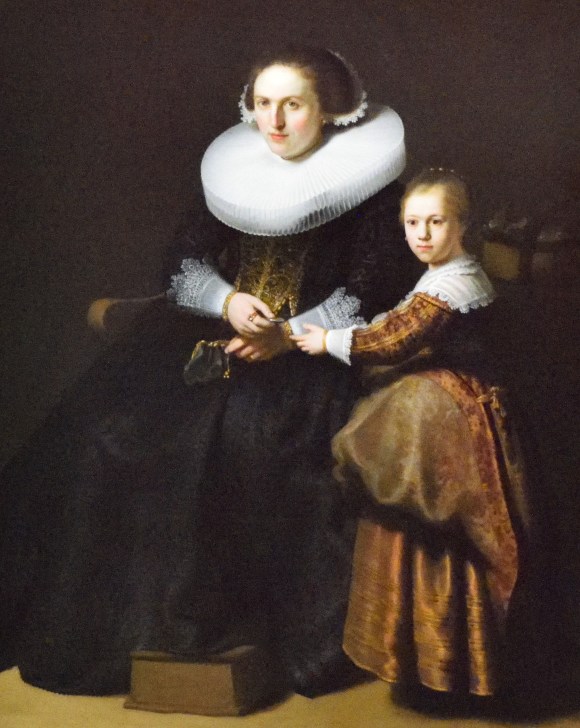
Rembrandt, Susanna van Collen and Anna
Rembrandt, Susanna Van Collen and her daughter Anna


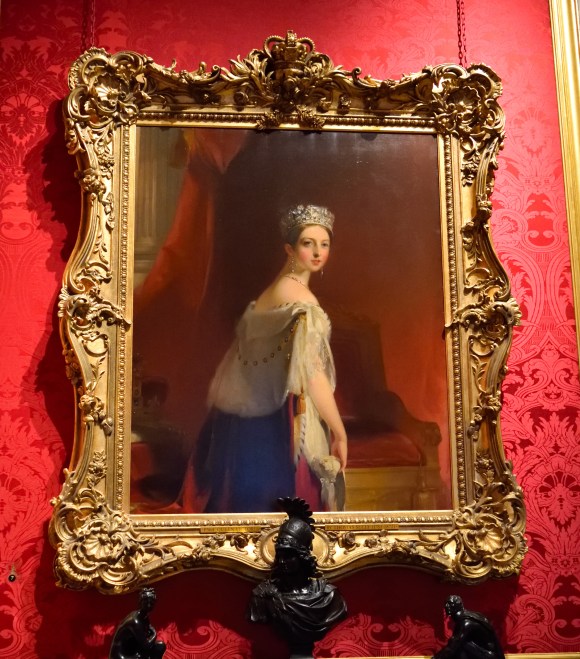
Notable among the Old Masters in the collection are 5 Rembrandt, 4 J. W. Turner, 8 Canaletto, 2 Titian, 12 Reynold, 5 Cuyp, 2 Gainsborough….. the list goes on, it is an amazingly rich and full list. There is even a wonderful portrait of Queen Victoria from 1837, when she was newly ascended to the throne.

Queen Victoria 1837.JPG

The Wallace Collection should not be missed when visiting London. Bring your friends when you visit, and you will surprise them with both the quantity and the quality of the art here. Given how quiet it tends to be, even in the summer, I am going to count this as a hidden gem, and I recommend it heartily.

Categories
Theatre review

The Host, National Youth Theatre of Great Britain, The Yard Theatre, London

The Host

“The Host” is an up to the minute play, set in a council block in Croydon. Nominally about refugees and our response to them, it is also about the meaning of family, and about cultural identity.

It is a well written play with colourful, but current, language. It is excellently performed by the 5 member cast. Rebekah Murrell and Zakary Douglas-Zerouali have a great chemistry as the two leads Yasmin and Rabea. Rebekah plays Yasmin with a nervous intensity, full of (mostly) repressed anger. This is balanced well with Rabea’s more resigned accepting nature.

Nessah Muthy, the playwright, is on this year’s BBC new talent hotlist. On this form, you can see why, although some of the issues felt unresolved, and the finale felt a little like the end of the first act, the script is good and she has a great ear for the rhythms of conversation.

The set and direction are good, the messy, claustrophobic flat is simply set up and, having the offstage cast on view at the back made us feel that we were never far from our neighbours.

This is the final play in the National Youth Theatre of Great Britain’s enjoyable East End Season at the Yard Theatre. I hope they repeat the idea next year.  However, they are doing a revival of “Zigger, Zagger”, the play about football hooliganism at the Wilton’s Music Hall early next month. I am looking forward to seeing it!


Categories
Theatre review

Blue Stockings, The Yard Theatre, London E9

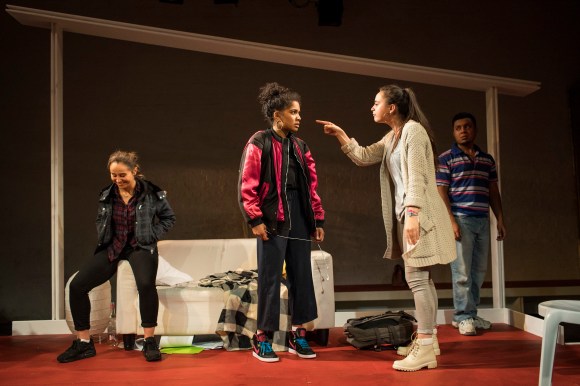
The-cast-of-the-National-Youth-Theatre-production-of-Blue-Stockings-at-the-Yard-Theatre-CREDIT-Helen-Murray

It is a shocking fact that women were not allowed to graduate from Cambridge University until 1948. This play is set 50 years earlier and concerns four ladies who attended Girton College, Cambridge at the end of the 19th Century. It is a well written and cogent drama about the beginnings of the women rights movement. it gives voice to all points of view at that time, ranging from those who believed that education would distract women from being good wives to those who thought that noisy demonstration calling for immediate emancipation was the only way forward.

The Yard is an interesting theatre space, the seats are close to the action, but the wide stage and high ceilings make it very open. I really like the apparent simplicity of the direction, schoolroom projectors set the scenes, blackboard writings mark us as being in a classroom, a pictures of an orchard or Van Gogh’s night sky move us outdoors. This is inventive and effective.

The quality of the acting is very high and there are nice performances even in the smaller parts. Mischa Jones is fabulous as Tess, she brings a nice balance of intelligence and innocence to her role. Laura Trosser has a great part as Miss Blake, resolutely playing the long game in the fight for equality and she plays it perfectly. I really liked Quinton Arigi as Will, whose position changes as the story develops.

Blue Stockings is part of the National Youth Theatre of Great Britain’s East End season at The Yard Theatre. It is a sterling production of a very good play, in an engaging venue. I will be looking out for more Jessica Swale written plays. It has also made me look forward to seeing the next play in the season, “The Host” and their revival of “Zigger Zagger” at the Wilton Music Hall, next month.

A thoroughly enjoyable evening. Recommended.

Categories
Theatre review

Apologia, Trafalgar Studios, London

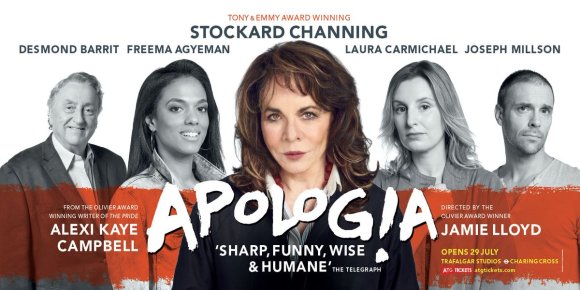
dd913zrxgaecwyp

I went to the first night of the previews. I really enjoyed it. The action takes place over an evening birthday party and the morning after. It was a little slow to get started but after that, the first act is good; the script is funny, arch and sharp. It appears to be a play about nostalgia for the idealism of the 1960s and children with abandonment issues. However, the second act is transformative, I love how it turns your perspective on its head, we get to know the characters better and see their motivation differently. The play is really about women’s place in society, whether this has changed over the past 50 years and about the price people are willing to pay for attempting to bring about change.

The direction is simple, Jamie Lloyd lets the words speak for themselves. The set is clever, the stage is framed like a picture or perhaps the old photograph given as a birthday gift.  The whole cast is good, but this play is really about the women, Laura Carmichael and Freema Agyeman are both outstanding and Stockard Channing is amazing.

The writing is great and I will be looking out for other plays by Alexi Kaye Campbell. I guess there will be a few tweaks before the general opening, but it got a full standing ovation on the night I went. I hope the critics like it as much as I did and that Apologia is a huge success.

Categories
Theatre review

Hamlet, Harold Pinter Theatre, London,

hamlet-2017-main-400x400

Hamlet is a play that has been done so many times in London over the last few years, it seems to be the role that every major star wants to do, to prove their worth. Well, this version, directed by Robert Icke and starring Andrew Scott is, without doubt, the best of them.  The direction is wonderful, it makes the play feel current and relevant to today. I love the use of technology; the ramparts on video cameras, the war coverage on a 24hour news station,  the paparazzi at the wedding.

Andrew Scott is a fantastic Hamlet, hurt, sarcastic and sardonic, he speaks every line as though he is having difficulty putting the depth of his feelings into words. The words are 17th century but his delivery of them is 21st century psychoanalytical. The modern setting brings out humour, in his lines, that was previously hidden and it makes his cruelty towards Ophelia and his mother, all the more harsh.

Derbhle Crotty plays Gertrude, as a worried caring mother, a bit frivolous and taken in by the attentions of her late husbands brother. I liked the chime in accent between her and Hamlet, it emphasised their bond and highlighted his reason for feeling betrayed by her.  Angus Wright is wonderful as Claudius. In this production he is a modern Machiavelli, concerned with approval ratings and how the public would feel if he prosecuted Hamlet for the death of Polonius. He is the ultimate politician king, bland and reasonable while plotting death. It makes one realise how little politics has changed through the centuries.

Peter Wight is great as Polonius, usually played for laughs, but here he is a family man, desperately trying to enhance the lives of his children by means of his diplomacy. The affection between Laertes, Polonius and Ophelia is underlined in this production, and the sense of loss is deeper because of it. David Icke is not afraid to take risks, I am not sure about the Bob Dylan songs, bringing 1960s music into such an up to the minute setting jarred a little, but Rosencrantz and Guildenstern work very well as a romantically involved couple and why wouldn’t one of them be female. I am looking forward to the Tom Stoppard update.

The finale is deliberate, each character allowed their own time. Horatio is solicited to tell the tale, but it has all been recorded on video, so it will be available for the news channels to package and present, from all points of view, for years to come….

This is a fantastic production, it has a month left to play, London theatre at its very best.