Categories
Theatre review

Pinter 1, Pinter at the Pinter season, Pinter Theatre, London WC1


pinter-season-1-one-for-the-road-6489-680x178-20180510

Pinter at the Pinter is a season of all of Harold Pinter’s one act plays in 7 different programmes over a period of 6 months. I saw Pinter 2 first. Pinter 2, Pinter at the Pinter Season, Pinter Theatre, London WC1

Pinter 1 is a collection of 9 short plays, sketches and poems, mostly from the 1980s and 1990s. The are generally political, often about authoritarianism, occasionally funny but broadly bleak and dark. The sketches “Press Conference”, “The Pres and an Officer” and the poem “American Football” are dark comedy but still light relief among the rest of the fare on offer here. “The Pres and an Officer” was discovered late last year, almost 10 years after his death. It seems to be so precisely what we would expect Pinter to say about Donald Trump that, if it is truly a Pinter piece, it is eerily prescient.

It is a measure of grimness of the writing that the next lightest piece is a poem called “Death”. This is lyrical, sad and it is beautifully delivered by Maggie Steed. “Precisely” is a comedy sketch about a nuclear holocaust. “The New World Order” a sketch about torture. “Mountain Language” is a moving short piece about the suppression of a language by an authoritarian state. The acting is phenomenal. Jonjo O’Neill is excellent as various political bullies in the pieces named above.

“One for the Road” is a piece about authoritarian interrogation. A man, wife, and their 7 year old son are interrogated in separate rooms by a tyrannical bully, played by Antony Sher. The violence is implied, as it all happens in the rooms we are not watching at the time, however it is actually more palpable because of this. A truly magnificent piece of writing, it was surely instrumental in his receiving of the Nobel Prize for literature, but in no way is it an easy watch. Paapa Essiedu and Kate O’Flynn are both amazing as the husband and wife.

They also play the husband and wife in “Ashes to Ashes”.  This is a later play, more abstract in narrative, though still dark in tone, experimental in the shifting of subject matter. It could be about the loss of a child, about the holocaust, about an abusive marriage or even about a murder. It hints at these, changes focus and moves on…  It is an interesting and brave piece, written by an ambitious author, confident of his ability.

All the pieces bar the last are directed by Jamie Lloyd and have a cold, metal, prison-cell like setting which suit the mood of the pieces. “Ashes to Ashes” is directed by Lia Williams, this is set in a living room and changes in lighting match the flow of the dialogue. It is ingenious how she makes the set feel more intimate without making it feel more warm.

Pinter 1 is a hard watch, I can’t imagine how tough it must be to act each day. It is dark and bleak with implied violence, both mental and physical. It may be emotionally draining, but the writing is strong, the themes are universal and the acting is tremendous. To say that I enjoyed it would not be entirely accurate, but I am really pleased to have seen it and if it were to return in at some point in the future, I would certainly gather together my mental strength and go to see it again. Warning! This collection is stimulating and disturbing and is definitely one to avoid on date night.



Categories
Theatre review

Taj Express, The Peacock Theatre, London WC2

taj-express-review-peacock-theatre-london-818313

Taj Express is a jukebox musical with a Bollywood movie theme. About half the music comes from hits of the Indian film industry, half is written by musical director Abhijit Vaghani, who has composed the background score to over 50 films himself. My knowledge of this area is scant, to say the least, so I only recognised a couple of the songs, but this took nothing away from my enjoyment of the show.

This show is basically a set of twenty four dance routines with short breaks in between for the dancers to change costume and regain their breath. None of the dancers have spoken lines, there is a kind of narrator whose job it is to join the dances together, to propel the story forward and to inject some comedy into the proceedings.

There is a tradition in jukebox musicals for the storyline to be thin. It is basically a hook on which to hang the songs and dance routines. Here the story practically transparent, although cleverly they make this into a joke, so we can laugh at how unlikely a tale it is, and to be fair, the story is not what the audience have come to see.

taj-express-peacock-theatre-1

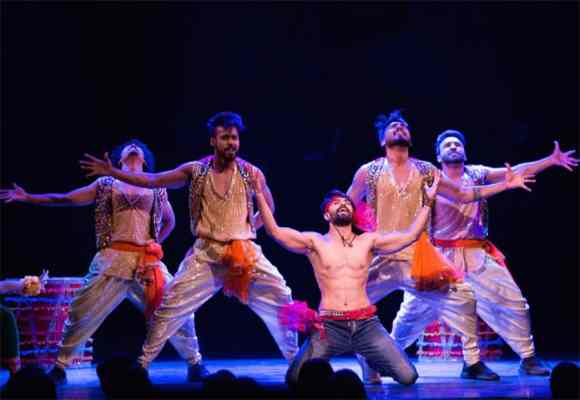
The dancing is spectacular. This show is an exhilarating riot of colour and energy. The variety in the music is surprising, there are elements of tango, salsa, mixed up with bhangra and rock. The opening of the second act even had a techno rave feel with its ultra-violet lights and dayglo costumes and props. Hiten Shah and Tanvi Patil play Arjun and Kareena, the shows romantic leads, their job is to relate the narrator’s story through their dance routines, a job they accomplish with considerable charm and allure. The ensemble as a whole are dazzling, full of acrobatic tumbling, gymnastic break dancing and twisting somersaults, their dynamic vigour is infectious and the audience is clapping along enthusiastically towards the end of may of the routines.

The set is simple but effective, a white backdrop leaves the stage completely clear for the main event, and pictures projected onto it provide the various settings in which the dancing is taking place. Bipin Tanna deserves special mention as the costume designer. They are a highlight of the show. To say they are bright and glittering is an understatement, they flow and shimmer with the dance moves, enhancing the movement of the dancers. They are vibrant and vivid, yet elegant and graceful when this is called for in the dance.

Taj Express is a show that you have to allow yourself to enjoy. It has elements of pantomime, don’t overthink – just let the pageant that unfolds onstage envelop you and  become swept up in the spectacle. By the end of the show much of the audience was up dancing in the aisles, a testament to the appeal of a most enjoyable evening.


Categories
Theatre review

Antony & Cleopatra, National Theatre, South Bank, London

antony-and-cleopatra-1280x720

Antony & Cleopatra is always a big undertaking. The play is an uneasy mix of love and war, it requires a wide variety of settings, scenes and textures and it is usual that a choice is made to make it either bellicose or romantic. Simon Godwin has made the brave decision to have it both ways. The talent and apparatus that are at his disposal at the Olivier theatre allow him to pull it off triumphantly.

The cast is high quality and on top form. The set and choreography are stars in their own right. Hildegard Bechtler, set designer and Evie Gurney, costume designer do a wonderful job.  I doubt that it would be possible to do the transformations from opulent Alexandria, through Roman war rooms to topside ship decks, with such efficiency on any other stage. It is beautifully done and gives the piece a cinematic quality that it is uncommon to see in the theatre. they have lavished money, care and attention to detail on this production and it has not gone to waste. The costumes are sumptuous, Cleopatra really does dress like a queen.

The huge change in ambience between the military settings and the romantic ones make it easy to see the dichotomy that Antony faces between duty and desire. He begins the play lounging by the pool but it not long before he is army fatigues. Ralph Fiennes plays Antony with a hint of midlife crisis, but when he is with Cleopatra there is never any doubt of his love for her. The chemistry between them is palpable, they are sultry and sensual, the perfect star crossed couple. Sophie Okonedo is every inch the Egyptian Queen, expecting adoration and receiving it; sharp and soft,  petulant and magnanimous, veering between vulnerable and dangerous. She owned the role, it feels like the part she was born to play.

The acting throughout is very good, Tim McMullan is excellent as Enobarbus. Hannah Morrish brings out the role of Octavia well, we see she is poorly used by Caesar as well as Antony, but takes what slight revenge she can. Fisayo Akinade is funny and sad as Eros, Antony’s freed slave.

Antony & Cleopatra is three and a half hours long, however there are a couple of light and funny scenes and director, Simon Godwin, makes good use of these to give relief from the tension and high drama. The ending of this play is often difficult to stage, but here it is done in a very authentic manner. There is a glimmer of compassion to the finale of  this play, that is not often there in Shakespearean tragedy. A word of warning to those who suffer from ophidiophobia – you may wish to get seats a little way back from the stage.

Everything about this show oozes high production values, right down to the programme, which has copious information about the background to the play. This is exactly the type of production that gives the National Theatre its worldwide renown.

Categories
Theatre review

Pinter 2, Pinter at the Pinter Season, Pinter Theatre, London WC1


lover-25-06-18-lead_1

In December 2018 it will be 10 years since the death of Harold Pinter. In celebration of his legacy, the Jamie Lloyd Company is producing a season of all 19 of his one act plays at the Pinter Theatre. There will be 7 different programmes each containing either 2, 3 or 4 of his pieces. The cast list for the season has to be seen to be believed, stellar is no over-estimate of their quality.

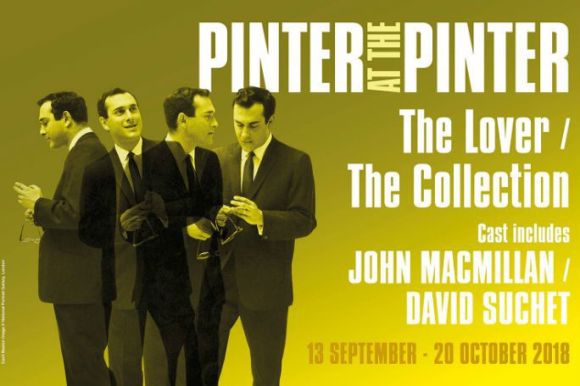
Pinter 2 contains two plays, The Lovers and The Collection, both comedies and both written in the early 1960s. The Lovers has John MacMillan, Hayley Squires and Russell Tovey. The Collection has these three and David Suchet. The Lovers is a one room play set over a couple of days in the living room of a married couple. The dialogue is, in true Pinter fashion, bright and stilted. The set and conversation are pastiche early TV sitcom. This works really well, it makes the subject matter funnier, darker and pinpoints it in time perfectly. John MacMillan and Hayley Squires are the husband and wife, Richard and Sarah. Their comic timing is impeccable. The piece lasts about 50 minutes, it starts off light an funny. The story is inventive and the writing witty. In short, this is classic Pinter done well.

The Collection is a four hander, this time about 2 couples, set in 2 living rooms. This one is more sinister, right from the start. It is still very funny though. David Suchet and Russell Tovey, play Harry and Bill, the other couple are Stella and James, played by Hayley Squires and John MacMillan. Although there is nothing explicit anywhere in this play, it must have been quite shocking when it was first performed in 1961, and I can imagine that the censor would have taken an interest in how it was produced. It is beautifully written, in that, there is nothing overt in the manner of their relationships, however we are in no doubt as to what is going on. For it to work this well, the actors have to be well attuned to the writing. All four of them are wonderful. David Suchet gives an acting masterclass in this play, he knows perfectly when to be larger than life and when to rein it in. Russell Tovey too, gave a nicely nuanced performance delivering funny double-entendres with an ominous undertone.

The set is simple and clever, spot lit areas move us from one scene to another. Jamie Lloyd directs both plays sympathetically, he allows the writing and acting to shine. This play is also just about an hour long. I am beginning to think this might be Pinter’s perfect length. This pair of plays are pure joy to watch and now I am left with the quandary of how to get hold of tickets for the other 6 in the season.

Categories
Theatre review

Hogarth’s Progress Part 2, The Taste of the Town, Rose Theatre, Kingston

New-Hogarth-Showpage

Nick Dear’s second part of Hogarth’s Progress is set thirty years on from part 1 which is reviewed here: Hogarth’s Progress Part 1, The Art of Success, Rose Theatre, Kingston. This second play is also a fictional story based around real events in the life of William Hogarth.  By this time he has enjoyed success, and he is serjeant painter to King George III. He has taken a house in the countryside, in Chiswick.

This story also takes place on a drunken day, although by now William Hogarth is something of a reformed character and one has the impression that days such as these are less frequent than in the past. Although the day itself is a fictional day, the characters in the play are real, and the people and events that they discuss are fact. Hogarth is worried that, although he is relatively rich and famous, his art is not given the gravitas it deserves. The play then, although it is a light comedy in style, has an underlying discussion about what exactly it is that constitutes success. It is a cleverly written piece and it works well on both levels.

The dialogue is crisp and funny. The characters have depth, we see their flaws and like them nevertheless. Mark Umbers is very good as David Garrick, the multi faced actor. He is smooth, accomplished and very aware that the whole world is a stage. The role of Horace Walpole is beautifully written and it is beautifully played Ian Hallard. His lines are witty, barbed, and perfectly delivered. He rips Hogarth to shreds so sweetly that the artist leaves his house almost believing that he has made a new best friend.

The acting throughout is superb. Sylvestra Le Touzel is wonderful as Lady Thornhill, arch and harsh, but knowing where her best interests lie. Jasmine Jones shines again, this time as Bridget. It is interesting to see the cast playing different parts in each play and I enjoyed the links between the two shows, although each is an independent narrative and works without any knowledge of the other.

Both of these shows are interesting and both are worth seeing. If you can only see one, the first is frenetic and explicit, the second is calmer and sharper but each one is funny in its own way, so it depends on how you like your comedy. If I had to choose, I think I would probably pick the second, simply for the wonderful characters Walpole and Garrick.


Categories
Theatre review

Strictly Ballroom, Piccadilly Theatre, London W1.

Strictly

Strictly Ballroom is a crowd pleasing juke box musical. It certainly has a lot of good things going for it. The film, on which is based, is a classic Australian indie comedy of the early ’90s and it is wonderfully odd and funny. The songs are popular upbeat singalong tunes that the audience will know and love. The cast is great and the director and choreographer have some great musicals on their CV.

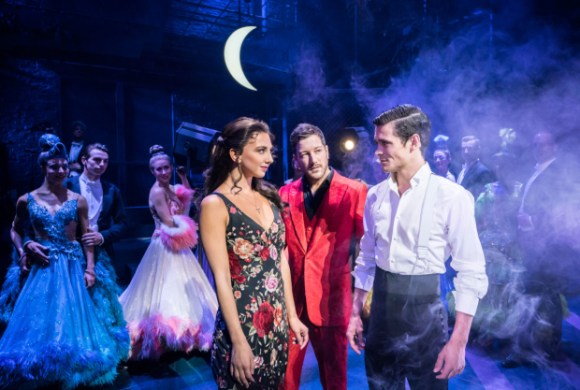
The show has been rewritten for the stage and a new character, a narrator, has been added. The idea is brilliant, he sings the songs, adds perspective to the larger than life characters and propels the action along with some knowing repartee. Matt Cardle plays this part, Wally Strand, and he does a good job. He has a great voice and he is nicely self deprecating. However there are 35 different songs in this 2 hour show, many of them delivered in two, three or more pieces. He rarely get to sing more than one bar without stopping. It would have been lovely to listen to a complete song in one go, instead of hearing them broken up into fragments.

The story has not been changed from the film and is simple but solid. The difference is that, in the film it was mostly played straight and the characters were unintentionally amusing. Here we have cartoon-like caricatures played for laughs and the comedy feels strained at times. There are funny lines and the caricatures are comical. The acting is  good, Matthew Stevens and Anna Francolini’s over the top performances as Doug and Shirley Hastings were both enjoyable.

Jonny Labey and Zizi Strallen are both good dancers and excellent as Scott and Fran. The ensemble look good, but the stage at the Piccadilly is too small fit the entire company  and the group set pieces feel cramped and uncomfortable.

The set is sparse and effective, it needs to be because of the lack of space. The costumes are wonderfully sparkly and camp. “Strictly Ballroom, the Musical” has been damned with faint praise, the show is fun and the audience gave it a warm reception. It is a good show, but the sum does not quite live up to all its parts. I liked it but the expectations are high and, in London’s West End, the competition is fierce.


Categories
Theatre review Uncategorized

Hogarth’s Progress Part 1, The Art of Success, Rose Theatre, Kingston

hogarths-progress-6005-680x230-20180226

The Art of Success was first produced by the Royal Shakespeare Company in 1986. it was written by Nick Dear, he has now written a companion piece, set 30 years later and they are being presented as a double bill at the Rose Theatre in Kingston, under the title “Hogarth’s Progress”. The first play depicts Hogarth’s life at the time just before the copyright act came into force when he had just done “A Harlot’s Progress” and before he started “A Rake’s Progress”. The second will depict him in later life. They are meant to complement each other and still work as stand alone plays.

Set in London in the 1730s, “The Art of Success” is a ribald and raucous story, telling of the partying antics of many of the renowned people of the day. These include Hogarth himself, the satirist Henry Fielding, Prime Minister Robert Walpole, brothel keeper Elizabeth Needham and even George II’s wife Queen Caroline. Many scenes are salacious and slanderous, reflecting the satirical plays of the time that led to the passing of the Theatrical Licensing Act. Hogarth was instrumental in causing the engraving copyright act to be passed and there is a subtext to this play about the ownership of art and about how art develops in times of social change, which chimes with the present day challenges for art in the different forms of social media.

Having said all that, the main thrust of the play is a bawdy farce about an epic night on the town and is meant to be enjoyed as just that. In this respect it works well.  It has funny jokes, although it occasionally veers into Carry-on territory. It is merciless in lampooning the aristocracy and it has enjoyable characters. The cast is spectacular, every performance is good.  Jasmine Jones is excellent as Sarah Sprackling, she manages to get a great balance between comedy and pathos. Jack Derges as Henry Fielding is both funny and loathsome. Bryan Dick does a fantastic job of holding it all together as runs about the town in various stages of disrepair.

The set is ingenious, I liked how contemporary it manged to be while still displaying the 18th Century. I cannot imagine that they had the ability to use the effects on display here when it was first produced 32 years ago, and I enjoyed the little nods to modern technology in the direction. “The Art of Success” is a play that you continue to appreciate after you have left the theatre and I am looking forward to seeing part 2 “The Taste of the Town” when it opens next week.


Categories
Theatre review

Allelujah!, Bridge Theatre, London SE1

alellujah

Alan Bennett has consistently been one of England’s best playwrights over the course of the past fifty years. His last couple of plays have been well written and funny, but were a little too cosy to be among my personal favourites of his work. Having said that, everything he writes is at least very good and nicely droll.

Allelujah! is set in the geriatric ward of a hospital that is at risk of closure, and for most of the first act we are lulled into a gentle musical comedy about the hardships and indignities of growing old. However, towards the end of the act, things take an unexpected and darker direction and we realise that, during the first third of the play, the scene was being set for a biting political satire. Alan Bennett is cross, and this irritation has led to some of his best writing in years.

This is a play about how poorly we treat the aged in our society and it examines the reasons why this is the case, while entertaining us with smart one liners and whimsical song and dance routines. Nicholas Hynter directs the play, he is a long time collaborator with Bennett and he complements him well. The cast is big and there are many good performances. I particularly liked Sacha Dhawan as Valentine, diffident at first, but bristling with restrained anger by the end. Samuel Barnett is good too, he has an unlikable character to play, yet he manages to have us understand his motivation.

The play has so many scene changes that it might have been written for television. The ingenious set design prevents us feeling that the stage is in a constant state of flux. Arlene Phillips is the choreographer and she has a fine line to tread between keeping the routines tight and having us remember that these people are too old and unwell to be released from hospital – she does a fine job.

The real star of the show is the writing. I love Alan Bennett’s balance, he always presents both sides of an argument. Even when he is presenting a personal point of view, I admire his fairness in giving the other side a voice. He does this particularly well here, he writes some characters with quite unsavoury personality traits in this play, yet they are unapologetic and we understand that they feel justified in their actions, even if we cannot condone them ourselves.

I hope that I haven’t made the play seem too dark and political, because it is a truly funny and entertaining show, made all the better by the fact that it makes you think about the way the old and infirm are treated in our society. I think this is possibly my favourite Alan Bennett play yet.


Categories
Theatre review

Imperium, Gielgud Theatre, Shaftsbury Avenue, London W1.

ImpreriumIII_SwpMH7Z

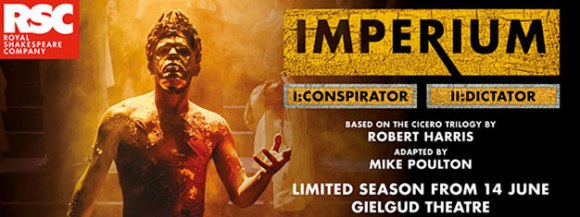
Imperium is an adaptation of Robert Harris’ three books on the life of Cicero, into six plays, each just over one hour long. These have been amalgamated into two plays; Conspirator and Dictator, which are running concurrently with the same cast at the Gielgud Theatre. It is possible, if you choose the correct day, to watch the first play as a matinee and the second one the same evening.

This is a Royal Shakespeare Company production which has transferred from Stratford to the West End. Robert Harris is an acclaimed author of historical novels, renowned for making history accessible. Mike Poulton who adapted these novels has recently brought Hilary Mantel’s,Tudor novels to the stage with great success. These three combine well to make a thoroughly entertaining and interesting biography of one of Rome’s less covered  characters.

Imp

Cicero has been written as the hero here although not without flaws. He is honourable and steadfast to his belief in the Republic of Rome. He has great oratorical skills and is politically adept. He is also vain, aware of his talents, but blind to his faults. Richard McCabe plays the part admirably, with charisma – he is self important and gossipy, but witty and likeable still. The other main part in this play is Tiro, Cicero’s slave, who is writing his biography. Joseph Kloska is fantastic in this role, he is effectively the narrator of the story. He is integral to making Cicero likeable and his affection for his master, while seeing his faults, shines through his performance. Both of them are on stage for almost the entire seven hours of the show. The synergy between these two main characters is lovely and is the column around which the whole production is built.

Nearly everyone else is an antihero and a threat to the Roman Republic. Peter de Jersey is a smooth, smiling Julius Caesar – politically adept, desirous of power for personal gain. Joe Dixon is very good as Cataline, all brawn and little brain, who believes that he deserves to rule Rome and is prepared to bring it down in revenge, if it fails to deliver his wishes. In the second series of plays Oliver Johnstone is good as Octavian Caesar. He is cold, calculating and calm, able to bide his time as he is convinced of his own divinity.

First-Look-Imperium-e1530081620609

For me, the one misstep was portraying Pompey as a Donald Trump type figure. In historical terms it is likely that they were far from alike politically, and director Gregory Doran did a nice job of drawing our own comparisons with the present day throughout the rest of the show, without us needing any coercion, so maybe we should have been trusted to do the same here. However that is a small quibble, for a production that has managed to walk the line between accuracy and accessibility.

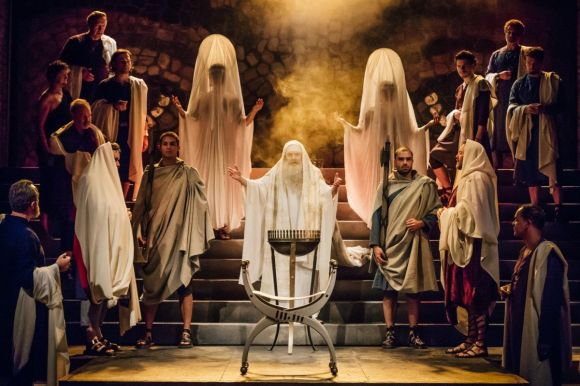
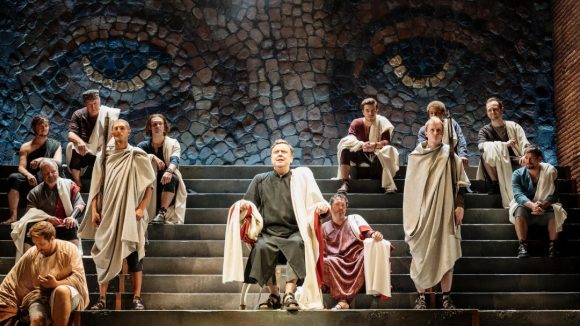
The set too is good, simple and effective. Senate steps that the cast sit upon while listening. Tesserae of watching eyes at the back of the stage. The walls of the senate are built with Roman bricks. There is a huge revolving, reflective, silver globe suspended over the set, that changes hue with events on stage – perhaps a pun on Urbis et Orbis from the city to the world. Anthony Ward has done well making the audience the forum, to whom the senate are speaking and drawing us in to the action.

Imperium is a lovely reproduction of a small part of ancient history. it is witty, funny and accessible, an enjoyable show whether or not you have an interest in the Roman Republic. Robert Harris famously said of his Cicero trilogy that is “The West Wing with Togas”, well this contemporary adaptation turns it into “House of Cards in Ancient Rome”. Surely a Netflix production cannot be far away – and if it is I will surely be watching!


Categories
Theatre review

Kiss Me Kate, Opera North, London Coliseum, London WC2

kiss me kate

Cole Porter’s 1948 musical, Kiss Me Kate is a complex show, some of its numbers are  classic Broadway showtunes, while others have a light opera edge. It has complicated, full company dance routines as well as individual virtuoso displays. It also has a couple of good comedy roles that require great timing and delivery. On top of this, the Coliseum itself, has a big stage that needs a large company to fill. All in all, this is a show, in a venue, which will test every part of the company putting it on, to the fullest degree. I have to say that Opera North have passed this test with honours.

The two operatic leads, Quirijn de Lang and Stephanie Corley, as Fred/Petruchio and Lilli/Kate both have splendid voices, suited to their roles.  Zoe Rainey and Alan Burkitt, as Lois and Billy, carry the more standard musical numbers perfectly. Each of the four of them has at least one great song to show of their respective talent. Lois has possibly the most famous songs in “Always true to you in my fashion” and “Tom, Dick or Harry” but Kate’s “I hate men” and Petruchio’s “Where is the life that I led” are really great songs that show of their vocal abilities. The show’s biggest song, of course, “Too Darn Hot” is sung by the chorus, and the dancers, particularly Aiesha Pease and Stephane Anelli, deliver a truly show stopping performance to this number.

Kiss me kate 2

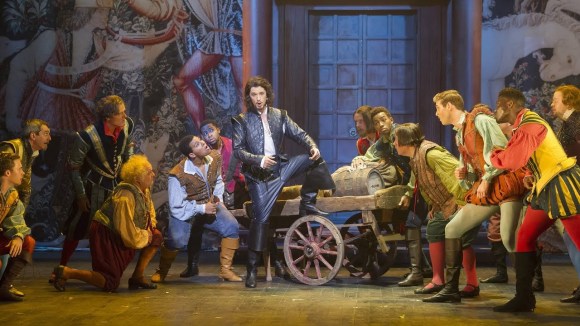
Joseph Shovelton and John Savournin play the comedy roles of first and second Gunman. They work very well together, their interaction is excellent and they make the most of their comedy duet “Brush up your Shakespeare” – a song more full of puns than I had previously realised. The company as a whole is excellent and you realise that this is going to be a show full of movement and vigour, right from the first song of “Another Op’nin’, Another Show”.

Kiss Me Kate is a big show, and this is a big full-on production of it. The costumes are bright and lavish.  The choreographer has a tough job, with so many people on stage at once, however the dance routines are vivacious and have lovely shape. The set design needs ingenuity too, and is very clever at swapping from front of stage to back of house in seconds.

The director, Jo Davies, has taken the bold decision not to update the show in any obvious way. At times, it felt like you were actually watching a show made in the 1940s, giving the show an interesting post-war period feel. The tap routine, in particular, had a dated, black and white movie quality, which suited the production very nicely. This is a lush and exuberant production of a distinguished show and it fully deserved the love it received from the packed audience at curtain down.