-
Macbeth, RSC Barbican Season, Barbican, London EC1
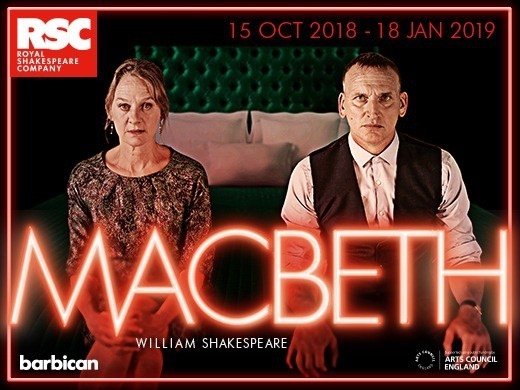
2018 is turning out to be a Macbeth fest, with 4 major productions in London at various times through the year. Spring brought a Punk style, post apocalyptic version to the National Theatre. Autumn had The National Youth Theatre’s stylish and stylized, gender fluid adaptation. Shakespeare’s Globe has a Macbeth opening just now which will run to 2019, and this, the Royal Shakespeare Company’s interpretation, has been playing in Stratford through the year and will be at the Barbican until January.
Here we have a large cast, big names and high production values. The Barbican has a huge stage which is kept fairly minimal throughout, a digital clock, ticking down the seconds, dominates the set – reminding us of the passing of time. The witches are a stroke of genius, three schoolgirls dressed identically in red dresses and shoes with white wool tights, advancing together across the set and speaking in unison. Slightly reminiscent of the film “Don’t Look Now” but certainly the eeriest Macbeth witches I have ever seen.
This is a Macbeth that emphasises the psychological horror of the story. It is a brutal and murderous play, but priority is given to the effects of the violence rather than the violence itself. Polly Findlay, as director has made a clever and thoughtful direction decision in doing this, because we get to see more deeply into the characters of Macbeth and his wife, without losing any of the malignancy of the tale.
Niamh Cusack proves herself to be one of the finest actors, as Lady Macbeth. She is the instigator of the action, she drives and encourages her husband in his moments of doubt. We are always aware that her ambition is not hers alone, it is for them both together – and when she realises that his ambition has gone past hers, that she cannot stop him and that she has lost him, her descent into despair is palpable.
Christopher Ecclestone is Macbeth, he plays him as a modern day fighter, comfortable in battle fatigues, yet ambitious enough to don a dinner suit to schmooze at parties. His acting is a tour de force, we see him grow in ambition as the play moves on. The first undefended murder hits him hard, but each death gets easier and less affecting, until near the end they all just chalk marks on a blackboard, made by the watching porter.
This is a cold and dark Macbeth, perfect for a winter night, one that will stay with you as you sip your whiskey in the pub on the way home from the theatre. A great production of a chilling play. My favourite Macbeth.
-
Don Quixote, Royal Shakespeare Company, Garrick Theatre, London WC2

The Royal Shakespeare Company have gone the whole hog in this version of Don Quixote. They commissioned James Fenton and Grant Olding to adapt Miguel De Cervantes story for a modern audience and the pair have come up with a show that feels contemporary but true to time in which it was written. With audience participation encouraged and the cast entering and exiting through the stalls, it feels like a show that would have worked very well in the Globe Theatre even in the 17th Century.
David Threlfall is Don Quixote. He plays him as the straight man to Rufus Hounds’ Sancho Panza. This works very well as we care for Quixote, the fantasist who sees the world as he wishes it was. Panza is his faithful squire who sees the real world but makes sure that we are laughing at the situation not at the man. They make a fantastic double act, Rufus Hound improvises and involves the audience while Threlfall is too involved in his windmills to notice.
Audience participation is a large part of the show, it has a panto feel in places. Some of the comedy is slapstick and it is still funny – a sweary monk as he trips over an audience members foot, a bun fight between the cast and the audience. However, there is more to the show than this, it has so much going on that catching it all in one viewing is unlikely. The songs are good and give the piece an Andalusian atmosphere. There is puppetry that is both attractive and clever. The lion is spectacular and the hawk is funny. The horses are brilliant and their interaction threatens to steal the scene on a number of occasions.
The Don Quixote that we see these days consists of two books, the original and the follow up. The second was written roughly a decade after the success of the first, it tells of the exploits of Don Quixote after he becomes famous and this show retains that tradition. Often it leads to a change in tone between the two acts. Here is it handled cleverly by making the Duke and Duchess, nicely played by Richard Dempsey and Ruth Everett, into caricatures of pantomime villains, so their cruel tricks are jokes on them rather than our hero Quixote.
The ending of the story is done well, Rufus Hound has surprising depth, having laughed with him through the show, we feel his sadness at the end. Don Quixote has the last laugh though and we can be moved and still grin at his ascent to heaven.
The RSC have invented posh panto. A show that an Eton educated ex prime minister might take his son to see. This show is a blast from beginning to end, great fun and a great night out. It deserves to be this year’s big Christmas hit.
-
Macbeth, National Youth Theatre, Garrick Theatre, London WC2

This is the third of the National Youth Theatre’s West End season that I have seen, after Consensual and Victoria’s Knickers, which were on last month at the Soho Theatre. I am pleased to say that Macbeth maintains the high standard set by the first two.
This is a contemporary and stylish version of the play. It was interesting to see Macbeth, Lady Macbeth and Duncan, all as women, it was good to see how little it changed the dynamic of the piece. Of course, Macbeth and Lady Macbeth are both ambitious, determined characters and this setup underlines that each has their own portion of the guilt to bear. Isabel Adomakoh Young as Lady Macbeth does a fantastic job of displaying her ambition when strengthening her partner’s resolve at the start, and then showing her despair when she feels it has gone too far. Olivia Dowd as Macbeth makes us see how difficult it is to carry out the first undefended murder and then shows us that each successive one becomes more easy, until by the end she doesn’t care how many lives it costs as long as she keeps her power.

The witches in this Macbeth are fantastic. They look both dramatic and other worldly. Their movement and utterances are chilling, perhaps the best realisation of the witches I have seen, in a perfect combination of costume and delivery. The direction with regard to the apparitions is masterful too, they appear as though spawned by an archfiend that the witches have conjured up. This is a Macbeth where the effects of the supernatural world are strongly felt.

Back in Scotland, Jay Mailer is good as Ross, Oseloka Obi is a strong and sturdy Macduff and Jamie Ankrah is great as a soldierly Banquo. This is a very accessible Macbeth, Natasha Nixon as director has been clever in managing to convey the horror of the tale while minimising the blood and the gore. I really enjoyed this stripped down, stylized telling of the Scottish play. Its on Tuesday, Thursday and Friday afternoons at the Garrick Theatre until the 7th December.
It has been most enjoyable to see 3 of the NYT West End shows this winter, the standard of acting has been very high and I am looking forward to seeing many of the actors on stage or screen again in the near future. If you are in town when the next year’s season is announced, it is worth looking up – the tickets are such good value for a west end show and the productions are excellent quality. I have to say that, for me, The National Youth Theatre Rep Company’s West End seasons are a highlight of the theatre year.
1600s, actor, art, culture, drama, garrick, literature, Macbeth, national theatre, NYT rep, NYTofGB, play, review, Scotland, Shakepeare, show, tcspr, theatre, TOTastemaker, west end -
Stories, National Theatre, South Bank London SE1

About a year ago. I saw Nina Raine’s last play, Consent, also at the Dorfman Theatre here at the National. It was the strength of the writing in that production that drew me to see Stories. This is a play about Anna, a woman approaching 40, who is desperate to have a baby. She does not have a partner and she is investigating the options available to her as a would be single mother.
The Dorfman theatre is an intimate venue when laid out in the round, suited to the living room settings of this play. The show consists of multiple short scenes and the automated set changes where the sections of the floor rise to make a table or slide in to form a bed are very cleverly done. They contribute well to the maintaining the pace of the drama, through the constant scene changes. The clean IKEA lines also felt nicely contemporary.
Anna is played by Claudie Blakely with a controlled desperation, knowing that if she shows it too much, that she will frighten baby fathers off. Sam Troughton plays all the prospective sperm donors and he is almost too good at this, in that his changing performances are very funny and at times this becomes the focus of the play, distracting your attention from the main storyline. Anna is the only person in the entire play that is one person playing one part and this diminishes the clarity of the piece somewhat.
Brian Vernel is excellent as Anna’s younger brother and Stephen Boxer is fantastic as her Dad. They have great lines and the spiky but caring relationship the three of them have is beautifully conveyed. The rest of the characters are less fully rounded and although they have some very funny lines, they are sometimes two dimensional ciphers. I found this particularly true of Natasha and Girl. I did realise, eventually, that they are meant to represent Anna’s inner child and inner parent, but I am not sure what they added to the story.
I think there might be brilliant play in here, but the story is not presented clearly enough to follow easily. Nina Raine is a fantastic author, there are probably few writers who can capture current bar and dinner table conversations as well or as wittily. This is not the ground breaking piece that she will one day write, but I enjoyed it well enough and I will continue to look out for shows that she writes in the future.
-
Pinter 3, Pinter at the Pinter Season, Pinter Theatre, London WC1

Pinter at the Pinter is a season of all of Harold Pinter’s one act plays in 7 different programmes over a period of 6 months. Previously on this blog: Pinter 1, Pinter 2 and Pinter 4
The most well known pieces in this collection are “Landscape” and “A kind of Alaska”. These are the opening and closing items and they take up the greater part of the show. They are both interesting and have excellent performances from Tamsin Greig and Keith Allen. Tamsin Greig is spellbinding as a woman attempting to come to terms with the fact that she went to sleep at 16 years of age and only awakened 29 years later.
There are 9 other vignettes in the evening and although a couple might not do any favours to Pinter’s reputation, Jamie Lloyd has unearthed some absolute gems from among his lesser known pieces. Closing the fist half, Lee Evans does a piece called “Monologue” where he effectively has a conversation with an empty chair. This is funny and poignant, and Lee Evans’ uniquely physical delivery brings extra empathy to the character.
“Night” is very unusual amongst the Pinter work in that it is resolutely positive in tone. Meera Syal and Tom Edden make the most of the upbeat lines and portray a couple who patently care for each other, even at those times when their memories differ. This is a short sketch, perhaps only five minutes long, but it is sublime to see Pinter’s words made sweet. “Trouble in the Works” is another short sketch, absurd abstract comedy, well done and very funny. It is like Monty Python in style but it was written in 1959, so it predates them by a whole decade.

Great care has been taken in the direction of this presentation to make all the individual pieces link together, and the show certainly does not feel like it is made up of 11 discrete items. This is helped by the ingenious set design which is a slowly spinning living room, highlighting a different area each time it turns. Even though many of the sketches only have one or two of the actors actively involved, Jamie Lloyd has cleverly joined them up so the whole has the feel of a single ensemble piece. This is most apparent in the sketch “God’s District” which is a solo comedy item, delivered by Meera Syal, but by the end it has all 5 of the actors playing instruments or singing along.
Overall, the quality of the writing is very high and the acting is a joy to watch. A couple of the pieces have not aged well, perhaps we are more sensitive to hints of sexism now than we were when it was written. This is Pinter though, so it is hard to say for certain, and they could be seen as his comment on the times in which he lived. Having said that, this compilation is positively uplifting compared to some of his darker anthologies. After watching Pinter’s 1 and 4, I had begun to wonder whether I had the fortitude to watch the rest of the season, but now that I have seen this, I am looking forward to 5, 6. and 7 with a spring in my step.
-
Widows (dir. Steve McQueen) 2018

This film is based on a story written by Lynda La Plante which was originally made as a six part miniseries that was shown on ITV in 1983. It was very popular in the UK at the time and was the start of a successful career in crime shows for the writer. The original series was set in East London and the show started with a security van catching fire in the Kingsway Underpass at Waterloo Bridge. This remake has moved the action to Chicago. The script has been co-written by director Steve McQueen and Gillian Flynn, the writer of Gone Girl. It is possible to see connections between the two films. They are both gritty, urban films with intelligent, believable dialogue.
The quality of the writing and directing team shines throughout and they have made Widows into a terse modern thriller. It has the edge of the seat moments, great characters and good plot twists – all the crowd pleasing elements necessary for an entertaining heist movie. It also has components that fix it firmly in todays society, with attention given to both the #metoo and #BlackLivesMatter movements. These actually add to the realism of the storyline and increase your connection with the characters portrayed.
The cast list is impressive too with some big names even in the smaller roles. Robert Duvall delivers a good cameo as a cynical, corrupt retired politician, handing over to his, not yet quite as corrupted, son – a part nicely played by Colin Farrell. Daniel Kaluuya is brilliant as a cold, hard, nasty villain. I hope he gets another best supporting actor nomination for this. The best parts in this film though are for women and all four grab the opportunities with both hands. Elizabeth Debicki is wonderful as Alice, a woman who has been brought up to please men, but gradually realises that she has the ability to have her own voice too. Viola Davis won best supporting actress Oscar a couple of years ago, her performance here must put her in contention for one in a leading role. Veronica is a beautifully written part and she pitches it perfectly.
The cinematography is great. Sean Bobbitt shows us Chicago from many different viewpoints and we are given the sense that it is a city of affluence and poverty, often in close proximity. Without direct words we are shown how short a step it is, from luxury to danger. The soundtrack is by Hans Zimmer and his use of Nina Simone’s Wild is the Wind to underpin a poignant moment is beautifully done.
Widows is so good because it touches on issues like political corruption, racism, sexism, domestic violence, religion and the difficulty of getting babysitters without them being the main thrust of the story. Steve McQueen has done a very good job of making an entertaining, enjoyable, thriller of a heist movie, where the protagonists are believable people with the real world going on in the background.
-
The London Lark!

From today, Reviewdonkey has become The London Lark! The content will still be the same. I have decided that the new name is a better reflection of the content of the blog, as most of the posts are related to London with the occasional foray into the wider world.
New posts will be published every Tuesday and Friday morning, eventually building up into a catalogue of the best things to do and see (and sometimes the things to avoid!) whether you are visiting or living in this wonderful city.
Let me know what you think of the new title and also drop me a comment if you think of any aspect of London life that I need to cover in future episodes of The London Lark!
-
Pinter 4, Pinter at the Pinter Season, Pinter Theatre, London WC1
Pinter at the Pinter is a season of all of Harold Pinter’s one act plays in 7 different programmes over a period of 6 months. Previously on this blog: Pinter 1 and Pinter 2
Pinter 4 consists of 2 plays. Moonlight which was first presented on stage in 1993. Night School was originally a a TV play from 1960 with Milo O’Shea as Walter. The programme notes date it as 1979, perhaps they are referring to the first live performance.
Moonlight is a kind of abstract drama. It has some funny lines and some, quite dark, humour but I would hesitate to call it a comedy. It is about a man on his deathbed waiting for his sons to visit him. In his lucid moments he is reminiscing with his wife. In his more clouded times he imagines his sons to be there, but their conversation is intermingled with discussions about him, his memories from work and sometimes their sister is there, perhaps calling him over. I guess the moonlight is the, not quite dark not quite light, gap between life and death. This is the classic oblique writing for which Pinter is notorious. Atmospheric words with ethereal meaning.
The acting is phenomenal. Robert Glenister and Brid Brennan are brilliant as the truculent husband and wife, the definition of tough love. The direction is restrained, Lyndsey Turner keeps it unobtrusive and allows the words to do all the work. The set is low-key too, an old mans bedroom in muted tones. If you want to see Pinter at his most “Pinteresque” then this is probably the one.
Night School is a comedy. First shown in 1960 it feels its age. It is funny and the use of language is clever and witty. It was probably a little bit shocking and regarded as slightly off colour when it was first shown, but that frisson has gone now. Wally returns from prison to find that his aunts have rented out his room while he was away. The new tenant is a pretty young night school teacher…..
The sets for this play are representational, a tea trolley depicts the living room, a chair and door make up the bedroom and shiny curtains portray the nightclub. This play is directed by Ed Stambollouian, with a drummer and drumkit on stage throughout, playing drumrolls at dramatic moments. I’m interested to know whether this is specified by Pinter in the staging notes, I have looked online but can’t find any reference to it. It made the play slightly reminiscent of, John Osborne’s, The Entertainer from 1957.
The acting is the best thing about Night School. The Aunts, Annie and Milly are very funny. Janie Dee is as different as it is possible to be from her role as Phyllis in Follies, but still brilliant as she always is. Al Weaver is obviously the man of the moment, he is on TV in Press on the BBC and in the cinema in Peterloo. Here he is excellent as the funny, but menacing, petty crook Walter. He might not be classroom clever, but he is nobody’s fool.
For me, Moonlight stands up the better of the two plays, although the Aunts in Night School are the funniest characters. It is worth going to see for the acting but,this is really a combination for the Pinter completists.
-
Romeo & Juliet, RSC Barbican Season, Barbican, London EC2

Romeo and Juliet was written roughly 420 years ago, but this production makes it feel as though it was taken from stories that we see on the news today. Director Erica Whyman has made bold decisions and taken calculated risks in order to emphasise the similarities and the differences in society in the intervening time.
This is a Romeo and Juliet that deals with gang culture and knife crime. Romeo, Juliet and their friends are young teens dealing with self image, perception and how they wish to be seen. This production highlights how young they are, Shakespeare wrote Juliet as a fourteen year old and I have never before seen a version where I was so aware of their youth and inexperience. Romeo, Mercutio and Benvolio are schoolkids trying to look hard in a world where they and all their peers carry knives.
Karen Fishwick is convincing as Juliet – a feisty teenager, used to getting her own way and not above a fit of defiance when she does not. She is surprised by her depth of feeling for Romeo but trusts it completely. Bally Gill is excellent as a contemporary Romeo. At the start he is mooning over his unrequited love for Rosalind but within a day he is head over heels in love with Juliet, the most beautiful girl he has ever seen. He squeezes comedy out of dramatic text. They make a credible young couple, each feeding off the others love.
The director has made a couple of other interesting decisions too. She has changed the gender of Escalus and Mercutio. Both bring something new to the text, The Prince of Verona being a woman brings new light to the speeches about the posturing of men in order to appear powerful. Mercutio’s change is double edged, she is more aggressive because she has to prove herself in a man’s arena, thereby verifying the effect of the sexism she is trying to dispel. Josh Finan is fantastic as Benvolio, he plays him with a schoolboy crush on Romeo, a contemporary twist that fits the text surprisingly well.
The set is bare except for a metal cube. A very abstract idea, but quite practical. It works as a room, the balcony, a dais for the bed, a wall to hide behind…. Personally, I would have preferred a more specific setting, but it is clever and inventive, and it is always interesting to see new thought provoking designs.
Do not go to see this if you want a historic, late 16th Century, costume drama performed as it would have been when it was written. Do go if you want to see why this play has endured and why a story written so long ago still has relevance to our society today. I know that this production will not be universally loved but I really enjoyed it. It brings new life to one of Shakespeare’s most well known plays.
-
Burger and Beyond, Unit 62 West Yard, Camden Market, London NW1

The hunt for London’s best burgers in unlikely places has brought us to a petite market stall, hidden deep inside Camden Market. When we arrive, we find that it is not quite as strange as it sounds, there is a street food section of the market, nicely situated just by the canal, which has lots of very trendy stalls and vehicles selling quirky upmarket indie food. Even at four o’clock on a Friday afternoon this place was packed to the gills and finding a seat at which to eat our burger in comfort involved some sharp elbow use.

Burger and Beyond occupies an internal corner of this little enclave. The menu is tiny and your food is cooked to order. It basically does a hand pressed burger, you can have it with cheese, bacon, onion, jalapenos and mayo or any combination of the above. It does fries and something called Tater Tots, which seem to be like griddled or fried rosti potatoes. There is also a choice between one or two beef patties.
They sell their fare well, we don’t just have a beef burger here – we have hand pressed patties made with 45 day aged beef from rare breed cattle. According to their marketing, the same people who own the stall are the ones who run the farm, so there is no ambiguity in the provenance of their food.
Whatever the publicity says, the truth of the quality of their burger is in the taste, and this is good. The beef is succulent and tasty, you can tell that the meat is good quality. The toppings are good too, the bacon is crispy and slightly smoked, the cheese has that just on the edge of runny condition. They obviously train their people to cook their burgers just so. In terms of their menu, the adage small is good, works very nicely here. The Tater Tots were satisfying too, an interesting change from regular fries.

My one quibble is that they are difficult to eat. They are not served with a knife and fork, it is a street market stall, so I did know what I was getting in to. They are too large to fit in your mouth without dripping bits everywhere – the double patty ones must be truly messy. I managed to procure a knife and fork from a different stall nearby, but it would have been nicer to be able to get one from Burger and Beyond itself.
Obviously, word of the quality of their food is spreading, because I believe that they are about to open their first permanent restaurant, in fashionable Shoreditch no less. Their burgers really are good, so if this restaurant has cutlery, they will certainly be in the running for the best burger in London!
-
Subscribe
Subscribed
Have a WordPress.com account? Log in now.

