-
Great London Songs
2 West End Girls – Pet Shop Boys
The West End is how London’s Central and nightlife area is known. The East End is traditionally the working class part of the city to the east of town. This was more true in the 1980s, when this song was released than it is now, certain parts of the East End are quite upmarket these days. It was released first in 1984 and then a remixed version went to number 1 in the UK and US the following year. It is a great song that captures the tension in the growing gap between rich and poor that was happening in urban centers at the time. To me it always brings back memories of living in the South London (also less affluent) and working in the West End during the 1980s. It was voted the UK’s best No.1 single by the Guardian in 2004 and it was used as the closing song of the 2012 London Olympics.
The video for the single is very London too, it has images of a deserted Petticoat Lane Market, Waterloo Station, Leicester Square, Trafalgar Square and the No. 42 bus among other iconic London views. E17 (East End boys) had a hit with a cover of this and Flight of the Conchords did a brilliant parody with “Inner City Pressure”
-
Van Gogh Immersive Experience
A company called “Life You Deserve” – A website which hosts curated activities for the over 55s in London, has asked me to create content for their website. They suggest an activity, they pay for my ticket and travel and in return I have to review the event and say how suitable I believe it would be for their client base. I send them some photos and video clips and they will edit it all into a short video that they put onto their website.
This all sounded interesting so I have agreed to do it. It fits in well with the idea behind the London Lark and with a little luck it will inspire me to reignite the blog which I had left lying dormant over the past couple of years.
This is the first one I did. It was The Van Gogh Immersive Experience.
It takes place in a huge old building in Commercial Street, just across from Spitalfields Market. They try to immerse you in his life from the moment you enter – offering you perfumed tea to drink while you read about his life and works. They have many recreations of his works throughout the exhibition, some converted into moving images. It is very interactive too you are encouraged to try his techniques and then post them on the walls just before you leave. There is an ingenious room where you get to sit under his starry night and amongst his flowers, I really enjoyed it and found it very relaxing.
The Virtual Reality section of the exhibition costs an extra £5, but do not miss it, for me it was the absolute highlight. You walk through his life and paintings at Arles. Virtual Reality has come on so far since I last tried it a few years ago – it really did feel like I was walking through his paintings.
Of course they do not have any of his actual paintings at this exhibition, they are all recreations, so it is perhaps not one for the purists among us, but it was hugely enjoyable. I loved it, I stayed about an hour and a half and when I left I felt that I had learnt so much about Van Gogh his life and his painting and whenever I go into a traditional gallery, I will certainly make sure that I see the Van Gogh if they have one in their collection.
My intention is to continue blogging about London things and occasionally add these Life You Deserve videos when they are kind enough to make a video for me. I am looking forward to being back in the world of blogging! Also, I’m surprised at how much practical stuff I’ve forgotten about tags, categories and how the blog looks – so if you spot something that need improving, I will be grateful for the feedback. Cheers!
#LoveLondon, art, culture, Day out, Gallery, immersive, London, Painting, retirement, review, Shoreditch, show, travel, Van Gogh, video, virtual reality, VR -
Hamlet, Sh!t-Faced Shakespeare, Leicester Square Theatre, London WC2

The Sh!t-Faced Shakespeare Company, now Magnificent Bastard Productions, have been bringing various Shakespeare plays to theatres around the UK for a number of years. It is an improv styled show where one of the cast has drunk one third of a bottle of spirits and a number of beers before taking to the stage. The comedy comes from the sober actors attempts to keep their drunken compatriot onstage and on track.
It is great fun to watch and it also looks like it is great fun to take part. Drunken Hamlet takes pleasure in his leeway to make things difficult for the rest of the cast, trying to push them off course and attempting to make them laugh. There is audience participation, in that a couple of audience members are chosen to call for the drunk actor to have another drink if they feel that he is sobering up. Also, Polonius is played by an audience member, this is a brave choice, given that his is the first death scene and the only people on stage are the audience member, the drunk actor and Gertrude, his mother.
It is a good introduction to Hamlet, because it zips through the simplified storyline in around an hour and a half. Drunken Hamlet forgets his lines surprisingly seldom – he makes a great fist of the “to be or not to be” soliloquy despite being made to drink while reciting it- and those parts where he does get lost he has the professionalism to give the audience a synopsis of the scene in modern language.
Hamlet, of all Shakespeare’s plays, is the one that is most often taken too seriously and it is often forgotten that these plays were written as mass entertainment, and that the performances as well as the audiences were raucous and bawdy. This version emphasises that element of the Bard and works very well on that level. I really enjoyed Sh!t-Faced Shakespeare’s Hamlet and I look forward to seeing others in their repertoire in future.
-
The First Modern Man, Hen & Chickens Theatre, London N1

Michel de Montaigne is an interesting figure, and this is a well written and beautifully delivered play about the 16th Century French essayist. Much like the essays of the man himself, it is not easy to define. It is not quite a biography because it really only touches incidentally on his life and times, it is an imagined hour long conversation with the man, where you are introduced to a selection of his ideas and preoccupations in a seemingly disordered manner.
However, this is where the cleverness of the writing comes in, the rambling way in which the conversation takes place, is very similar in composition to the way his essays were actually written, with detours, diversions and asides taking you around many different ideas before bringing you back to the original, titular point of the piece. In this play, it serves to capture what you could think of as the personality of de Montaigne.
The Hen & Chickens theatre is a good venue to see this play, because it is intimate enough to give the feeling of a personal conversation. Jonathan Hansler takes full advantage and engages members of the audience individually – he makes Michel de Montagne chatty and affable. The author, Michael Barry, and actor have worked together well, both obviously care for the man they are displaying onstage, and their combination of talents makes him a likeable figure full of interesting concepts, some deep and insightful, some weird, but all entertaining in a quirky and engaging way.
I particularly enjoyed this play, possibly helped by knowing a little of his work before I attended. The quality of the writing and the delivery of the words ensure that there is much to enjoy here whether you have heard of Michel de Montaigne or not. The First Modern Man has that elusive and winning blend, it is a play that manages to be both enjoyable and informative. Recommended.
-
Brinkley’s Kitchen, Bellevue Road, Wandsworth, London SW17
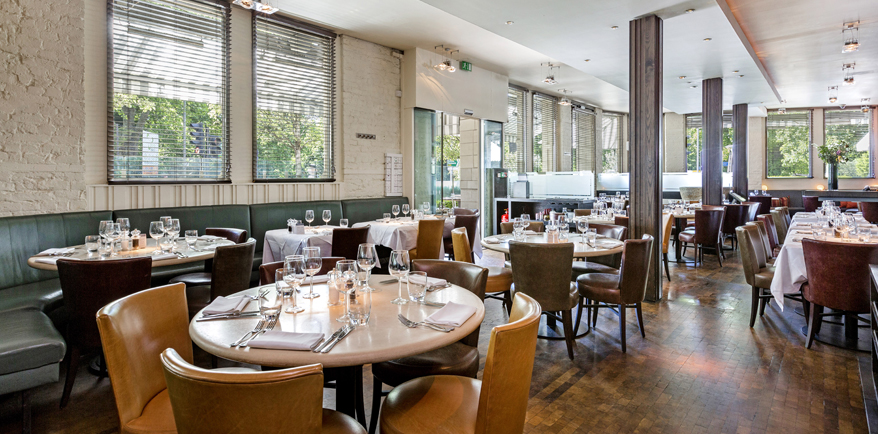
Wandsworth is a suburb of South London that is well served with places to eat. Bellevue Road in particular is an attractive road with the broad expanse of Wandsworth Common along one side, and an array of restaurants, pubs, artisan tea rooms and independent shops along the other. Brinkley’s Kitchen is near the top of this road, we chose it for a late lunch on a Sunday afternoon.
The restaurant is decorated in a smart contemporary manner. The photos on its website show it as very bright and airy, but the blinds were all drawn on the afternoon we were there. There was no tablecloth on our table for three, but it does have linen napkins, nice cutlery and glasses. The brunch menu has good choice, we opted for roast beef and a steak. The wines by the glass had a more limited selection, for example they only had one rose. When I asked the waiter what it was like – as I didn’t know it – he told me it was very good. I said I was hoping for a more descriptive reply, he just said “you will love it”. So, I asked to taste before I chose and it was fine, although I suspect the whole bottle cost a fraction of what they charged for the glass.
The food was good but unremarkable. The beef was overcooked for my taste but the gravy was nice. When I pay top end prices for a Sunday roast, I would expect the Yorkshire pudding to be freshly prepared. These had clearly been made earlier and reheated. The ribeye was okay and the chips were hot and fresh. When my friend asked for tomato sauce for her chips, they brought a bottle of ketchup to the table, at least it was Heinz. It came without the lid, so much hitting the bottom of the bottle was required to get any out.
The service was entertaining, every different waiter who came to the table enquired “How is your day going?” which became a little Stepford Wives creepy after the sixth time of asking, especially after the busboy asked it twice in five minutes without waiting for a reply. I didn’t like the fact that they brought us the bill without us asking for it, I felt they were rushing us to finish our drinks.
Overall, Brinkley’s Kitchen served us reasonable quality pub food, but charged high end restaurant prices. In an area, indeed even a street, where there are so many fine places to eat, it will not be difficult to find somewhere that gives far better value for money.
-
Kensington Palace, London W8. Part 2. Queen’s State Apartments and King’s State Apartments.

Kensington Palace has been a place of residence of the British Royal family since 1689. It was bought as a completed building by William and Mary when they ascended to the throne. Those parts not being lived in are open to the public. Currently they contain four exhibitions, one ticket allows entry to all four. Entrance to the Palace gardens, including the attractive sunken gardens is free and these are certainly worth the time it takes to walk round them on days when the weather is clement. The first two exhibitions are about Queen Victoria and Princess Diana’s dresses. They are both interesting in different ways, I have a blog post about them here: Kensington Palace, London W8. Part 1. Victoria Revealed & Diana, her fashion story.

The next two exhibitions are The Queens’ State Apartments, which has the rooms decorated as they were in the 1690s, during the reign of William and Mary, and The King’s State Apartments, which has the rooms restored in the way they were in the early 1700s, during the reign of Georges I and II.
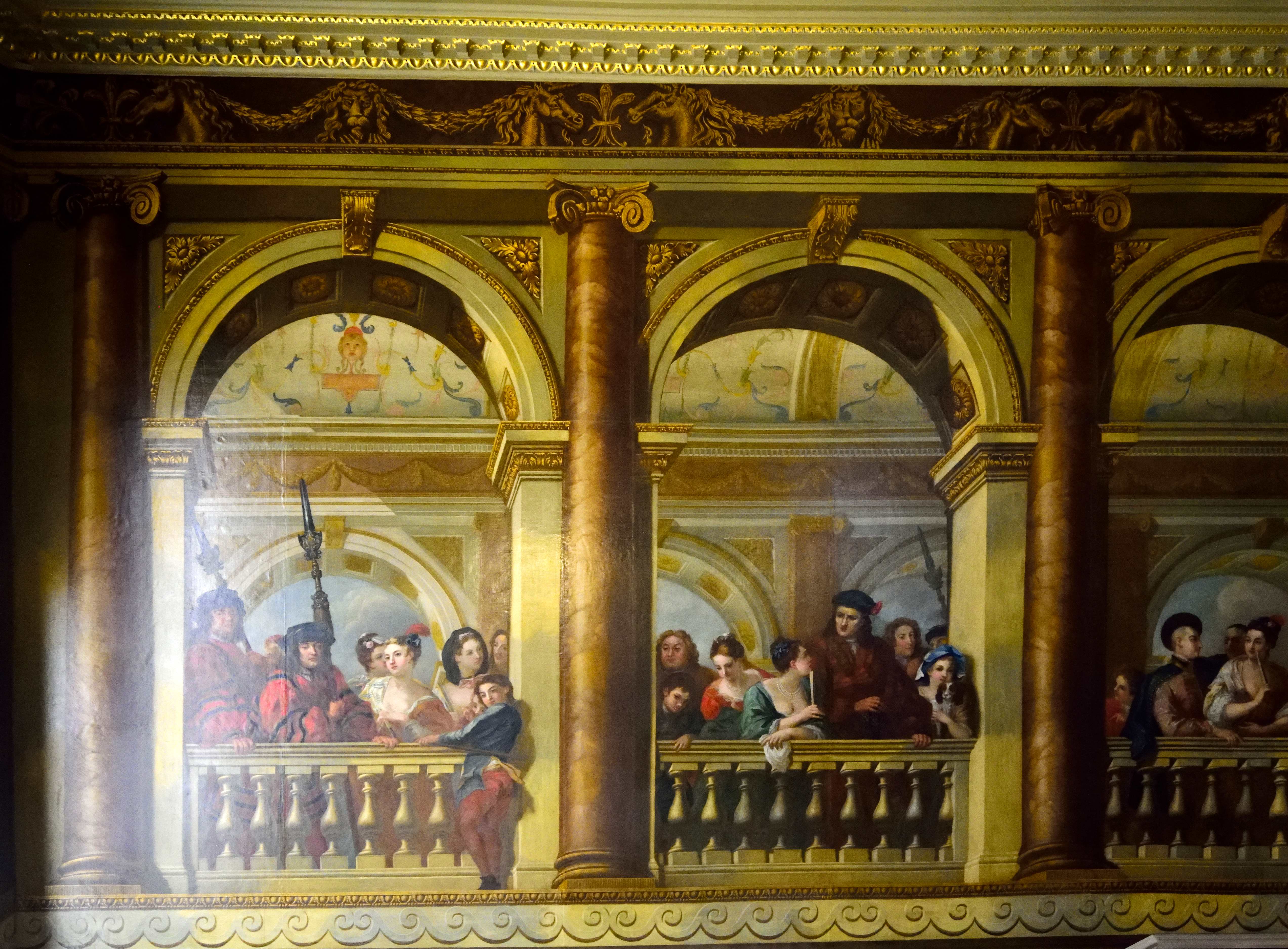
These are arranged in reverse chronological order, entry is through the sumptuous King’s Grand Staircase. Decorated in the time of George II, this is broad and spacious, we are overlooked by painted figures as we ascend. The staircase is certainly grand, immediately we can tell that we are in an era when conspicuous wealth was expected of the monarchy. The mural was painted by William Kent in 1724 and contains depictions of many actual members of the royal court at the time. Kent even included himself in the painting, he is the man wearing a brown turban and holding an artist’s palette, and the lady looking over his shoulder was reportedly his mistress.

The rooms in the King’s State Apartments have many wonderful Georgian features. The fireplaces and ceilings are spectacular. One ceiling is decorated with shields representing the members of the Order of the Garter, with its insignia making the centrepiece. The King’s Gallery has a mantelpiece with a map of the British Isles and Western Europe. This is linked to a weather vane on the roof, so that King George could see how the wind was affecting his fleet. It is still working today. The drawing room has some interesting examples of gaming tables from the era and the best perspective of the gardens, down to the lake.

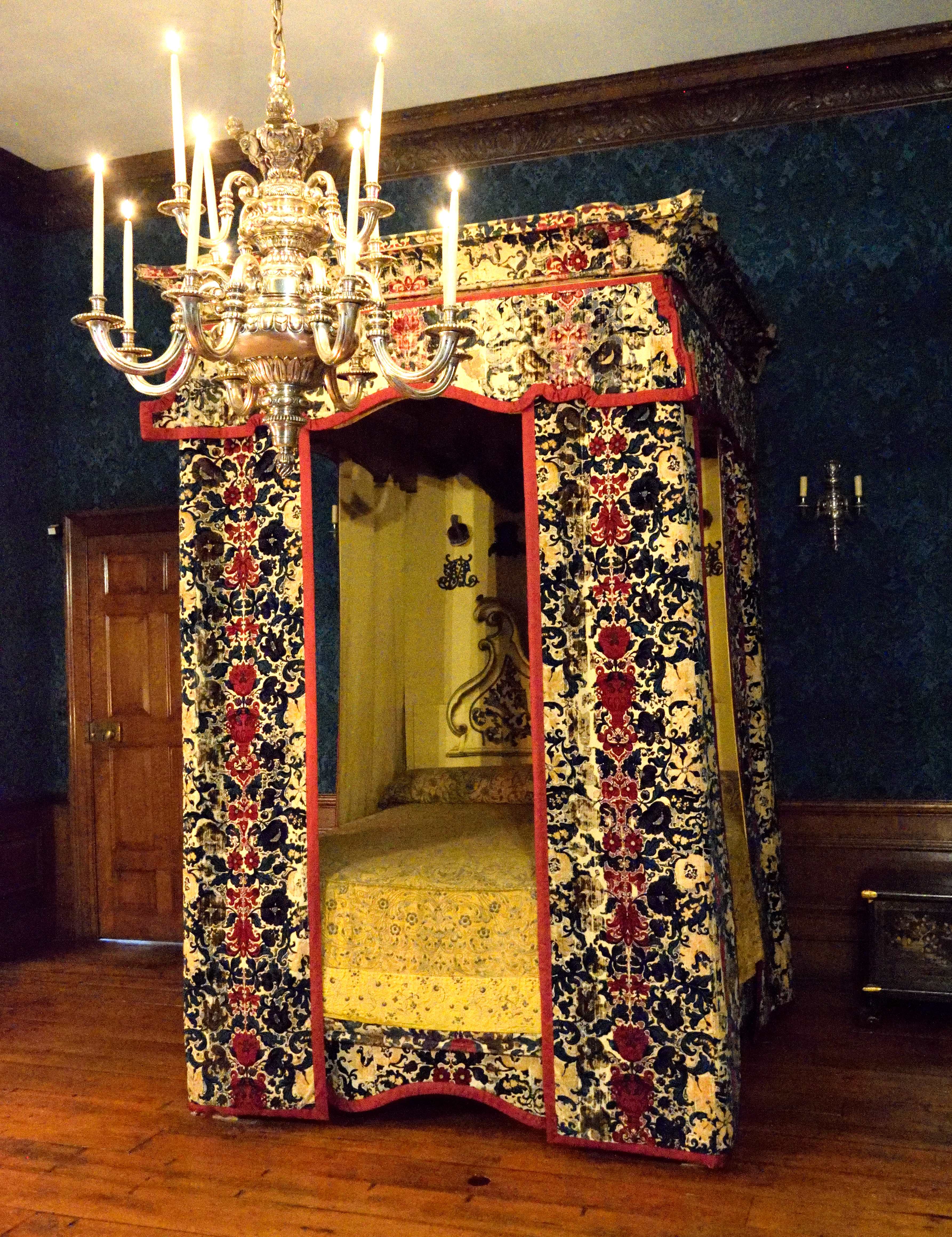
The Queen’s State Apartments are 17th Century and this exhibition is more intimate, showing their bedrooms, their dining room and gives a little more of an insight into how they went about their, still opulent, daily lives. The furniture and delft is remarkable and the tapestries and bed coverings are extravagant. It is interesting to see the shortness of the four poster bed, it was thought at that time to be beneficial to health to sleep in a sitting position.
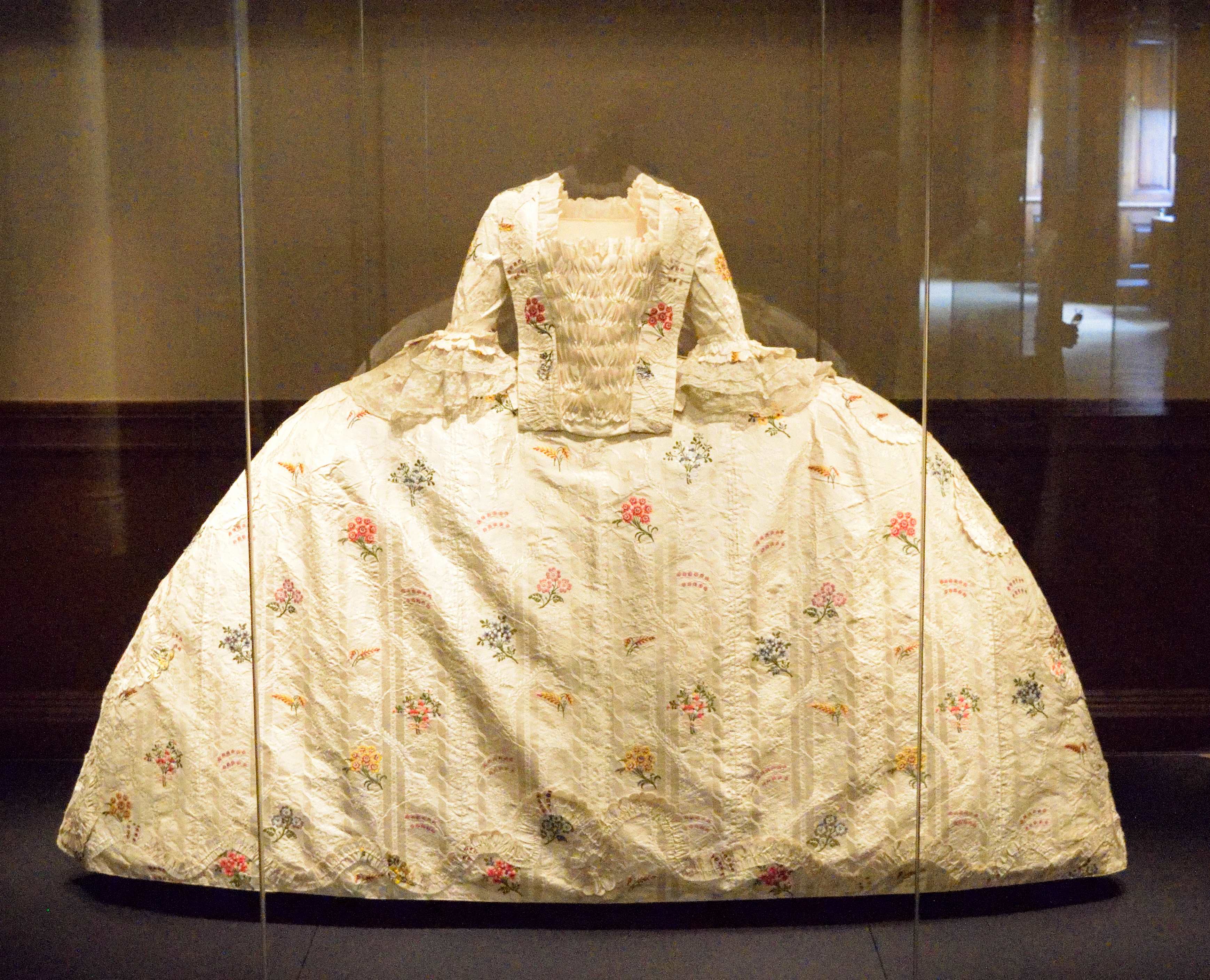
The exhibitions also contain lovely examples of the fashions at the time, there are some wonderful farthingale supported embroidered skirts, which look spectacular but must have been completely impractical to wear.
Between all four of the shows here, it would be difficult to do it justice in less than a couple of hours, there is almost too much to see in one visit. Perhaps it would be worth viewing the Palace on one day and the Gardens, Park and Orangery, which are free to enter, on another. This way you could spread the visit over a couple of days and only have to pay the, not inconsiderable, entry fee once. Kensington Palace and Gardens is one of the most historic visitor attractions in London, the exhibitions are well stocked and informative, although it is not cheap to visit, it should be among the sights that you consider when in London. It is free to enter with an Art Pass, if you have one of these you should not miss it, Kensington Palace is a highlight of their offer.
1600s, 1700s, architecture, art, attraction, Britain, British, British Royal Family, building, Central London, culture, garden, Georgian, historical, history, Kensington, London, monarchy, museum, Palace, Royal Family, show, Stuart, TOTastemaker, tourism, tourist attractions, Tourist London, travel, West London -
Colette (dir. Wash Westmoreland) 2019

Biographical historical costume drama is a relatively specific genre of movie, but one that is in vogue at the start of 2019, with “The Favourite” and “Stan and Ollie” also getting UK release in January this year. Colette captures the zeitgeist in other ways too, it is about female empowerment, we watch Colette slowly grow in confidence and competence after entering Paris as a young ingenue, the wife of a powerful and authoritarian man about town. The storyline about gender fluidity and sexual freedom is timely too, as her relationship with Missy is treated in an honest and positive manner.The film is set in Paris and Burgundy at the end of the 19th and start of the 20th Centuries. It concentrates on the early life of Colette, the time of her first marriage, which was to Henry Gauthier-Villars a renowned Parisian socialite. It ends with the publication of the first Colette novel, although she was successful and notorious throughout the rest of her life, she was even nominated for the Nobel Prize for literature in 1948.
The film is lovingly made and the dialogue is beautifully written, Wash Westmoreland obviously cares about Colette and admires her writing, the film is directed in a manner that reflects her style, unhurried and descriptive, although aside from a few double entendre witticisms the film is less racy than her books. Giles Nuttgens is the cinematographer – the rooms, houses and gardens all look lush and inviting. The acting throughout is wonderful. Keira Knightley gives us a great performance in the title role, we watch her grow in courage and independence as the film goes on. Timothy West is brilliant as Willy, her despotic yet hugely charismatic husband. A lovely combination of good writing and good acting makes you understand how this dictatorial man held sway over Colette’s strong personality for so long.
The cast is of the highest quality throughout. Denise Gough is wonderful as the convention defying Marquise de Belbeuf, Missy. She plays the part sympathetically and with gusto. She is shown as a major influence on Colette’s courage and bravura. Jake Graf has a nice cameo as Gaston de Caillavet and Fiona Shaw is lovely as Sido, Colette’s mother.
Colette is a beautifully made and beautifully written biopic about a strong revolutionary woman. It focuses on a specific period of her life and we get the story very definitely from her point of view, however as she herself says in the film “The hand that holds the pen writes history”. The film is uplifting, inspiring and enjoyable.
-
Subscribe
Subscribed
Have a WordPress.com account? Log in now.

